In this series: Rhode Island 2025-26 Enrollment.
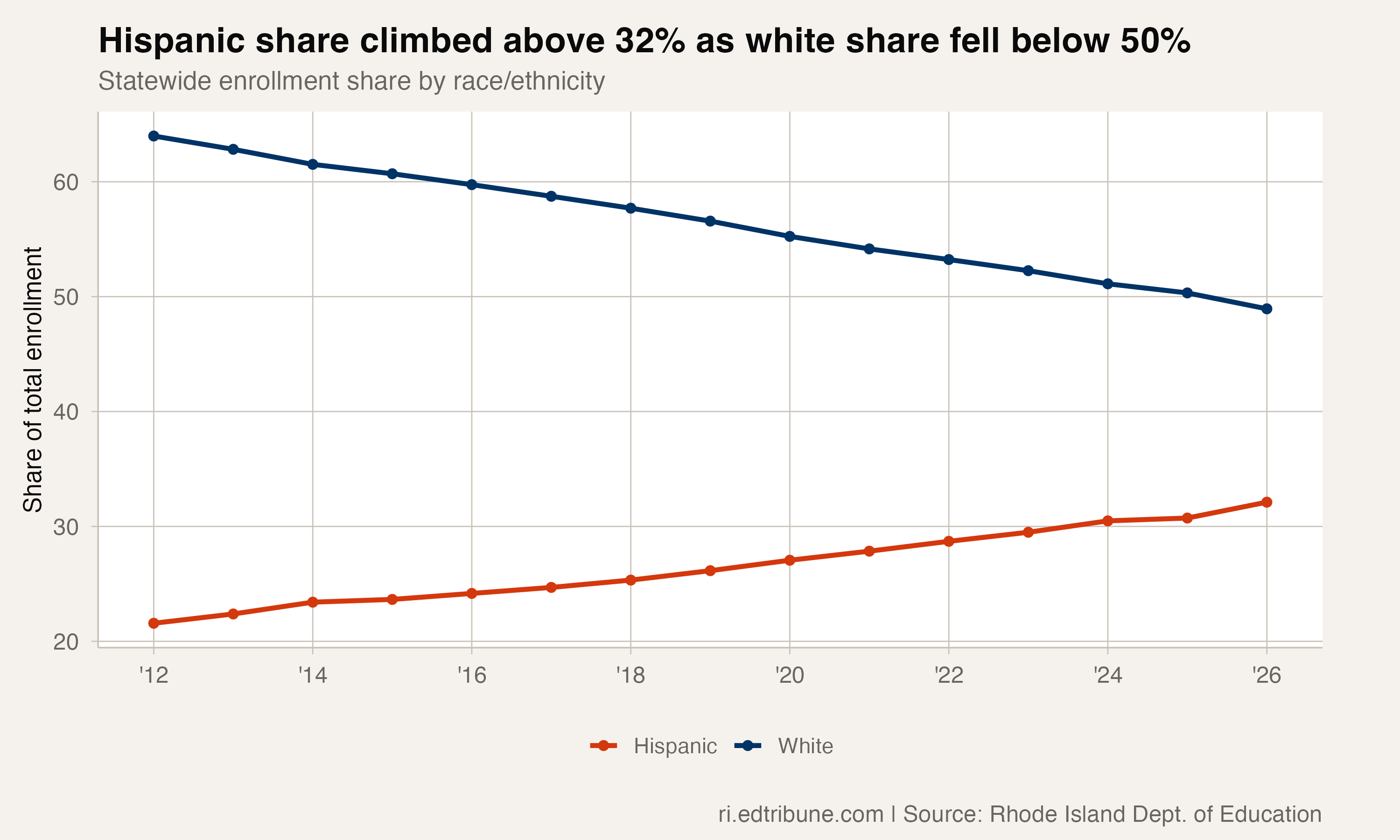
When white students fell below 50% of Rhode Island's public-school enrollment for the first time in 2025-26, the other side of that demographic crossing got less attention: Hispanic students are now closing in on one-third. At 42,974 students in 2025-26, Hispanic enrollment has reached 32.1% of the statewide total — up from 30,816 and 21.6% in 2011-12. That is a gain of 12,158 students and a 10.5 percentage-point shift in share over 14 years.
The growth did not happen in a burst. It happened year after year, through recessions and recoveries, through a pandemic that disrupted nearly every other enrollment trend in the state.
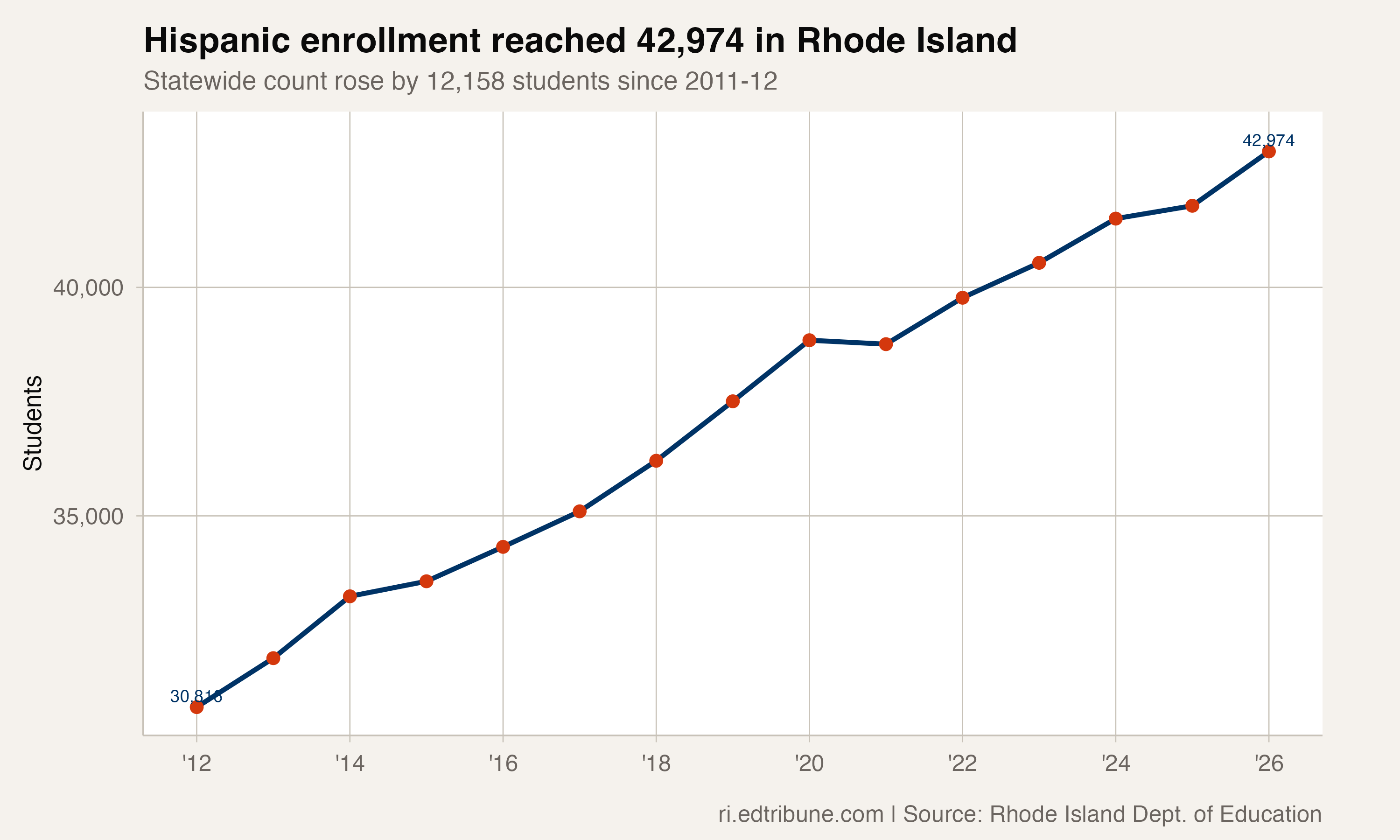
Fourteen years, one interruption
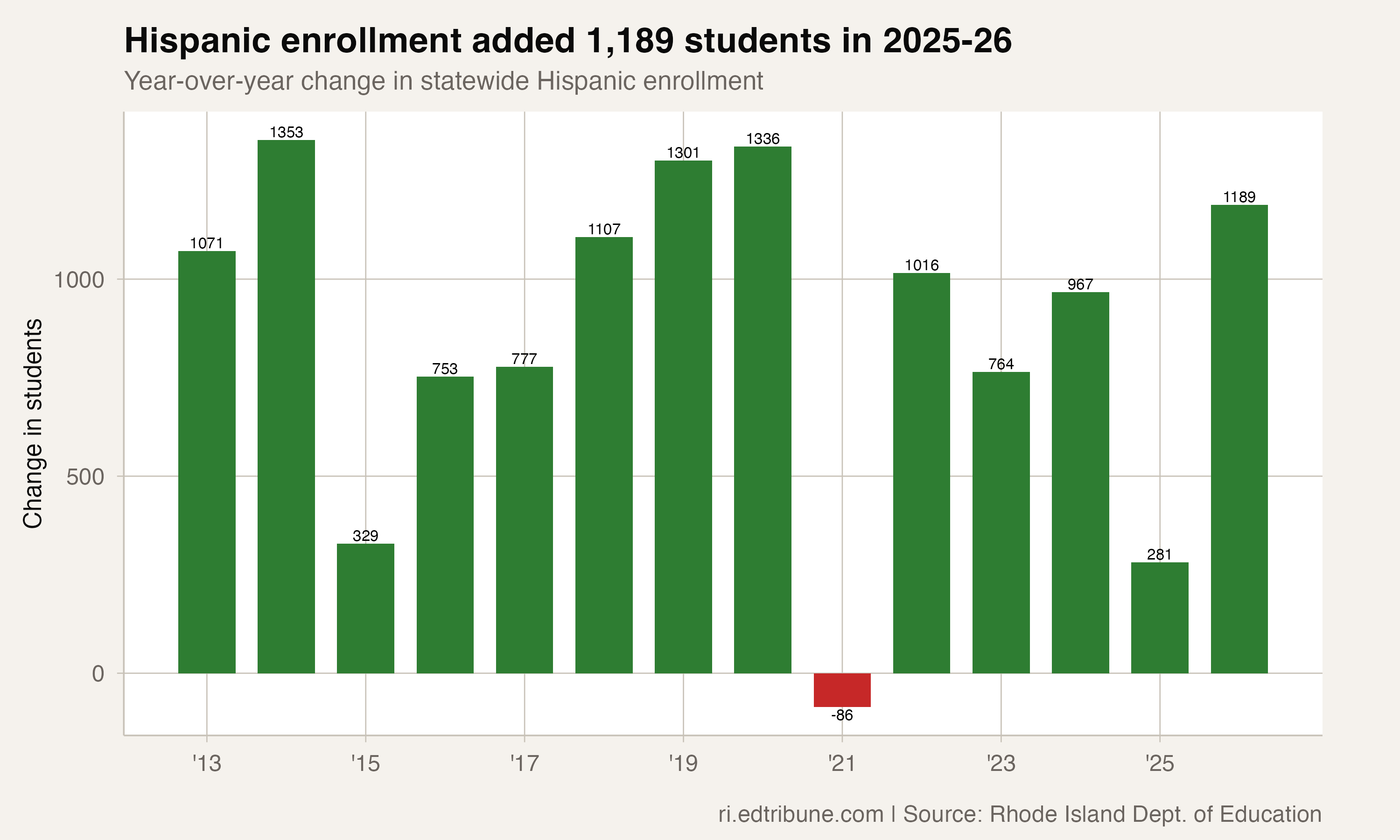
Hispanic enrollment grew in 13 of the past 14 years. The sole exception was 2020-21, when the count dipped by 86 students — a blip against the pandemic's 4,373-student statewide crater. Growth resumed immediately: 1,016 students in 2021-22, 764 in 2022-23, 967 in 2023-24, 281 in 2024-25, and 1,189 in 2025-26.
That persistence matters more than any single year's number. A trend that survives COVID-era disruption, fluctuating migration patterns, and shifting district boundaries is not a statistical wobble. It is a structural change in who Rhode Island's schools serve.
In 2011-12, roughly one in five Rhode Island students was Hispanic. By 2025-26, it was nearly one in three.
| Metric | Value |
|---|---|
| Hispanic enrollment, 2011-12 | 30,816 |
| Hispanic enrollment, 2025-26 | 42,974 |
| Net change | +12,158 |
| Hispanic share, 2011-12 | 21.6% |
| Hispanic share, 2025-26 | 32.1% |
| Share change | +10.5 percentage points |
| 2024-25 to 2025-26 change | +1,189 |
What the data can and cannot explain
The enrollment file confirms the trend but cannot explain it. There are no direct demographic-driver fields — no age-specific migration counts, no birth-cohort breakdowns by district. Four plausible factors are tangled together:
- In-state cohort growth — more Hispanic children reaching school age from families already in Rhode Island.
- Interstate or international migration — new arrivals enrolling for the first time.
- Shifts among school sectors — movement between traditional districts, charters, and private schools.
- Classification effects — changes in how families report or how districts record race and ethnicity.
The long-run persistence of growth in both count and share points toward something durable rather than a one-year fluctuation. But the enrollment file alone cannot apportion the change among those four factors. Additional mechanism claims require external demographic and migration datasets that Rhode Island does not publish alongside its enrollment data.
RELATED: White students are no longer the majority in Rhode Island schoolsET
A shift that has already reshaped the budget math
A one-third Hispanic enrollment share is not a future planning scenario. It is the current reality, and it carries fiscal and operational weight. The overlap between Hispanic enrollment growth and the state's surging English learner populationET — which reached 20,359 students in 2025-26 — means that bilingual instruction, multilingual family engagement, and interpreter services are no longer niche line items. They are core operating costs.
Districts still building budgets and staffing models around the enrollment mix of a decade ago are building for a school system that no longer exists. Recruitment pipelines, professional development, and curriculum adoption all require alignment with who is actually sitting in the classroom.
What comes next
At the current trajectory, Hispanic students will surpass one-third of statewide enrollment within the next two years. Whether growth accelerates, holds steady, or finally plateaus depends on demographic forces the enrollment file cannot predict. The gateway cities already at historic enrollment lows — Providence, Pawtucket, Woonsocket, Central Falls — are also the districts where Hispanic enrollment is most concentrated. How those cities manage simultaneous overall decline and demographic composition shifts will test whether Rhode Island's funding formula and district infrastructure can adapt to a student body that has already changed.
Detailed code that reproduces the analysis and figures in this article is available exclusively to EdTribune subscribers.
Discussion
Sign in to join the discussion.
Loading comments...