In this series: Rhode Island 2025-26 Enrollment.
Rhode Island lost 9,728 students over the past six years. One school gained 327.
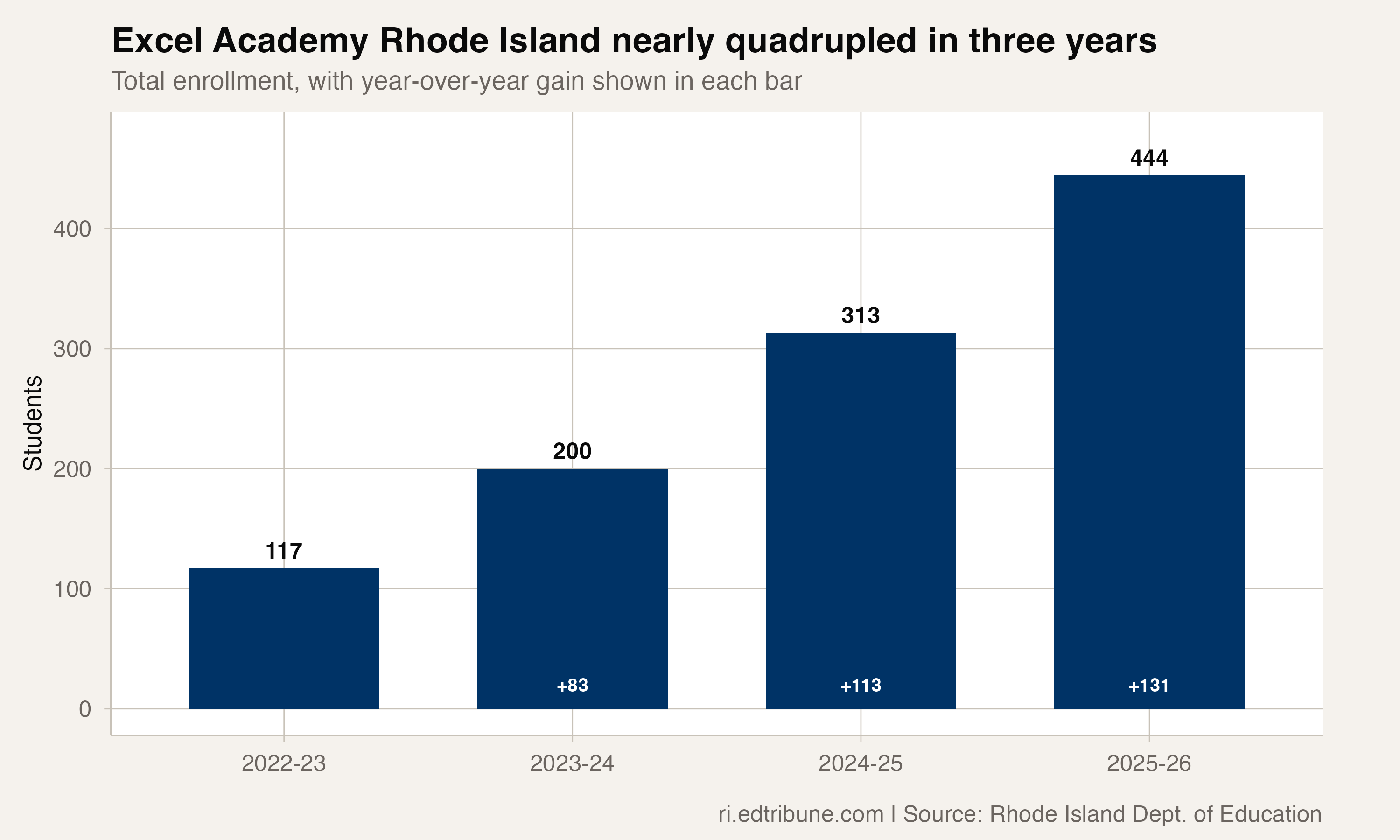
Excel Academy Rhode Island enrolled 444 students in 2025-26, up from just 117 in 2022-23 — nearly quadrupling in three years. That 131-student gain in 2025-26 alone was the largest of any school in the state, traditional or charter. The growth rate, 41.9%, was also the highest statewide.
It is a striking trajectory for a school that ranks 43rd out of 64 districts by total size. Providence, the largest district at 19,824 students, enrolls roughly 45 times as many.
Each year bigger than the last
Excel Academy has posted three consecutive years of enrollment growth, with each year adding more students in absolute terms than the one before — even as the percentage growth rate has naturally moderated.
| Year | Enrollment | Change | Pct Change |
|---|---|---|---|
| 2022-23 | 117 | — | — |
| 2023-24 | 200 | +83 | +70.9% |
| 2024-25 | 313 | +113 | +56.5% |
| 2025-26 | 444 | +131 | +41.9% |
The pattern is unusual. Most new schools see their growth rates and raw gains taper off together. Excel Academy's raw gains have accelerated — 83, then 113, then 131 — suggesting demand has not yet caught up with capacity.
A state losing ground
Excel Academy's growth stands out even more against the statewide backdrop. Rhode Island enrolled 133,829 students in 2025-26, down 2,149 from the prior year — the largest single-year drop since the pandemic year of 2020-21.
| Year | RI Total | Change |
|---|---|---|
| 2019-20 | 143,557 | — |
| 2020-21 | 139,184 | -4,373 |
| 2021-22 | 138,566 | -618 |
| 2022-23 | 137,449 | -1,117 |
| 2023-24 | 136,154 | -1,295 |
| 2024-25 | 135,978 | -176 |
| 2025-26 | 133,829 | -2,149 |
The state has lost students every year since 2019-20, dropping from 143,557 to 133,829 — a decline of 6.8% over six years.
RELATED: Charter enrollment crosses ten percent of Rhode Island's student populationET
The few that grew
The largest enrollment declines in 2025-26 were concentrated in urban districts. Providence lost 426 students, followed by Pawtucket (-282), Woonsocket (-261), Warwick (-149), and Westerly (-134). Cranston, the state's second-largest district, lost 131 students — exactly the number Excel Academy gained.
Of Rhode Island's 64 districts, only a small number posted gains — and the top growers were predominantly charter and specialty schools.
| District | Change | Enrollment |
|---|---|---|
| Excel Academy Rhode Island | +131 | 444 |
| MET Career and Tech | +77 | 894 |
| Segue Institute for Learning | +75 | 489 |
| Trinity Academy for the Performing Arts | +71 | 305 |
| RISE Prep Academies | +66 | 701 |
| Nuestro Mundo Public Charter | +43 | 335 |
| Cumberland | +38 | 4,919 |
Cumberland, at 4,919 students, was the only large traditional district among the top gainers.
What to watch next
Sustained growth at this pace raises practical questions. A school that has nearly quadrupled in three years must hire teachers, add classroom space, and scale operations to match. Whether Excel Academy can maintain program quality while continuing to expand is something the 2026-27 enrollment data will begin to answer — particularly if the school approaches the 500-student mark.
At the state level, the shift of students from traditional urban districts to smaller charter and specialty schools adds pressure to already-strained budgets in Providence, Pawtucket, and Woonsocket, where per-pupil funding follows departing students. If the 2025-26 pattern holds, the fiscal squeeze on those districts will deepen before it eases.
# Current and prior year
enr_2026 <- fetch_enr(2026, tidy = TRUE)
enr_2025 <- fetch_enr(2025, tidy = TRUE)
# Historical
enr_hist <- fetch_enr_multi(2020:2026, tidy = TRUE)

# Excel Academy enrollment
enr_hist |>
  dplyr::filter(is_district, subgroup == "total_enrollment",
                district_name == "Excel Academy Rhode Island") |>
  dplyr::select(end_year, n_students)

# Statewide totals
enr_hist |>
  dplyr::filter(is_state, subgroup == "total_enrollment") |>
  dplyr::group_by(end_year) |>
  dplyr::summarize(total = max(n_students))

# Top growing districts
library(dplyr)
curr <- enr_2026 |> filter(is_district, subgroup == "total_enrollment")
prev <- enr_2025 |> filter(is_district, subgroup == "total_enrollment")
inner_join(curr, prev, by = "district_name", suffix = c("_2026", "_2025")) |>
  mutate(change = n_students_2026 - n_students_2025) |>
  arrange(desc(change)) |>
  select(district_name, change, n_students_2026) |>
  head(10)
Detailed code that reproduces the analysis and figures in this article is available exclusively to EdTribune subscribers.
Discussion
Sign in to join the discussion.
Loading comments...