In this series: Rhode Island 2025-26 Enrollment.
When COVID-19 hit Rhode Island's schools, enrollment dropped by 4,373 students in a single year. But the losses did not land where you might expect.
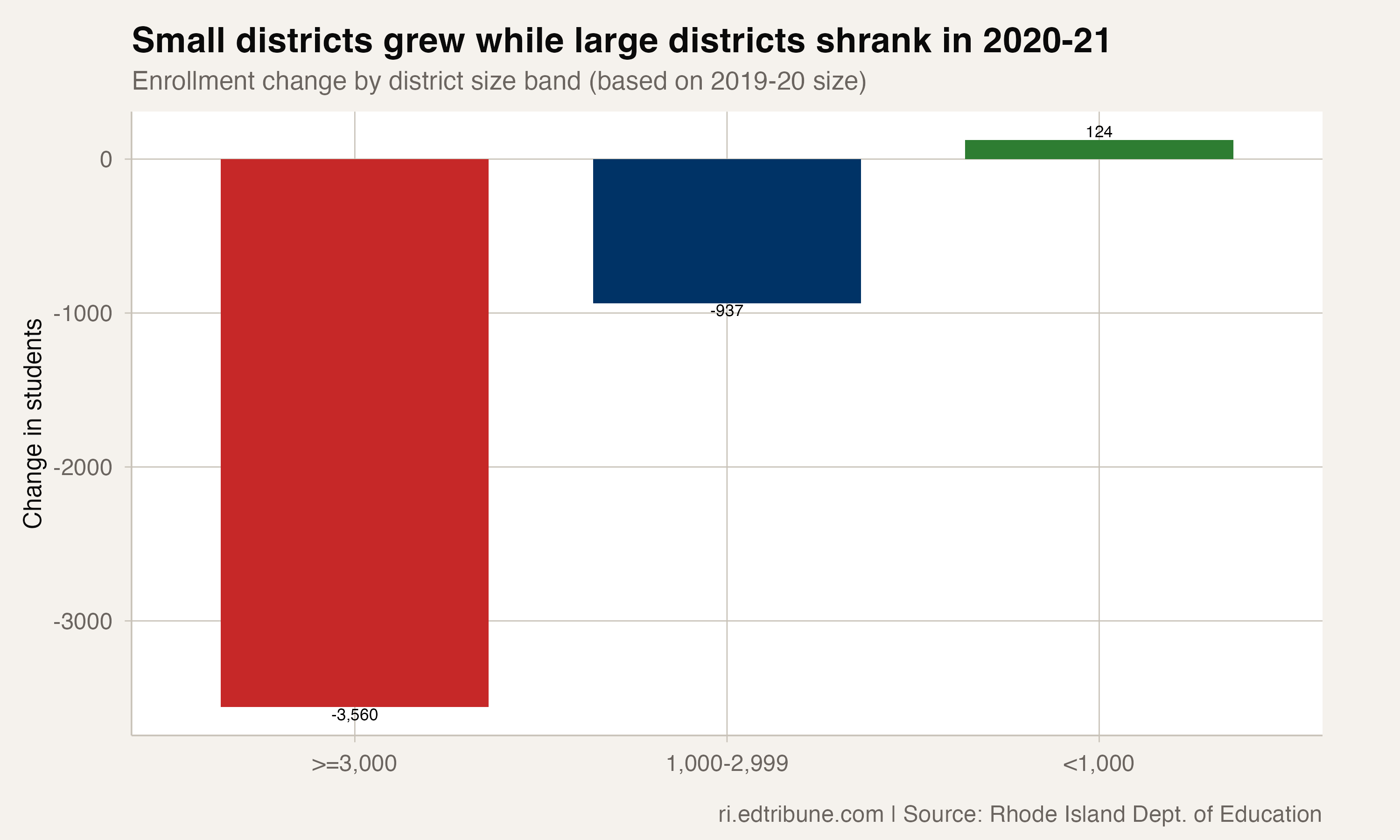
Districts with fewer than 1,000 students in 2019-20 actually grew, posting a combined gain of 124 students (+1.35%) in 2020-21. Meanwhile, districts with 3,000 or more students shed 3,560 students (-3.57%), absorbing nearly all of the statewide decline and then some.
The pandemic did not shrink Rhode Island's schools uniformly. It split them by size.
A statewide number that masks two different stories
Rhode Island's six consecutive years of enrollment decline make the state look like it is on a single downward trajectory. The 2020-21 shock year accelerated that impression. But aggregate figures obscured a structural divergence playing out at the district level.
| District size band (2019-20 baseline) | 2020-21 change | Percent change |
|---|---|---|
| <1,000 students | +124 | +1.35% |
| 1,000-2,999 students | -937 | -2.70% |
| >=3,000 students | -3,560 | -3.57% |
| Statewide | -4,373 | -3.05% |
The gradient is stark. Every step up in district size corresponds to a steeper loss. That is not what a random shock would produce. It suggests something systematic about how families in larger systems responded differently than families in smaller ones.
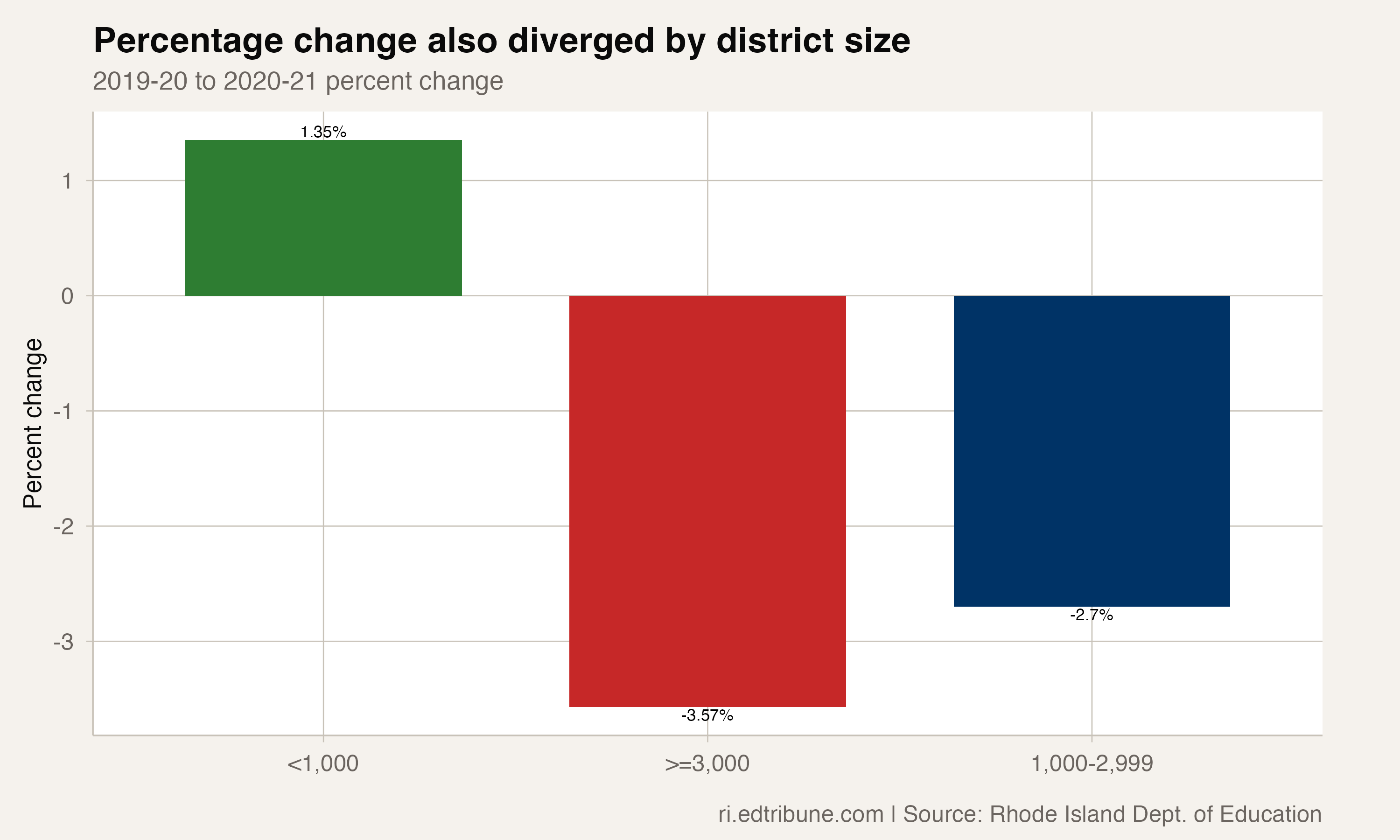
Districts with fewer than 1,000 students gained 124 students (+1.35%) during the same year that districts with 3,000 or more lost 3,560 (-3.57%).
Possible explanations, no definitive answers
Several forces could explain why larger districts bore the brunt of pandemic-year losses while smaller ones held steady or grew.
Families in larger urban and suburban systems may have had more alternatives available (private schools, pods, homeschooling cooperatives) and more reason to seek them out if their district's remote-learning experience fell short. Smaller districts, often in tighter-knit communities, may have retained families through closer relationships or fewer exit options.
But the enrollment data alone cannot separate these threads. The current figures do not include causal fields on exits, returns, household mobility, or instructional mode choices. External evidence would be needed to determine whether the pattern was driven more by temporary withdrawal, relocation, sector switching, or local policy differences.
What the data can confirm is that the size divergence is real and directly observable in district enrollment counts, not a statistical artifact.
Where the biggest swings landed
The extremes tell their own story. Some of Rhode Island's largest districts posted the sharpest absolute losses, while certain small districts saw gains that, proportionally, mattered for their communities.
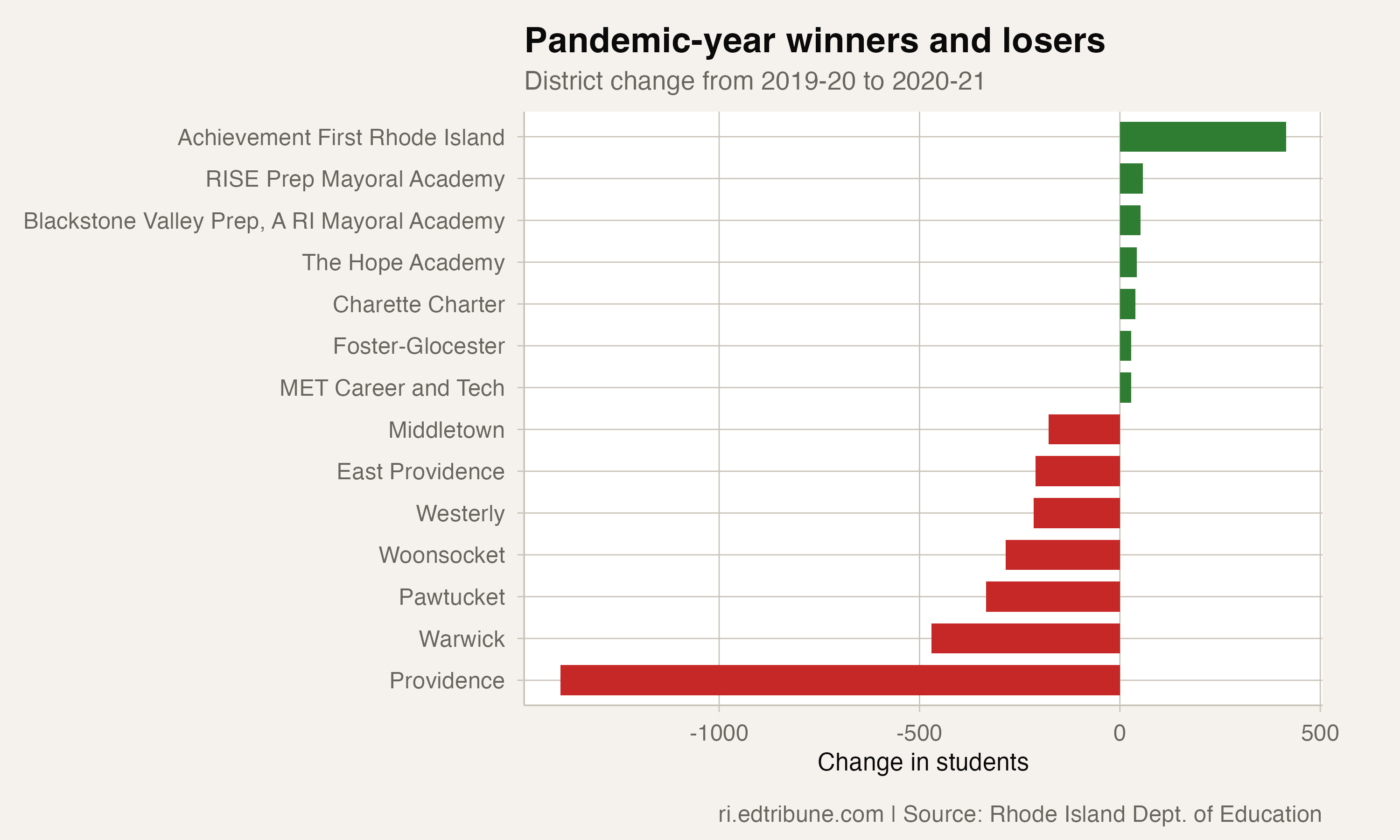
This pattern connects to a broader reality: half of Rhode Island's districts now enroll fewer than 1,000 students, and none of the six largest districts have recovered to pre-pandemic levels. The size paradox from 2020-21 was not a one-year anomaly. It marked an inflection point whose consequences are still playing out.
What this means for planning
For state officials and district leaders making budget and staffing decisions, the size paradox carries a practical warning: statewide decline is not uniform decline.
Fiscal and operational pressures can concentrate in large districts even when smaller districts remain stable or grow. A funding formula calibrated to statewide averages would miss this divergence entirely. And without student-level data that separates district-size effects from demographic composition, urban/rural geography, school-mode policy timing, and student mobility, the state is planning around a pattern it cannot fully explain.
Whether the size split was a temporary pandemic artifact or the acceleration of a longer-running structural shift: that is the question Rhode Island's enrollment data has not yet answered.
Detailed code that reproduces the analysis and figures in this article is available exclusively to EdTribune subscribers.
Discussion
Sign in to join the discussion.
Loading comments...