Five years after the state of Rhode Island took control of Providence↗ET Public Schools, the district is posting its best graduation numbers on record.
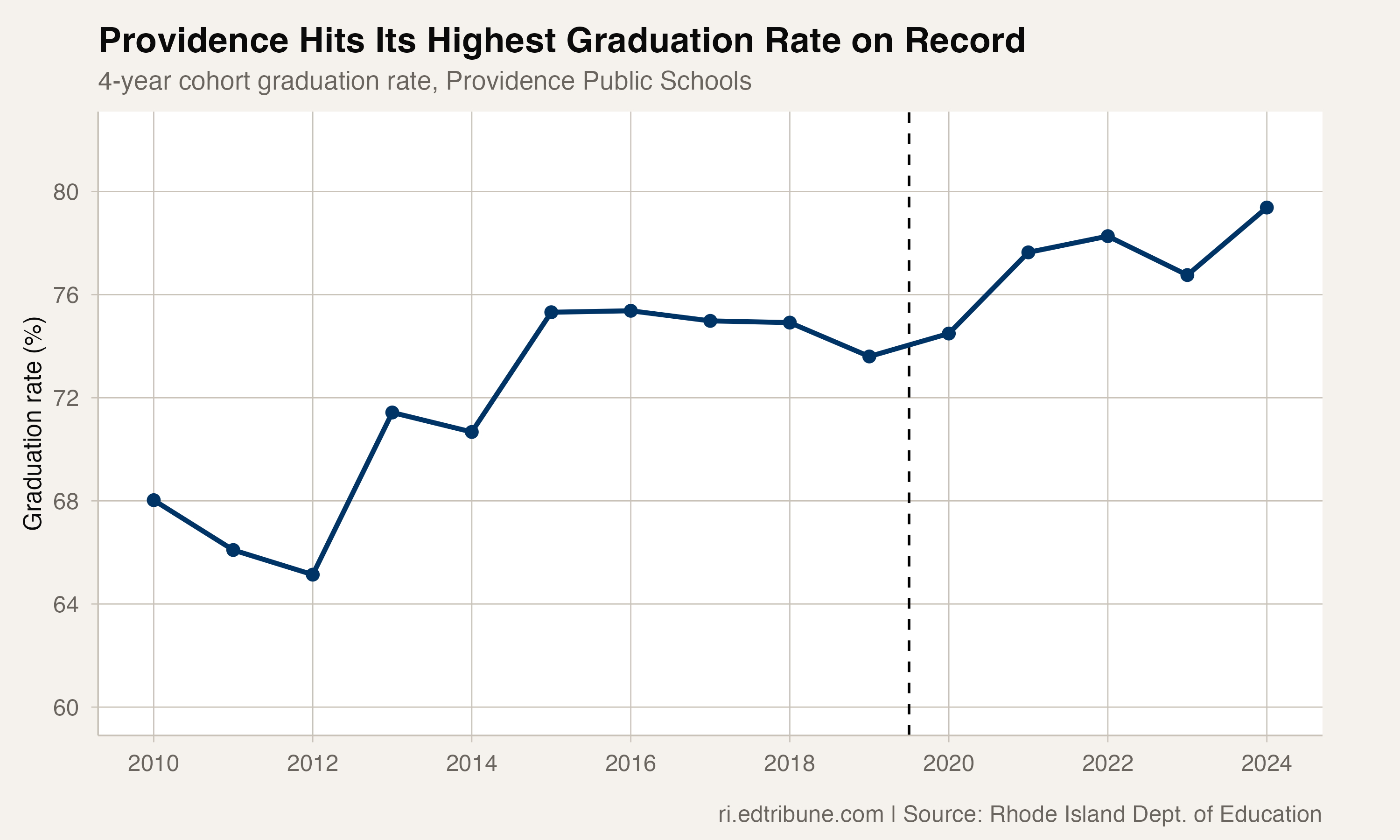
The four-year graduation rate reached 79.4 percent in 2024 — the highest in at least fifteen years of available data and a 5.8 percentage point improvement from the 73.6 percent rate in 2019, the last year before the state intervention began. The dropout rate fell from 15.8 percent to 11.2 percent over the same period.
A decade of stagnation, then movement
Providence's graduation story before the intervention was one of frustration. After climbing from 65.1 percent in 2012 to 75.4 percent in 2016, the rate stalled. It hovered between 73.6 and 75.4 percent for four years, seemingly locked in place while suburban districts continued to improve.
The state takeover in November 2019, prompted by a Johns Hopkins study documenting pervasive dysfunction — from building conditions to curriculum to school culture — was divisive. Critics called it an overreach. Supporters argued that incrementalism had failed.
The data since the intervention tells a cautiously positive story. The graduation rate has increased in four of the five post-intervention years. The 2024 rate of 79.4 percent crosses the threshold that separates a district in crisis from one making measurable progress.
Providence against its peers
The improvement is more striking when placed alongside Rhode Island's other urban districts. While Providence climbed 5.8 points since 2019, Woonsocket↗ET fell 12.4 points. Central Falls↗ET dropped 12.0 points. Pawtucket↗ET declined 6.1 points.
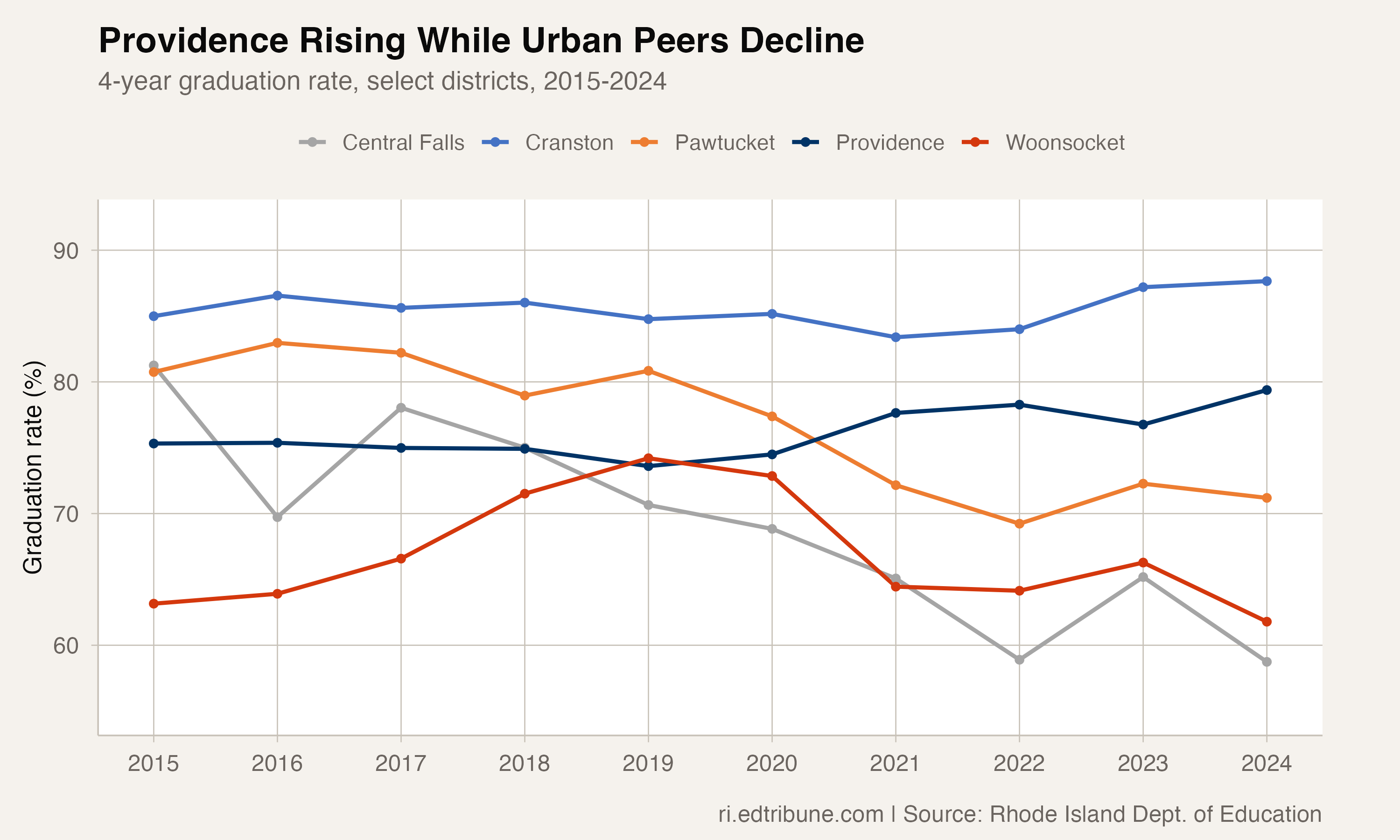
Providence is the only one of Rhode Island's four largest urban districts to improve its graduation rate since 2019. Cranston↗ET, which is more suburban than urban, also improved — reaching an all-time high of 87.6 percent. But among districts serving predominantly low-income, multilingual student populations, Providence stands alone in its upward trajectory.
The divergence raises a question: is Providence improving because of the state intervention, or despite it? Other urban districts faced similar pandemic-era challenges without state control, and their outcomes worsened. The most direct interpretation is that the intervention provided a floor of organizational competence — consistent leadership, curricular alignment, attendance tracking — that the district lacked before.
The dropout improvement
The dropout rate decline from 15.8 to 11.2 percent deserves its own attention. In 2019, nearly one in six Providence freshmen dropped out before graduation. By 2024, that figure was closer to one in nine.
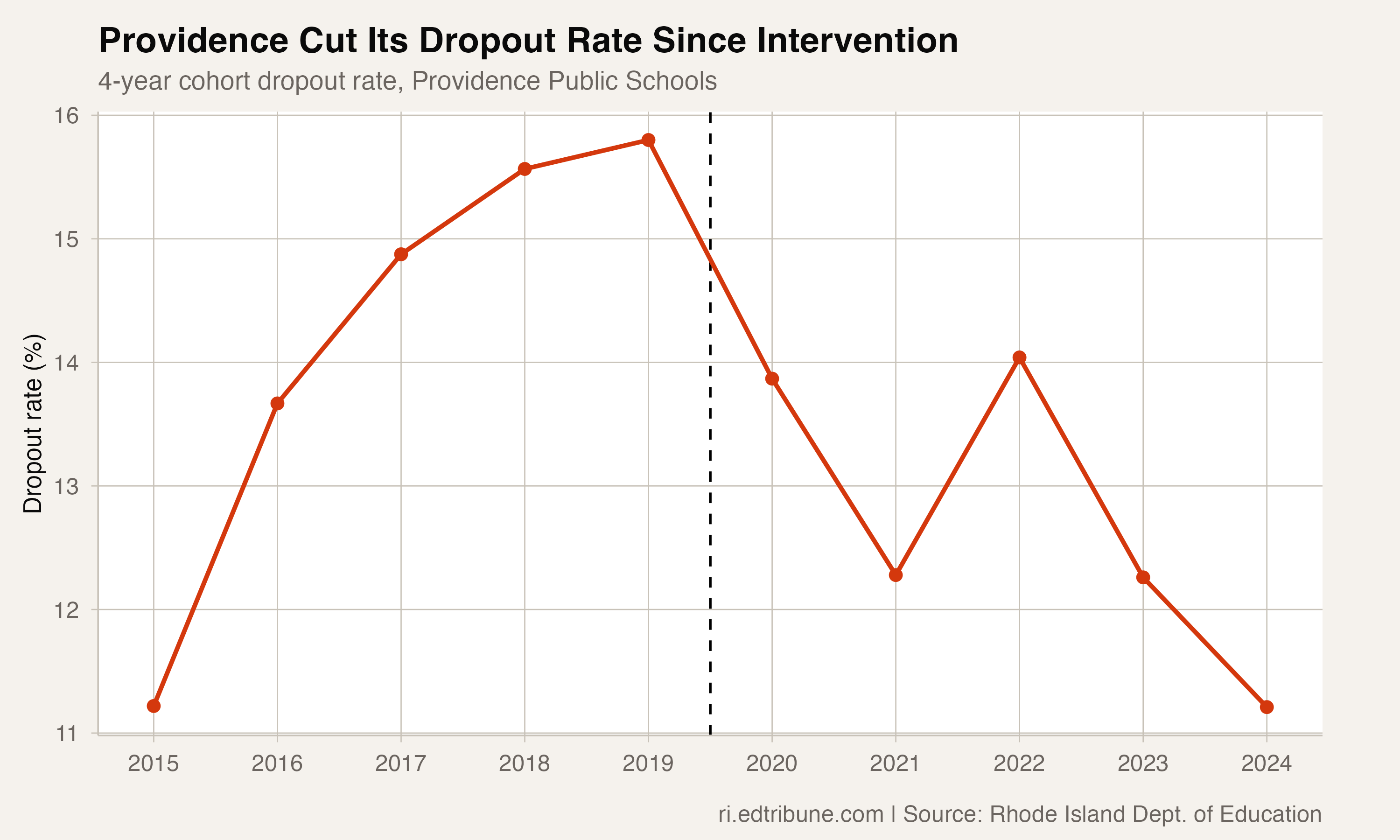
For a district with a 1,819-student cohort, the 4.6-point drop in dropout rate represents roughly 84 additional students per year who stayed in school. Some graduated. Others were retained or entered alternative programs. But they did not drop out, which means they remained in a system with a chance — however imperfect — of eventually earning a diploma.
What the intervention changed
The state-appointed superintendent brought a handful of concrete changes. Curricula were standardized across schools — previously, schools operated with wide autonomy, leading to inconsistent quality. Attendance monitoring was centralized, with real-time dashboards that flagged chronically absent students. Credit recovery pathways were expanded to give students who fell behind a structured way to catch up.
RIDE's 2024 accountability results showed that Providence decreased its schools designated for Comprehensive Support and Improvement from 11 to 9 — a metric that measures the lowest-performing schools based on graduation rate, chronic absenteeism, and academic proficiency.
None of these changes is revolutionary. They represent basic organizational competence applied consistently at scale. The fact that they produced measurable gains speaks to how far below baseline the district had fallen.
The remaining gap
Providence's 79.4 percent still trails the 84.1 percent state average by 4.7 points. The 11.2 percent dropout rate is still above the statewide 7.7 percent. The district is improving, but it is improving toward a statewide average that has itself been stuck for seven years.
The hardest work may lie ahead. Lifting the graduation rate from 74 to 79 percent required engaging the students closest to the finish line — those who needed targeted support to clear the last barriers. Lifting it from 79 to 85 percent will require reaching students whose challenges are more deeply rooted: those in foster care, experiencing homelessness, navigating the criminal justice system, or managing disabilities that the school system is not adequately serving.
The state intervention's charter runs through 2029. Whether Providence sustains its gains after returning to local control will be the ultimate measure of whether the turnaround was structural or temporary.
Detailed code that reproduces the analysis and figures in this article is available exclusively to EdTribune subscribers.
Discussion
Sign in to join the discussion.
Loading comments...