In this series: Rhode Island 2025-26 Enrollment.
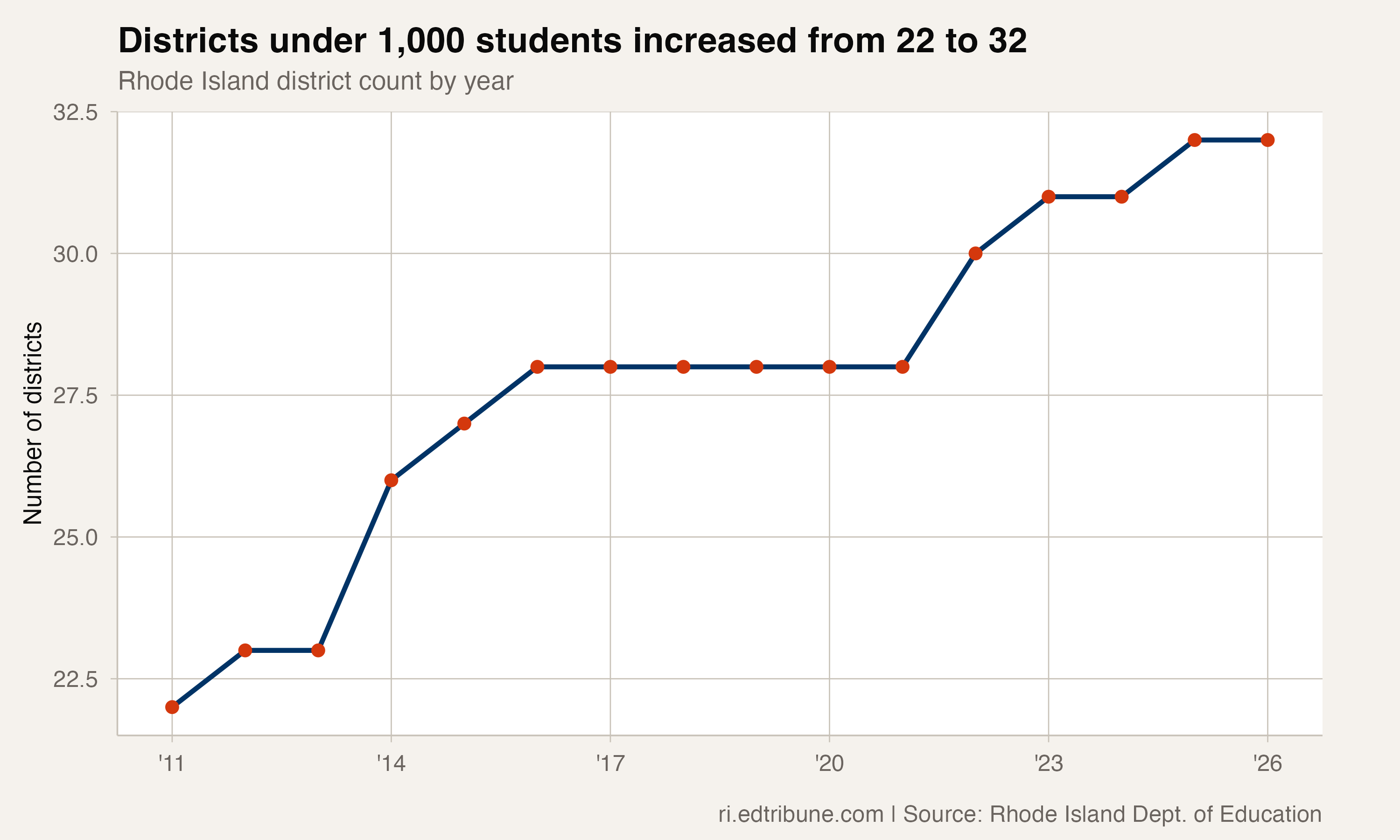
Somewhere around a thousand students, a school district starts running out of room to maneuver. There are not enough bodies to justify a second section of AP Chemistry, not enough tax base to absorb a boiler replacement without a budget fight. In 2025-26, exactly half of Rhode Island's districts are living in that territory: 32 of 64 enroll fewer than 1,000 students.
That number alone would be unremarkable if it had always been this way. It has not. In 2010-11, 22 districts fell below the 1,000-student line. Over the past 15 years, 10 more crossed it — not because Rhode Island created new districts, but because enrollment drained out of existing ones.
A threshold, not a cliff
The 1,000-student mark is not a regulatory boundary. No state funding formula kicks in at 999 or switches off at 1,001. But it functions as a practical dividing line. Districts above it can generally sustain a principal at every building, a handful of specialists, and enough schedule flexibility to offer electives. Districts below it face a version of the same math that keeps small rural hospitals closing: fixed costs that do not shrink with the population they serve.
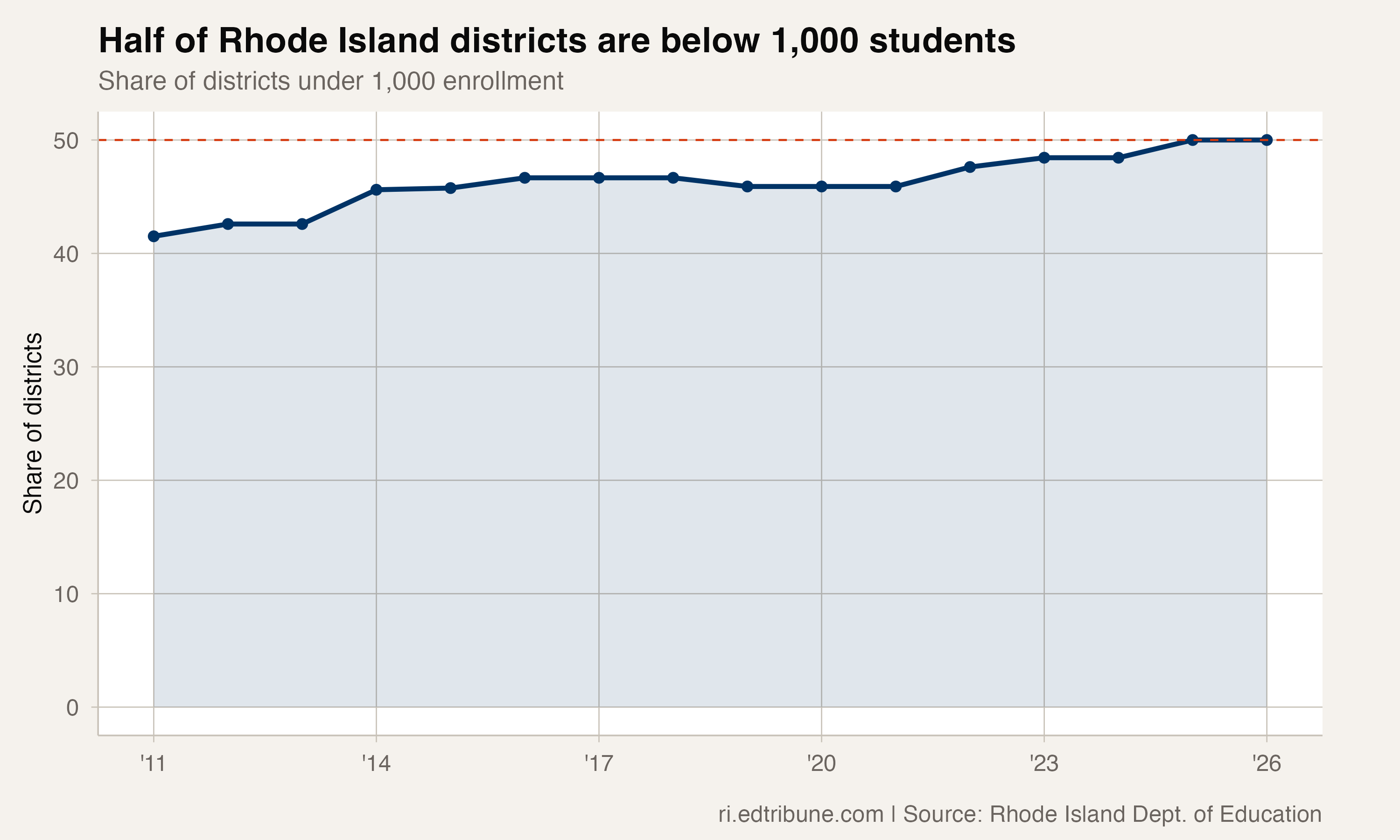
The share of sub-1,000 districts has climbed steadily and now sits at exactly 50.0%.
| Metric | Value |
|---|---|
| Districts in 2025-26 | 64 |
| Districts under 1,000 students (2025-26) | 32 |
| Share under 1,000 (2025-26) | 50.0% |
| Districts under 1,000 (2010-11) | 22 |
| Change since 2010-11 | +10 districts |
Slow leak, not sudden break
This is not a one-year anomaly. The count of sub-1,000 districts has moved upward over the full 15-year window, tracking alongside the state's broader enrollment decline. Rhode Island has lost nearly 10,000 students since its pre-pandemic peak, and as that loss distributes across dozens of small and mid-size systems, more of them slide beneath the threshold.
RELATED: Rhode Island enrollment drops below 135,000ET
Some of these 32 districts were always small — tiny charter networks, regional career-tech centers, island communities. Others were comfortably above 1,000 a decade ago and have since crossed the line. The enrollment data alone cannot separate districts that shrank into this category from those that were structurally small all along, but the net direction is clear: the club is growing.
What the data cannot explain
The enrollment file tells us how many students each district has. It does not say why. The plausible drivers — municipal demographic shifts, declining birth rates, families choosing charters or private schools, outmigration from smaller communities — all likely contribute, but the data does not apportion blame.
Thirty-two of 64: exactly half of Rhode Island's districts now operate below a scale that most education finance researchers consider minimally efficient.
What reporting has established is the fiscal pressure this creates. When Commissioner Infante-Green told state legislators that "it doesn't make sense sometimes to have two elementary schools and two districts side-by-side that are half empty," she was describing a state where the 1,000-student line is not an abstraction but a budget reality.
The smallest of the small
At the bottom of the distribution, the scale constraints are most acute. The smallest districts in the state enroll a few hundred students — a single school's worth, spread across grade levels that each may have only a handful of classrooms.
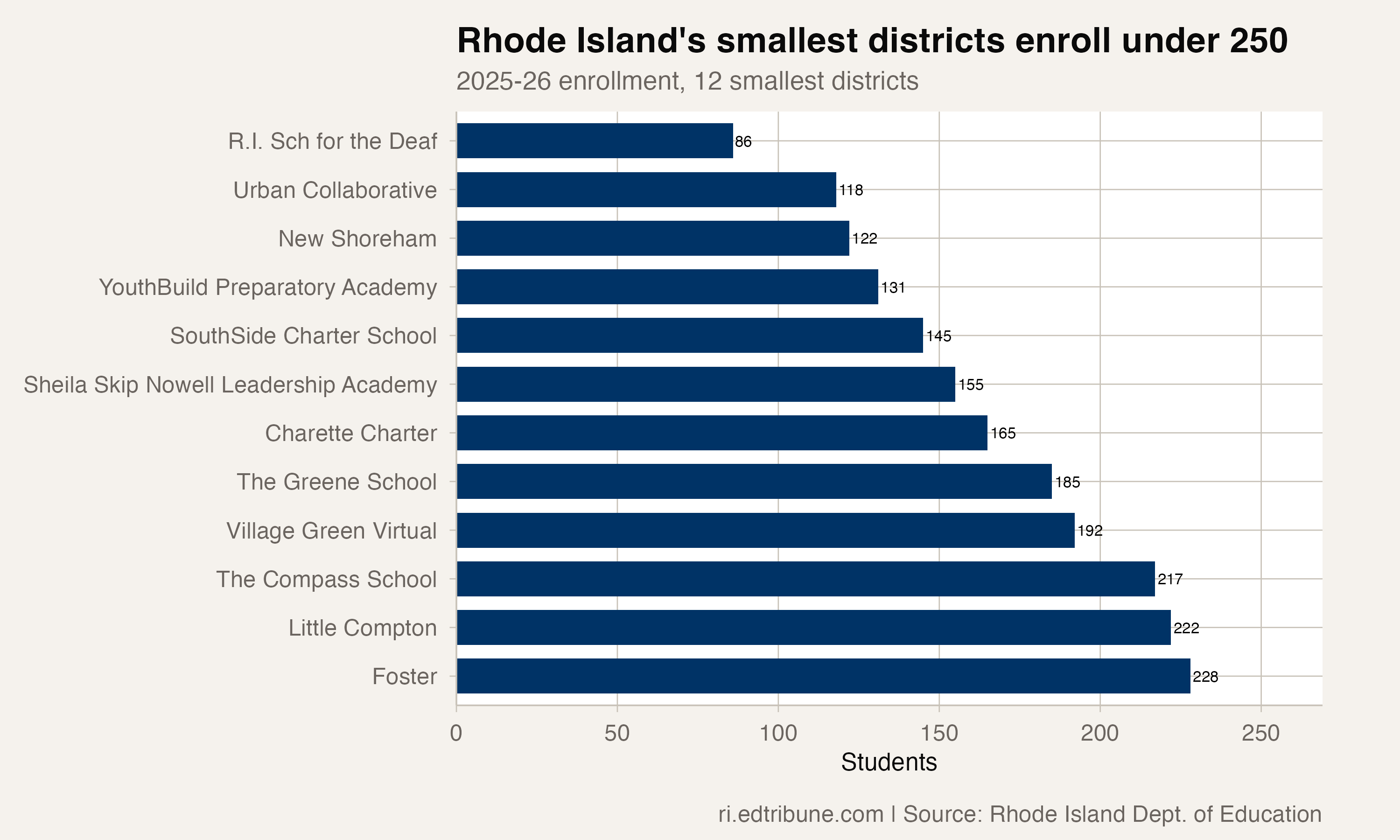
For these systems, every departure is felt individually. Losing 20 students is not a rounding error; it is a staff position. Statewide, the growing prevalence of districts this size means that Rhode Island's education system is increasingly a collection of very small operations, each absorbing the same regulatory and reporting requirements as systems five or ten times their size.
What happens next
The trajectory suggests more districts will cross below 1,000 in coming years. Rhode Island's birth rate continues to fall, and there is no demographic signal pointing toward a reversal. The state's ongoing funding formula review — and the regionalization legislation that has surfaced repeatedly in the General Assembly — will determine whether these small districts are asked to absorb rising per-pupil costs alone or whether the structure beneath them changes first. The 50% mark is not a crisis point. But it is a milestone that makes the structural question harder to defer.
Detailed code that reproduces the analysis and figures in this article is available exclusively to EdTribune subscribers.
Discussion
Sign in to join the discussion.
Loading comments...