In this series: Rhode Island 2025-26 Enrollment.
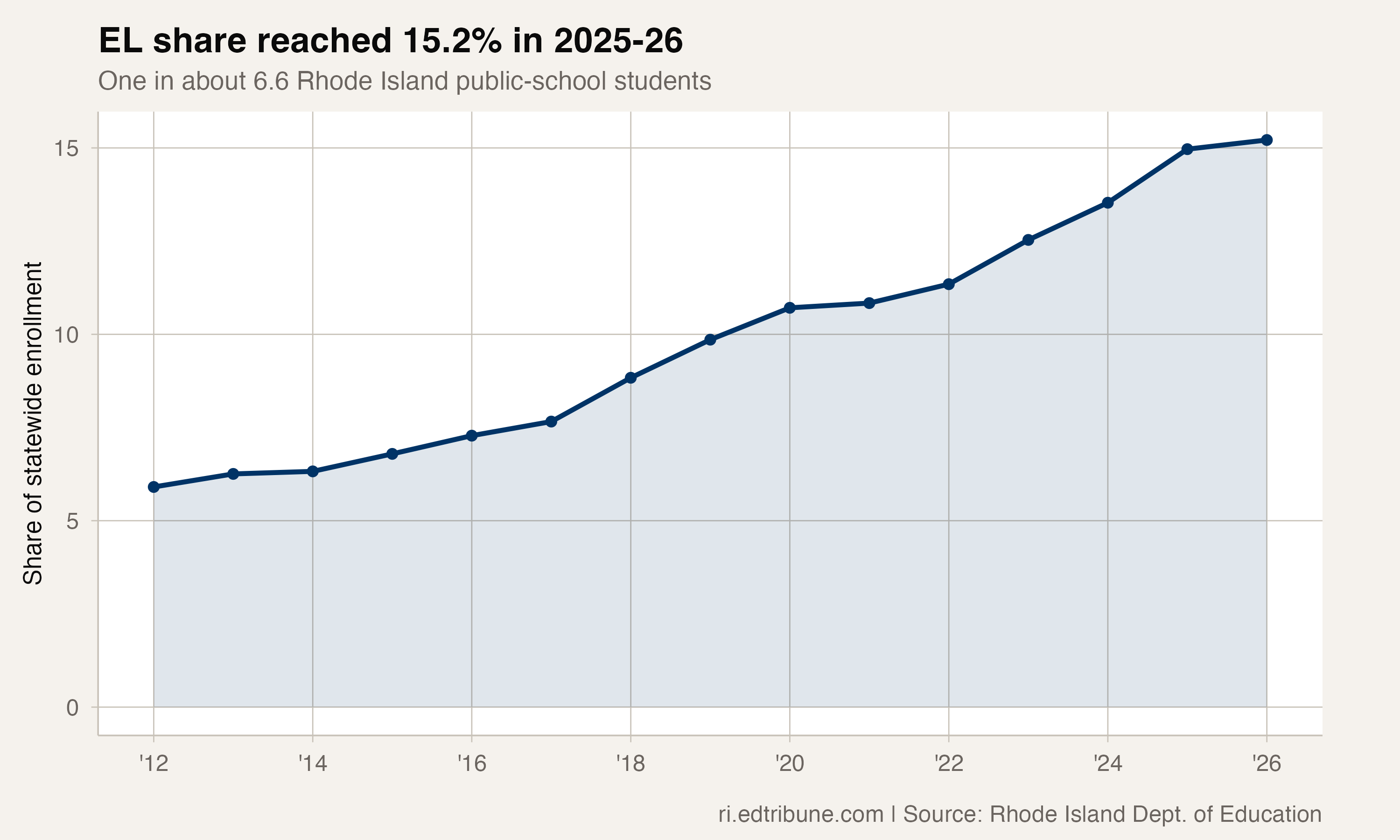
Fourteen years ago, roughly one in 17 Rhode Island public school students was classified as an English learner. By 2025-26, it was one in 6.6.
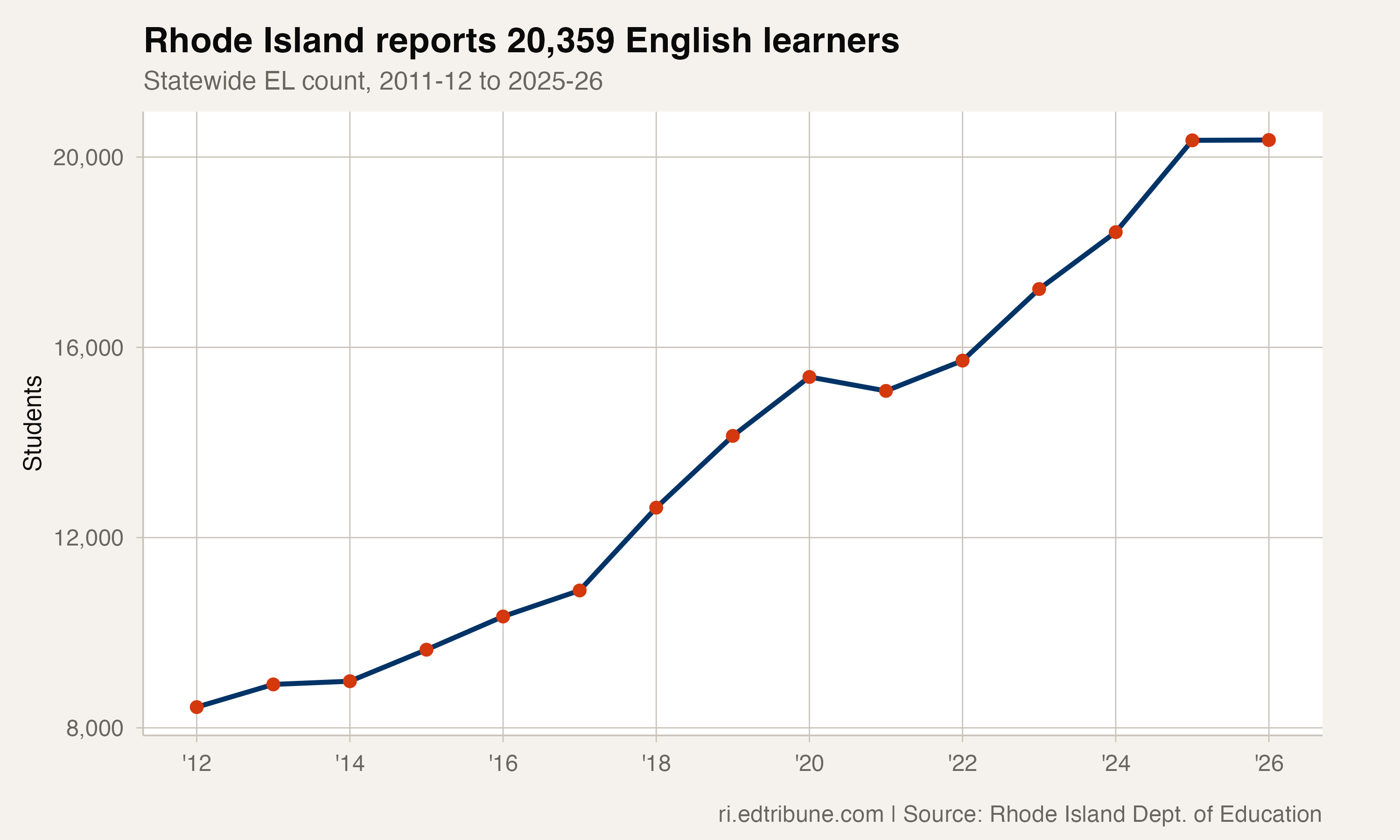
The state reported 20,359 English learners in 2025-26, equal to 15.2% of statewide enrollment. In 2011-12, the count was 8,436 — just 5.9% of the student body. That is an increase of 11,923 students and 9.3 percentage points in share, a shift large enough to reshape how districts budget for bilingual instruction and staffing.
Growth that stopped short of a reversal
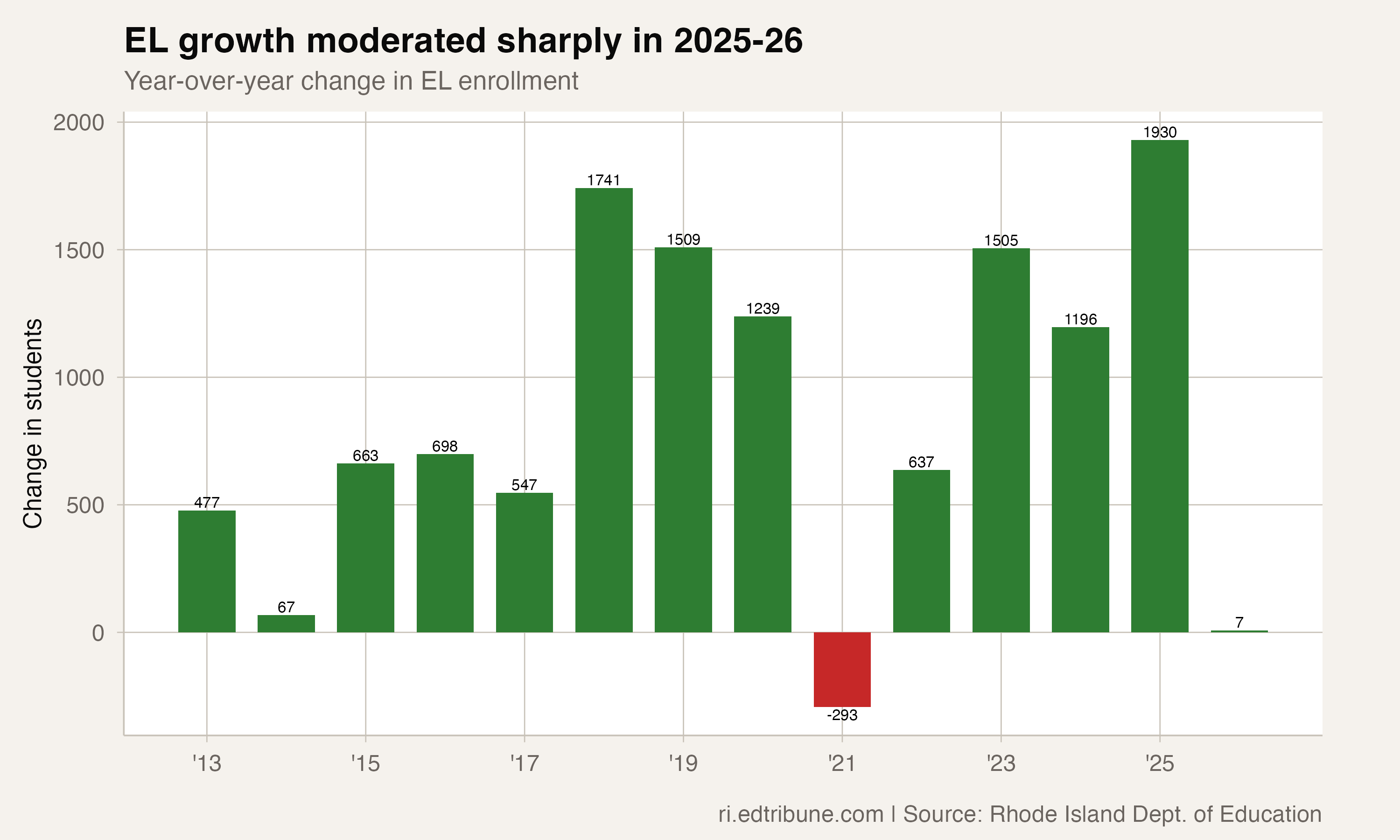
The long-run EL trajectory is upward in both count and share. But the latest year broke the pattern: 2025-26 added just seven students after larger gains in prior years.
RELATED: After 13 years of growth, Rhode Island's English learner surge freezesET
That combination — a nearly flat count alongside a rising share — can look contradictory at first glance. The explanation is arithmetic. EL share still climbed to 15.2% because statewide total enrollment fell while the EL count held steady. A shrinking denominator lifts the percentage even without a growing numerator.
One in 6.6 Rhode Island students is now classified as an English learner — up from one in 17 just fourteen years ago.
| Metric | Value |
|---|---|
| EL enrollment, 2011-12 | 8,436 |
| EL enrollment, 2025-26 | 20,359 |
| Net change | +11,923 |
| EL share, 2011-12 | 5.9% |
| EL share, 2025-26 | 15.2% |
| Share change | +9.3 percentage points |
| 2024-25 to 2025-26 EL change | +7 |
What the data cannot explain
Multi-year count growth plus share growth indicates sustained composition change over the period, not only a denominator effect. But the statewide enrollment file does not provide direct causal fields for migration patterns, changes in language-identification practices, or district-level program expansions.
The near-flat 2025-26 count could mean several different things. It may reflect a genuine stabilization in new arrivals. It could signal expanded reclassification, moving students out of EL status faster. Or it could be a reporting-cycle artifact — RIDE's own finance director has acknowledged that "the October data hasn't been great the last few years," and March updates have shown materially different EL counts.
The statewide file also cannot separate how much EL growth came from newly arrived multilingual learners, changes in identification practice, inter-district movement, or sector switching. Each explanation carries different policy implications, and the data supports none of them over the others.
The budget math keeps tightening
At current scale, EL enrollment share directly affects budget and staffing assumptions across districts. Bilingual teachers, translation services, and program capacity do not scale down when growth pauses for a year — they are built for the 20,359 students already in the system, not for the seven who were added last.
Meanwhile, the broader enrollment picture compounds the pressure. Rhode Island's overall student body shrank by 2,149 in 2025-26ET, its steepest single-year loss since the pandemic. That means districts are losing base funding while the share of students requiring specialized — and more expensive — instructional programs continues to climb. English learners at 15.2%, economically disadvantaged students at 54.2%, and special education students at 19.2% all represent overlapping populations whose program costs exceed base per-pupil rates.
What comes next
RIDE's March 2026 enrollment update is now available and should be checked before treating the October EL count as final. If the pattern of recent years repeats, spring revisions could shift the number enough to change the story — from a pause to continued growth, or from a pause to an outright decline. Either outcome would carry real consequences for the funding formula and for districts that have spent the last decade building multilingual infrastructure.
The longer arc still points one direction. Rhode Island went from 8,436 English learners to 20,359 in 14 years. Whether 2025-26 turns out to be a plateau or a comma in that sentence, the structural reality is already here: the state's schools serve a fundamentally different student body than they did a decade ago, and the systems built for that earlier era have not caught up.
Detailed code that reproduces the analysis and figures in this article is available exclusively to EdTribune subscribers.
Discussion
Sign in to join the discussion.
Loading comments...