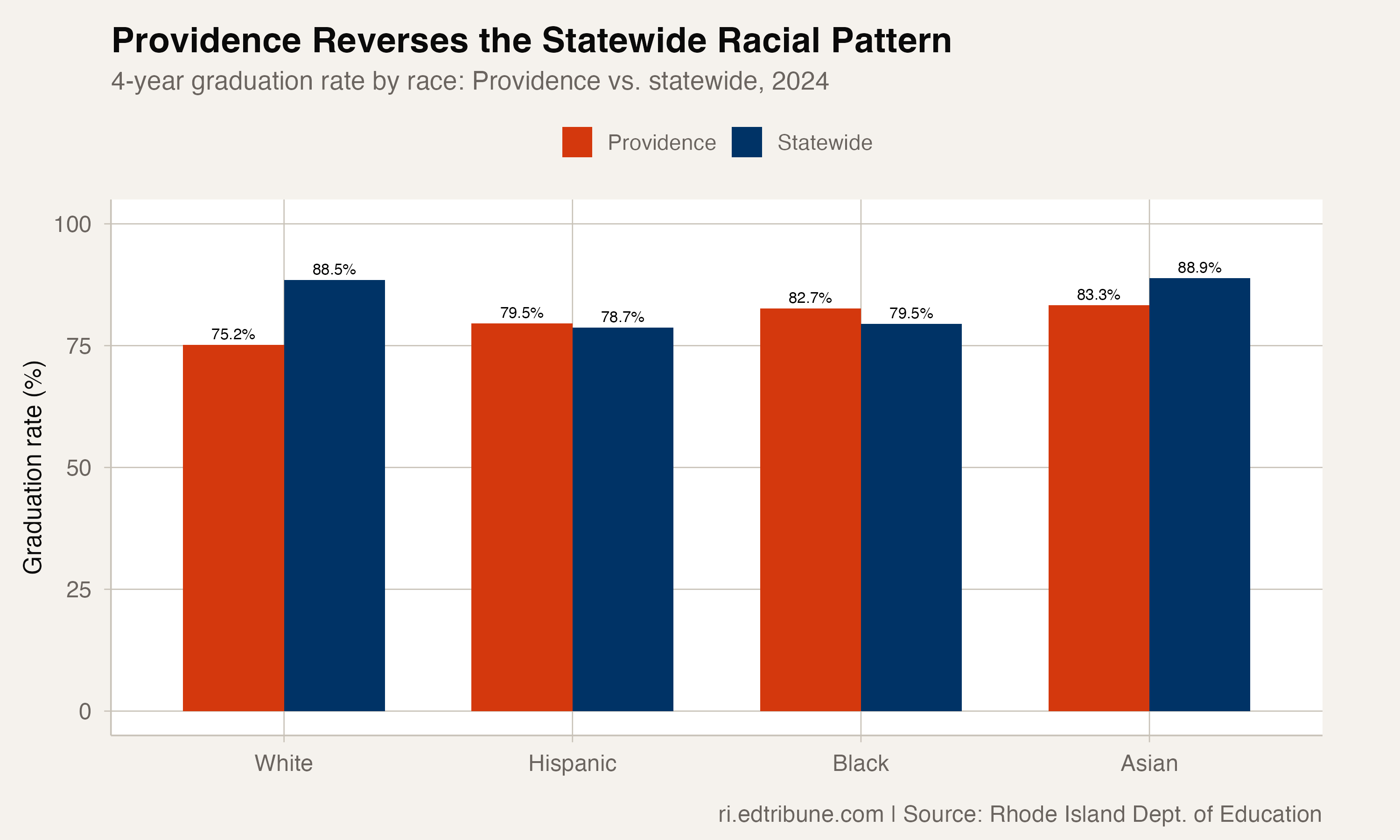
Statewide, the racial graduation hierarchy in Rhode Island follows a familiar pattern: white and Asian students lead, Black and Hispanic students trail. In Providence↗ET, that pattern inverts.
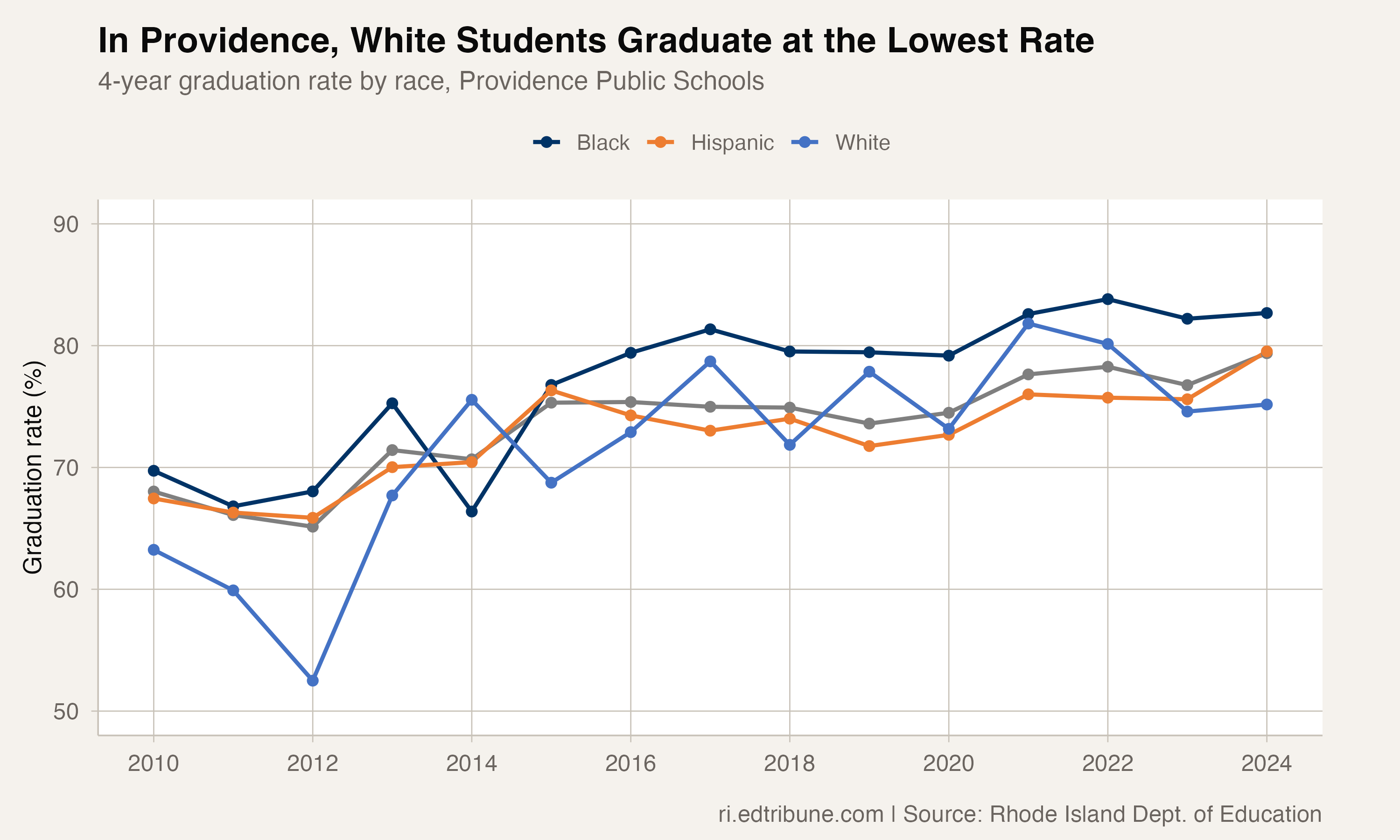
White students in Rhode Island's largest school district graduated at 75.2 percent in 2024, the lowest rate among the district's four largest racial groups. Hispanic students, who make up nearly 70 percent of the district, graduated at 79.5 percent. Black students graduated at 82.7 percent. Asian students led at 83.3 percent. The district-wide average was 79.4 percent.
Two different Rhode Islands
The contrast with statewide figures is striking. Across Rhode Island, white students graduated at 88.5 percent in 2024, 13.3 percentage points higher than white students in Providence. Statewide, the white-Black gap runs 9.0 points in favor of white students. In Providence, the gap runs 7.5 points in the opposite direction.
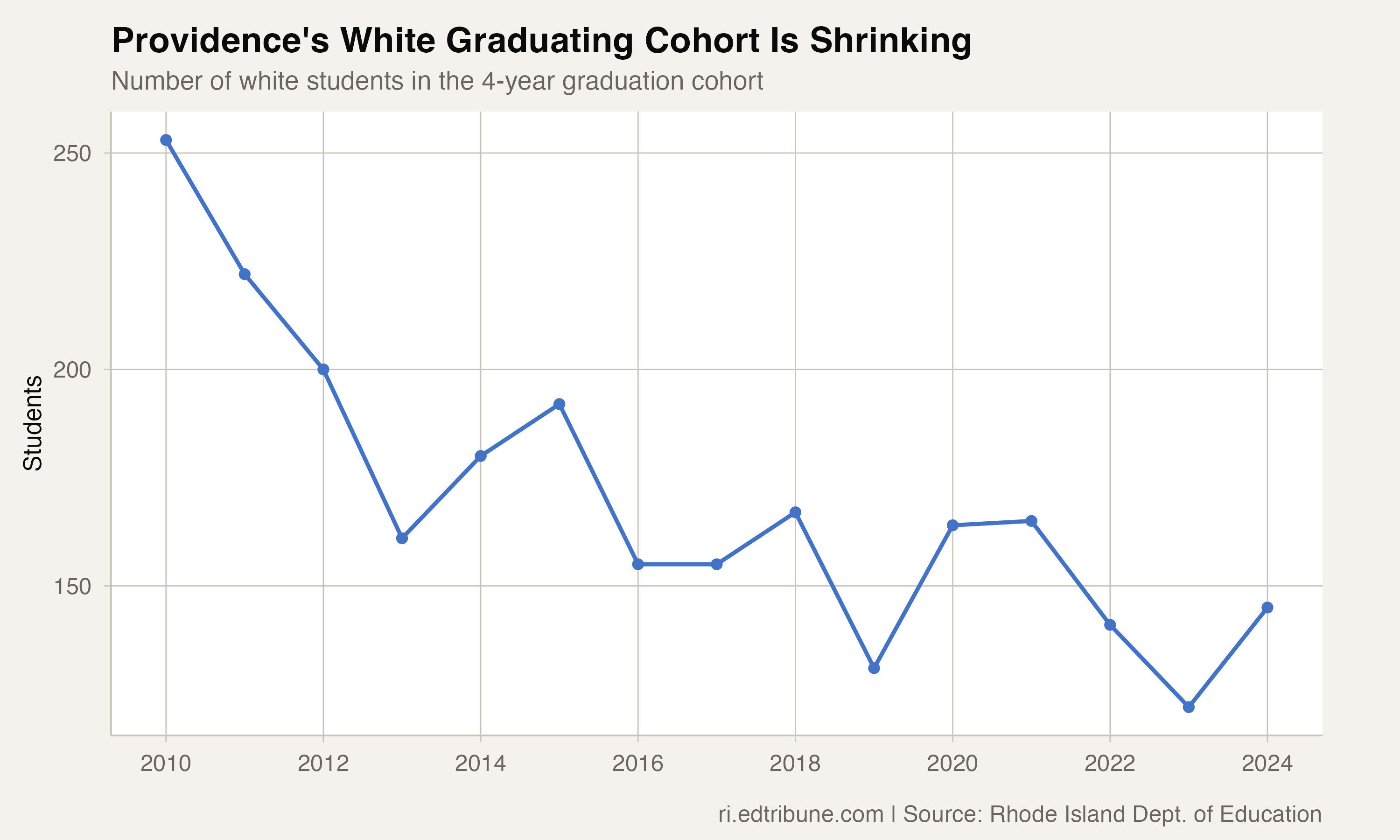
This is not a statistical fluke driven by tiny numbers, though the small cohort warrants caution. Providence's 2024 white graduating cohort was 145 students, about 8 percent of the district's 1,819-student cohort. That is large enough to produce stable rates, but small enough that a few dozen students' outcomes can swing the figure by several points in a given year.
The pattern is persistent. Looking across the full fifteen-year data window, white students in Providence have frequently posted rates at or below those of their Black and Hispanic peers. This is not a one-year anomaly but a structural feature of the district's demographics.
Who are Providence's white students?
The reversal becomes less surprising with context. White students who remain in Providence Public Schools are a distinctive demographic subset. They are not representative of white students across Rhode Island.
As the city's school system has contracted and struggled (Providence was placed under state intervention in 2019), white families with means have increasingly opted for private schools, charter schools, or neighboring suburban districts. The white students who remain in the traditional public school system are more likely to come from lower-income households, to have special education needs, or to face other challenges that correlate with lower graduation rates.
Put differently, the selection effect runs in both directions. The white students in Providence's graduating cohort do not resemble the white students in Barrington or East Greenwich. They more closely resemble the broader Providence population in their socioeconomic profile, and they graduate at rates that reflect those shared challenges, not the advantages associated with whiteness in statewide data.
The broader Providence story
Providence's overall 79.4 percent graduation rate in 2024 is its highest in at least fifteen years of available data. The district has climbed 5.8 percentage points since 2019, when the state took over management in response to a Johns Hopkins study documenting systemic dysfunction across the district.
The improvement has been broad-based. Hispanic students, who were graduating at 67.5 percent in 2010, have climbed to 79.5 percent. Black students have improved from 66.8 percent in 2011 to 82.7 percent. Five of the ten schools with the largest graduation rate increases statewide in 2024 were in Providence.
The white student rate, by contrast, has been more volatile, bouncing between the mid-60s and low-80s across years, reflecting the sensitivity of small-cohort data to individual outcomes. In some years, white students lead the district; in others, they trail sharply.
What the reversal does and does not mean
The Providence racial reversal does not mean the district has solved racial inequity. It does not suggest that being white in Providence is a disadvantage in any systemic sense. And it does not invalidate the statewide data showing persistent racial gaps in educational outcomes.
What it does reveal is that race and class interact differently depending on context. In suburban and rural Rhode Island, white students come disproportionately from stable, middle-income households, and their graduation rates reflect those advantages. In Providence, the white students who attend public schools are a self-selected group whose socioeconomic profile looks more like the city than the state.
The policy implication is that graduation gaps are ultimately poverty gaps and stability gaps. When you control for the circumstances that make graduating harder, things like housing instability, food insecurity, family disruption, and under-resourced schools, racial differences narrow and sometimes disappear. Providence's data makes that point more clearly than any regression model.
Detailed code that reproduces the analysis and figures in this article is available exclusively to EdTribune subscribers.
Discussion
Sign in to join the discussion.
Loading comments...