In this series: Rhode Island 2025-26 Enrollment.
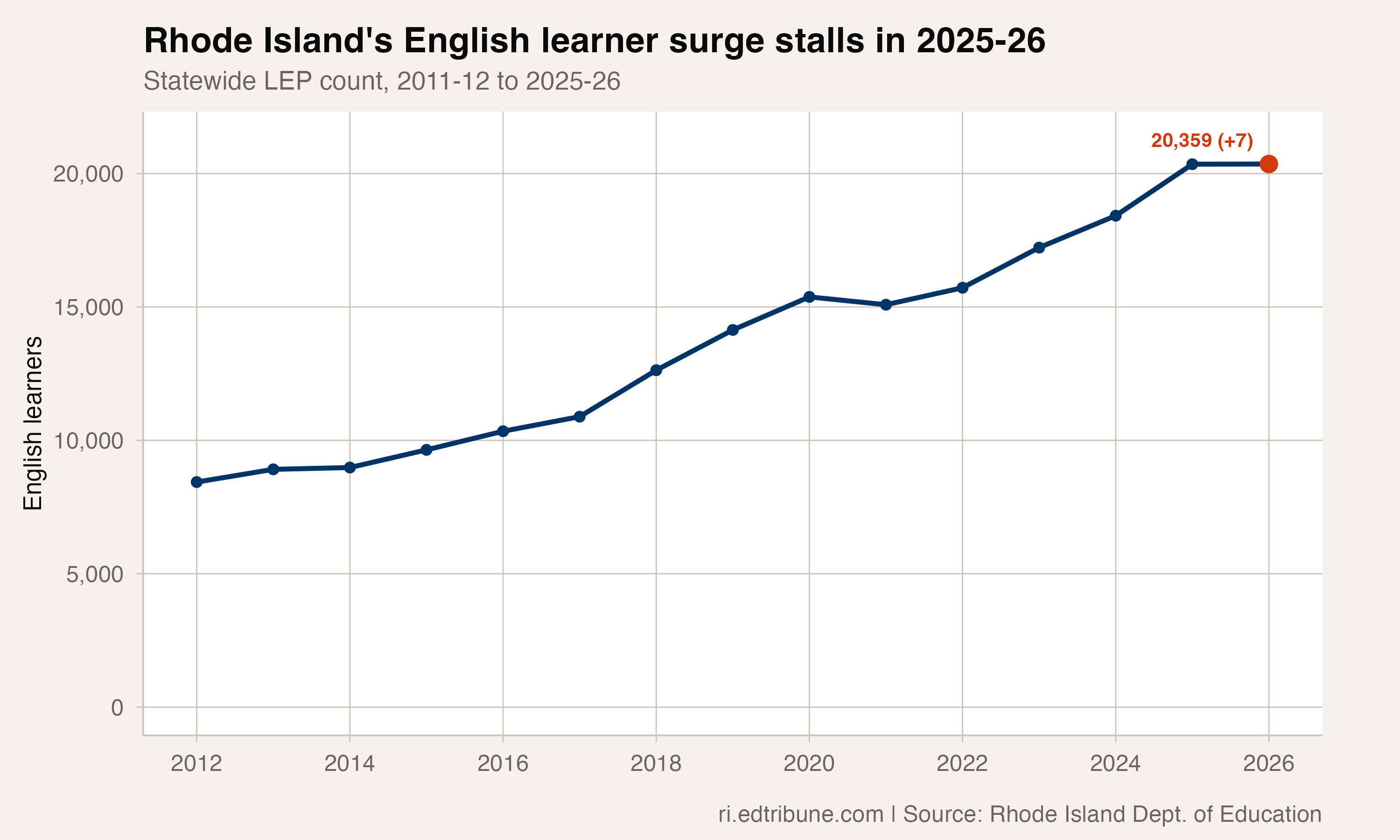
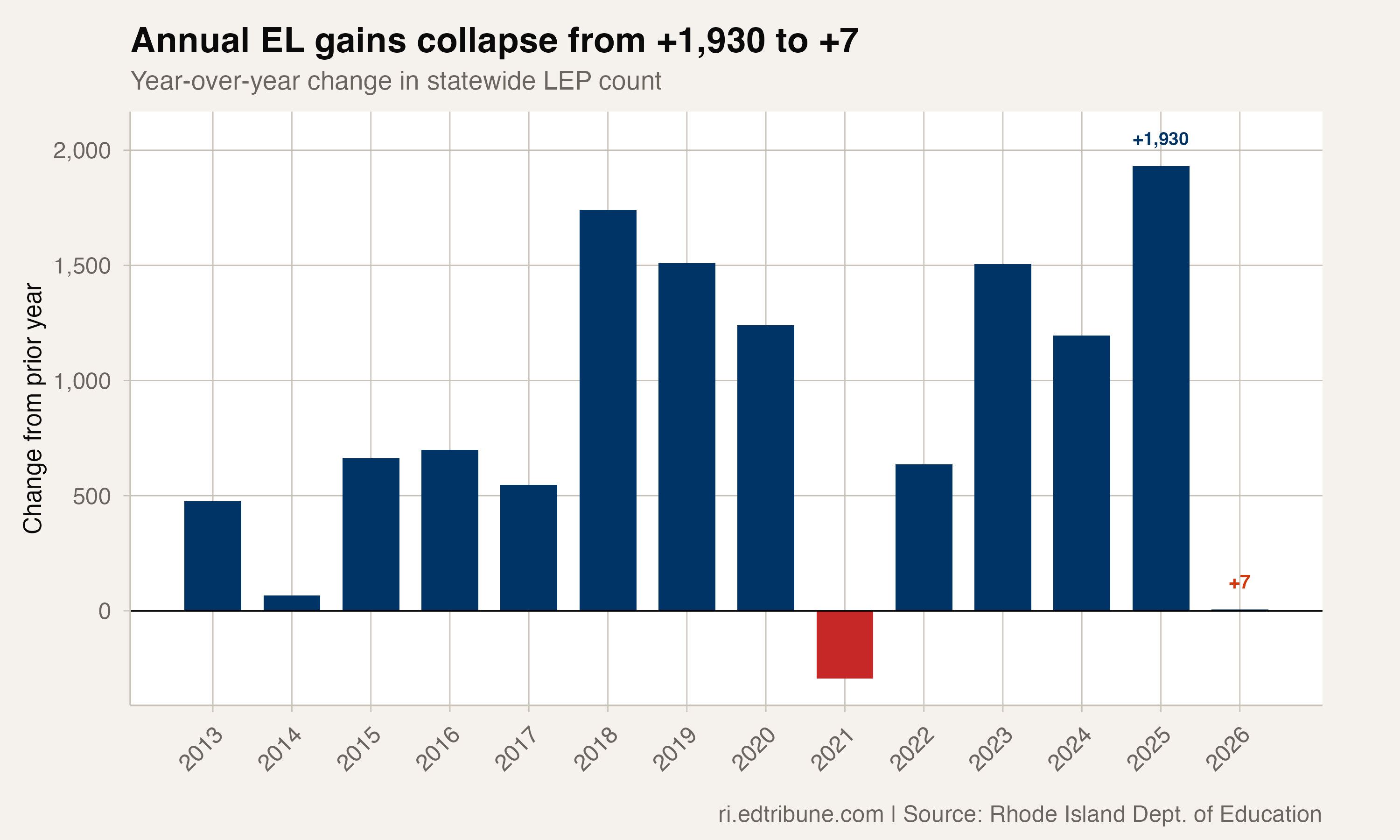
In 2024-25, Rhode Island added 1,930 English learners to its public school rolls. In 2025-26, it added seven.
Not seven hundred. Not seventy. Seven students, out of more than 134,000. The statewide EL count inched from 20,352 to 20,359, turning one of the state's most reliable growth trends into a question mark that districts now have to staff around.
A decade of growth, then a dead stop
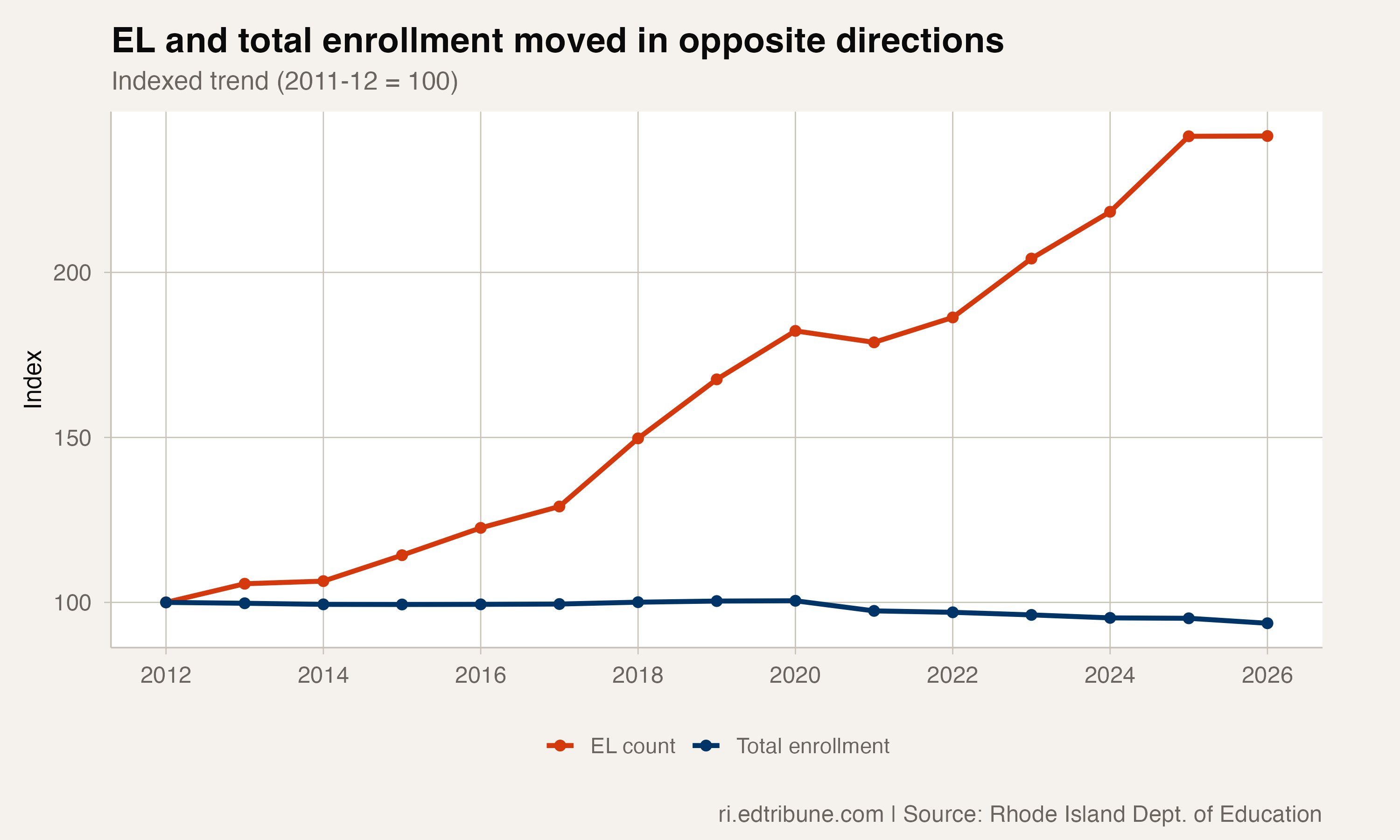
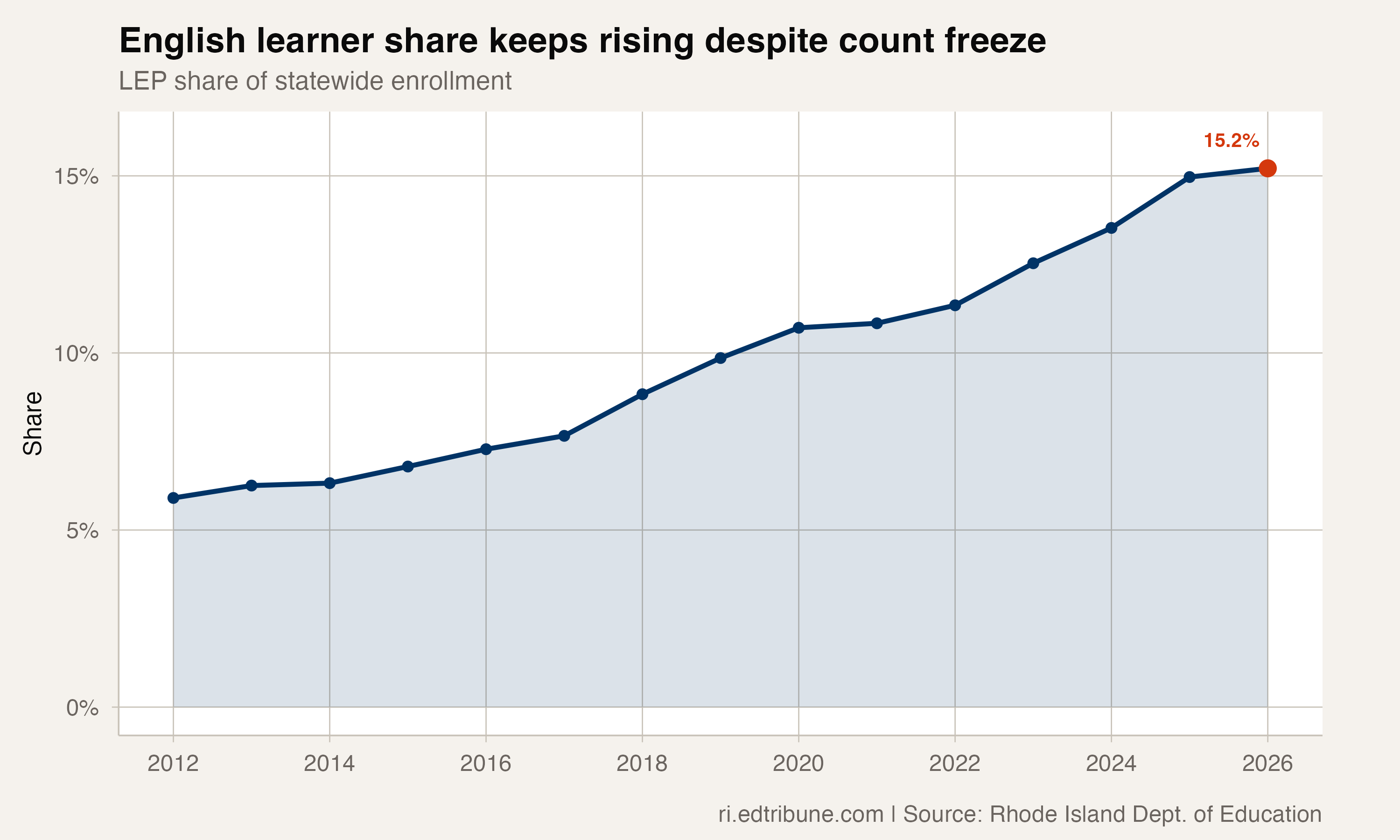
The scale of the longer trend makes the freeze harder to read. From 2011-12 to 2025-26, Rhode Island's English learner count rose from 8,436 to 20,359 — up 11,923 students, a 141% increase. Over the same period, total statewide enrollment fell. That scissoring pushed the EL share from 5.9% to 15.2%, or about one in every 6.6 students.
Annual EL gains stayed substantial through 2024-25, then effectively flatlined. One near-flat year does not erase that trajectory, but it does scramble the near-term planning picture. District leaders now face a forking path: treat 2025-26 as a plateau and scale back hiring plans, or treat it as a count-timing blip and keep building capacity. Those are different budget lines and different staffing decisions, and the data so far cannot tell them which bet is right.
By the numbers: Rhode Island's EL count rose 141% from 2011-12 to 2025-26 — then grew by just 0.03% in the most recent year.
| Metric | Value |
|---|---|
| EL count, 2011-12 | 8,436 |
| EL count, 2024-25 | 20,352 |
| EL count, 2025-26 | 20,359 |
| 2011-12 to 2025-26 change | +11,923 (+141%) |
| 2024-25 to 2025-26 change | +7 |
| EL share, 2011-12 | 5.9% |
| EL share, 2025-26 | 15.2% |
| Ratio at 2025-26 level | 1 in 6.6 students |
An index comparison makes the structural split vivid: EL count more than doubled while the total enrollment index fell below its starting baseline.
Three explanations, and no way to choose yet
A true plateau is possible. If inflow of newly identified EL students slowed while reclassification outflow increased, net growth could stall even as demand for multilingual services remained high. Under that scenario, classrooms would still be full of students needing language support — the count just would not be climbing anymore.
A timing or measurement effect is equally plausible. October snapshot counts in high-impact categories can be volatile, and the swing from +1,930 to +7 is dramatic enough that signal quality itself becomes part of the story.
The long-run rise from 8,436 to 20,359 still provides strong directional context, and Rhode Island publicly tracks multilingual learner trends through state data systems (RIDE Data Center). But the enrollment file does not include student-level entry, exit, and reclassification events, so the mechanism behind the 2025-26 freeze remains unresolved.
Reporting on Rhode Island enrollment and funding pressure has underscored how district planning now hinges on volatile category counts and shifting family decisions (NBC 10). Separately, RI KIDS COUNT tracks multilingual learner outcomes and district disparities (RI KIDS COUNT Factbook). Neither source resolves whether +7 is true stabilization or a timing artifact.
The staffing trap
The practical stakes are sharpest for districts caught between two pressures. Total enrollment is declining, which squeezes per-pupil funding and pushes leaders to consolidate. But EL share remains historically elevated at 15.2%, which means multilingual staffing, interpretation services, and language-support programs cannot shrink in step with the overall headcount.
Rhode Island aid and planning systems rely on enrollment categories (RIDE state education aid). When high-impact categories swing between early and later counts, district budget assumptions swing with them.
RELATED: Rhode Island enrollment drops below 135,000ET
Multilingual service design is not something that can be turned on and off with each October snapshot. Staffing pipelines, scheduling structures, and family communication systems all require lead time. A risk-managed approach is to plan to the elevated multi-year baseline while tracking updated count releases — reducing the chance of overreacting to one near-zero growth year when the longer trend is still steep.
For families, the consequences show up in service reliability: interpretation and translation access, multilingual instructional staffing, and continuity of language-support models. Even with a flat year, the EL share is still roughly triple what it was in 2011-12.
What the next count will settle
The 2026-27 enrollment snapshot, expected in fall 2026, will do more to clarify this moment than any amount of speculation now. If EL growth resumes, 2025-26 becomes a statistical hiccup and the expansion playbook stays in place. If it stays flat or declines, Rhode Island will be operating a multilingual infrastructure built for growth in a new steady-state environment — and districts will need state-level guidance on how to fund sustained services without the growth signal that originally justified them.
Either way, the 20,359 students already classified as English learners are in classrooms right now. The services they need do not pause while the trend line sorts itself out.
Detailed code that reproduces the analysis and figures in this article is available exclusively to EdTribune subscribers.
Discussion
Sign in to join the discussion.
Loading comments...