In this series: Rhode Island 2025-26 Enrollment.
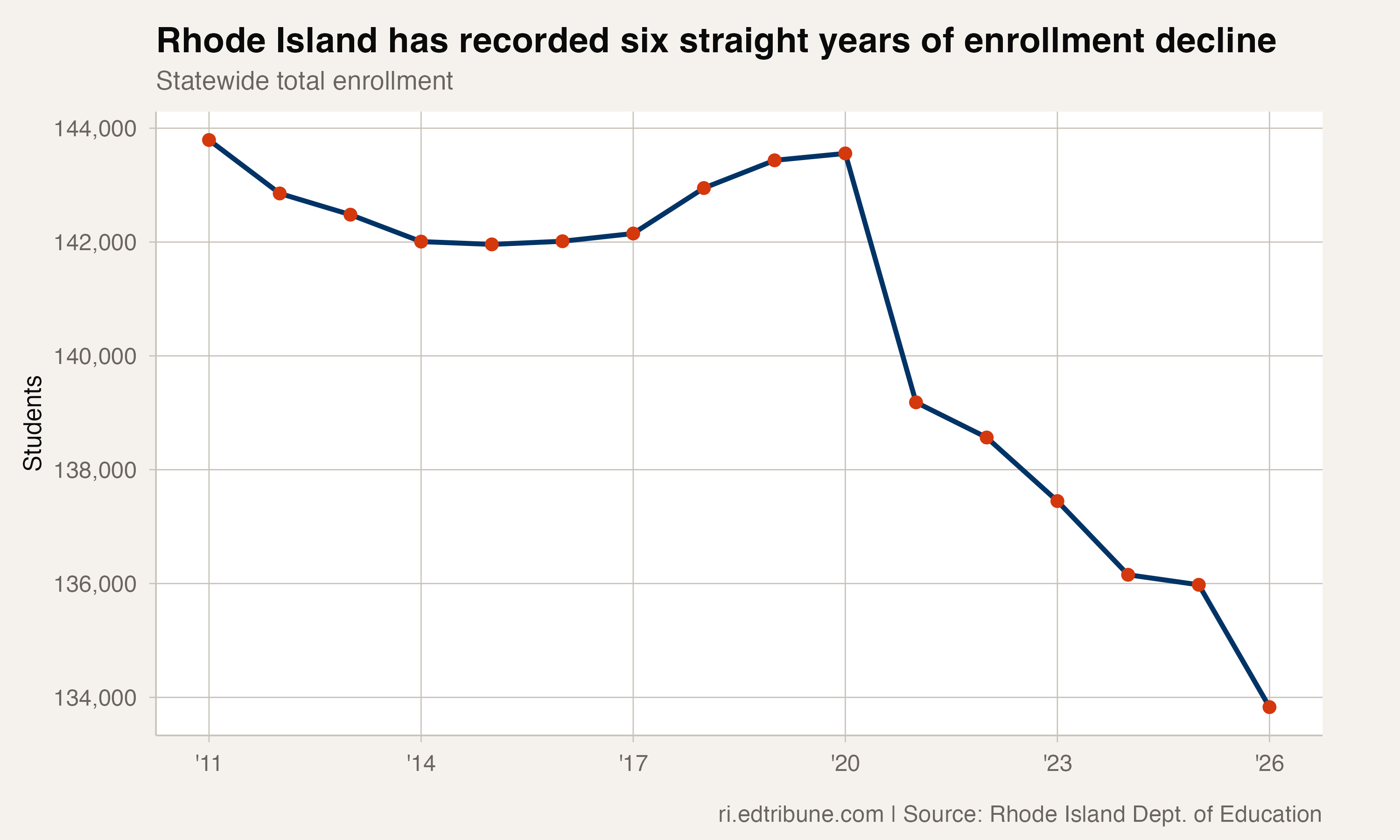
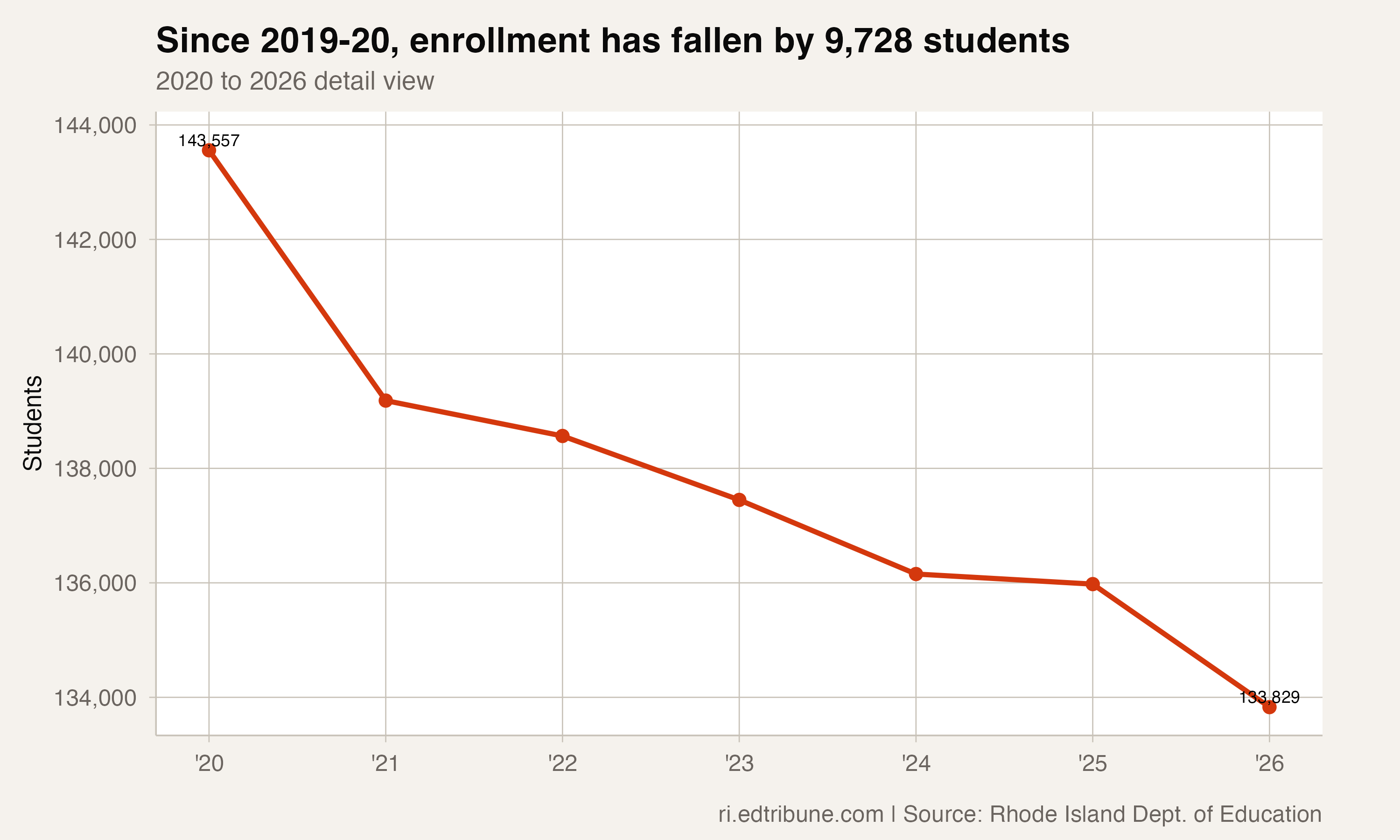
A student who entered kindergarten in Rhode Island in fall 2020 has never attended a school system that was growing. Every year of that child's education so far — six and counting — has seen statewide enrollment fall. The latest drop of 2,149 students brought the total to 133,829, extending a streak that has now erased 9,728 students and 6.8% of the system since 2019-20.
Rhode Island has not posted a single year of enrollment growth in that span. No pause long enough to plan around, no rebound to point to. Just six consecutive years of decline.
A false floor in 2024-25
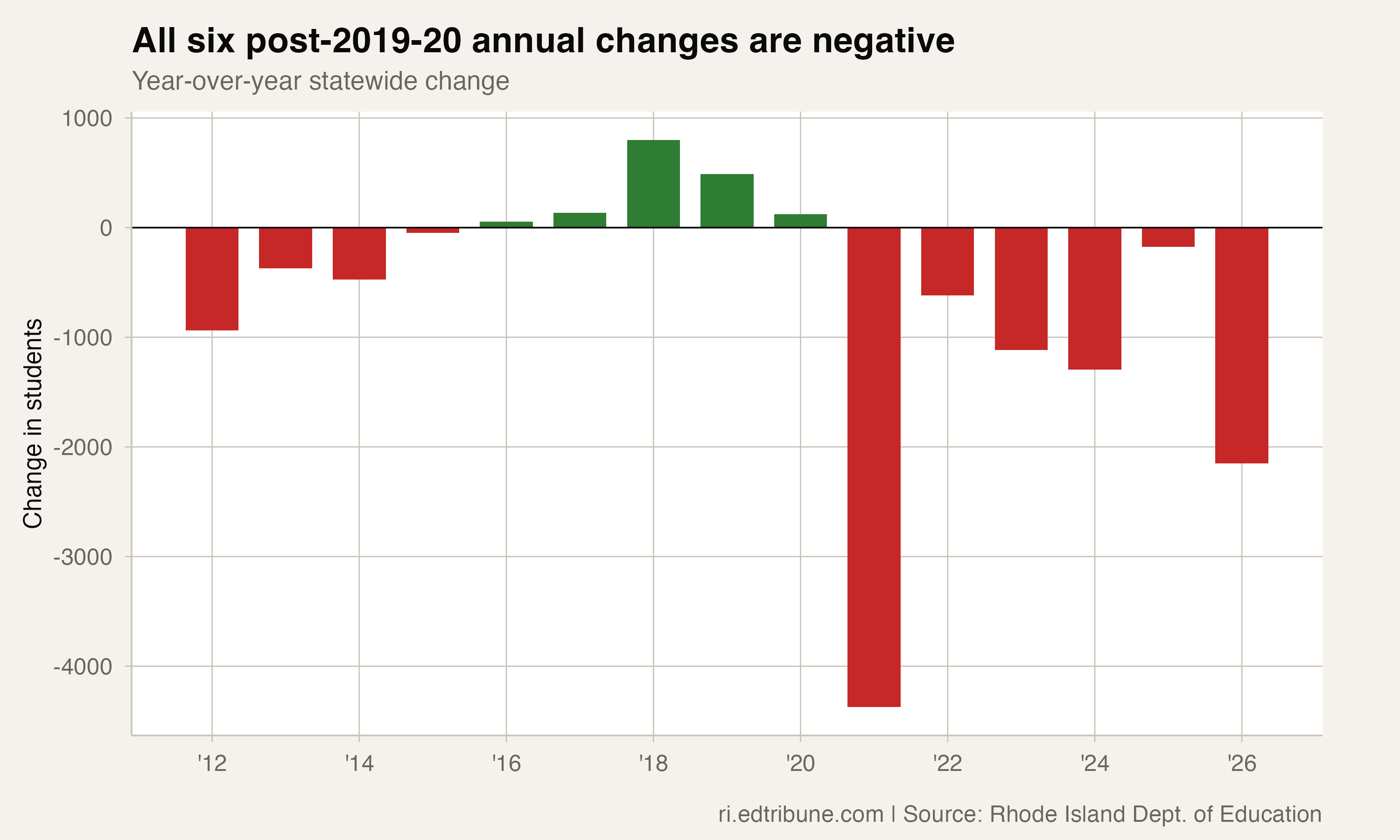
The year-over-year numbers tell a story of jolts and lulls. The pandemic year brought a staggering loss of 4,373 students. What followed were smaller but relentless declines: -618, -1,117, -1,295. Then came 2024-25's near-flat result of -176, which briefly suggested the system had found its footing.
The 2025-26 figure demolished that hope. A drop of 2,149 students re-accelerated the trajectory, landing as the second-largest annual loss of the streak.
Six years. Every single one negative. The question for Rhode Island schools is no longer whether enrollment is declining but how long they can absorb the fiscal consequences.
| Year | Enrollment | Annual change | Annual % change |
|---|---|---|---|
| 2019-20 | 143,557 | +121 | +0.08% |
| 2020-21 | 139,184 | -4,373 | -3.05% |
| 2021-22 | 138,566 | -618 | -0.44% |
| 2022-23 | 137,449 | -1,117 | -0.81% |
| 2023-24 | 136,154 | -1,295 | -0.94% |
| 2024-25 | 135,978 | -176 | -0.13% |
| 2025-26 | 133,829 | -2,149 | -1.58% |
Multiple forces, tangled together
What is driving this? The honest answer is that the statewide enrollment file alone cannot say. It does not include migration flows, birth-cohort data, or counts of students switching to private and charter schools.
What the data does show is persistence. Six straight negative years is not the signature of a single cause. The pandemic hammered enrollment in 2020-21, but the losses kept coming long after schools reopened. That pattern points to multiple overlapping forces — demographic contraction, families leaving the state, sector switching — layered on top of one another with different timing.
The streak also cuts across every corner of the state. Some communities like Portsmouth and South Kingstown have been losing students for 15 years, well before COVID provided an easy explanation. Meanwhile, none of the state's six largest districtsET have managed to claw back to pre-pandemic levels.
The budget math gets harder
A six-year decline changes how districts plan. One or two bad years can be treated as a dip. Six consecutive years of losses force a different conversation — one about structural realignment rather than patience.
The fiscal pressure is straightforward: count-based funding falls while fixed costs for buildings, transportation, and contracts do not. Districts that were already operating lean have fewer places to cut. Those that delayed adjustments now face steeper ones.
The statewide total dipping below 135,000ET in 2025-26 crossed a symbolic threshold, but the real pressure is cumulative. Nearly 10,000 fewer students means roughly 10,000 fewer units of per-pupil funding flowing into a system whose overhead has not shrunk proportionally.
What comes next
Nothing in the data suggests a seventh year of decline is inevitable — but nothing suggests a turnaround either. Rhode Island's shifting demographicsET are reshaping who enrolls, but not yet reversing how many. Until birth rates, migration patterns, or sector preferences change direction, school leaders should plan for the streak to continue.
The numbers will not fix themselves. Whether Rhode Island responds with consolidation, reinvestment, or something else entirely is a policy question the data can frame but cannot answer.
Detailed code that reproduces the analysis and figures in this article is available exclusively to EdTribune subscribers.
Discussion
Sign in to join the discussion.
Loading comments...