In this series: Rhode Island 2025-26 Enrollment.
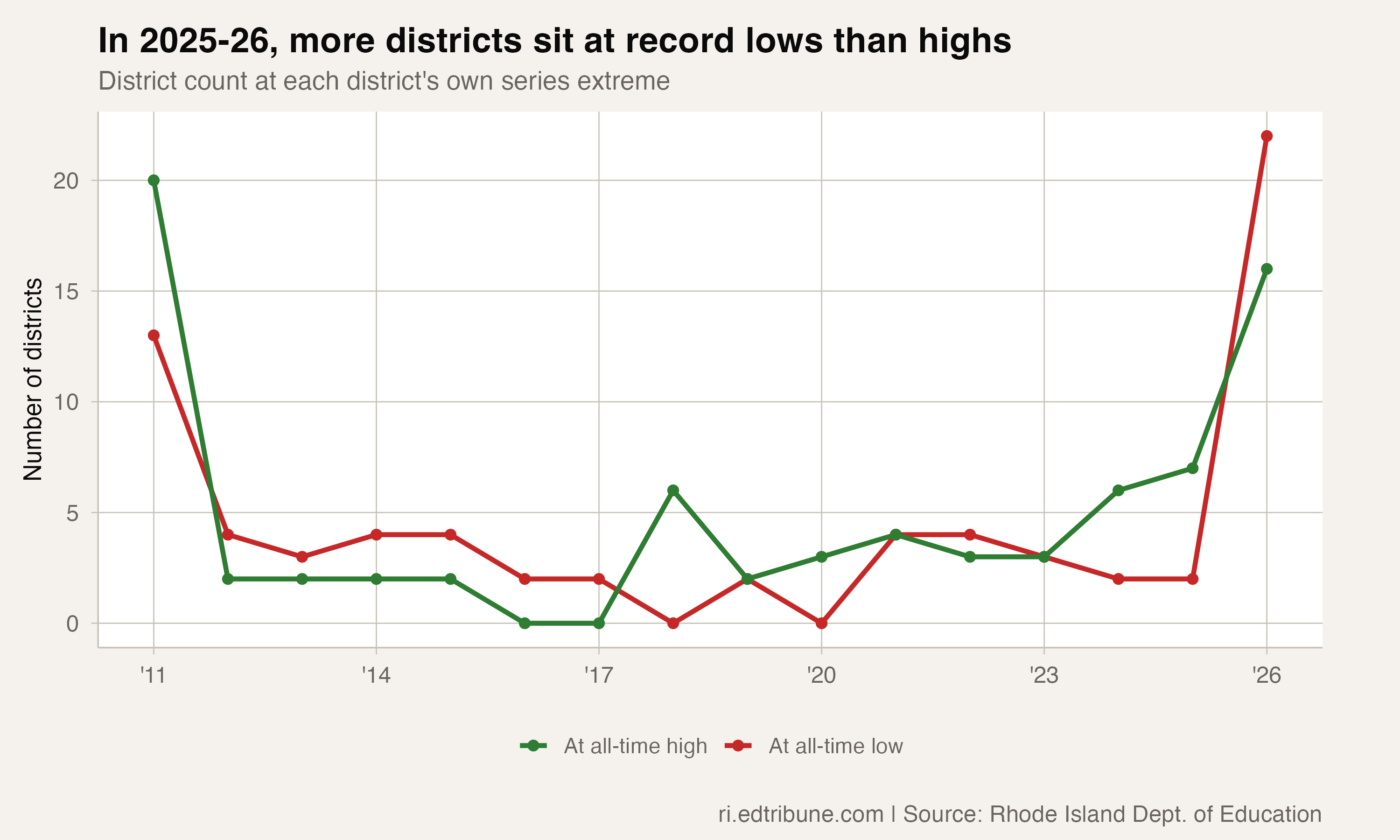
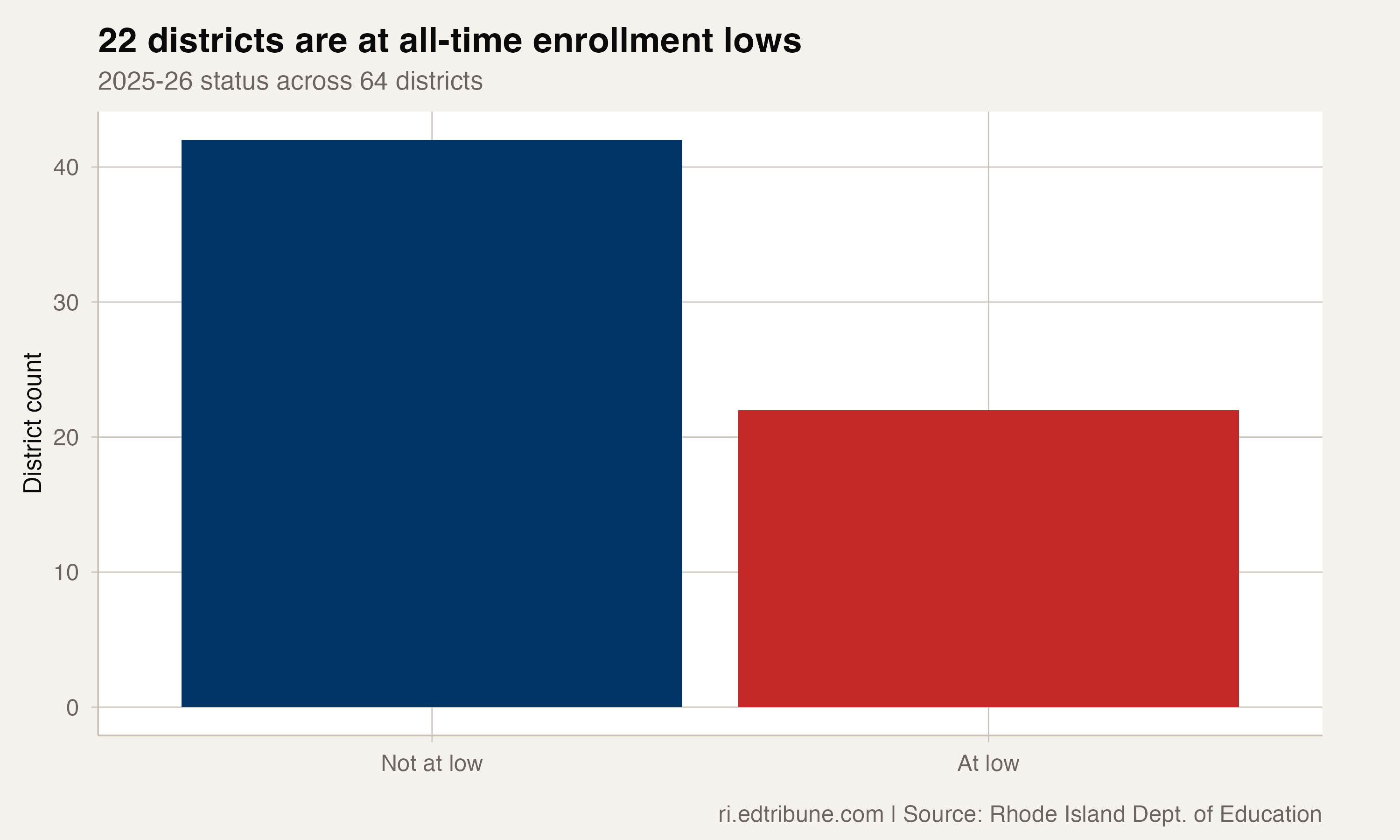
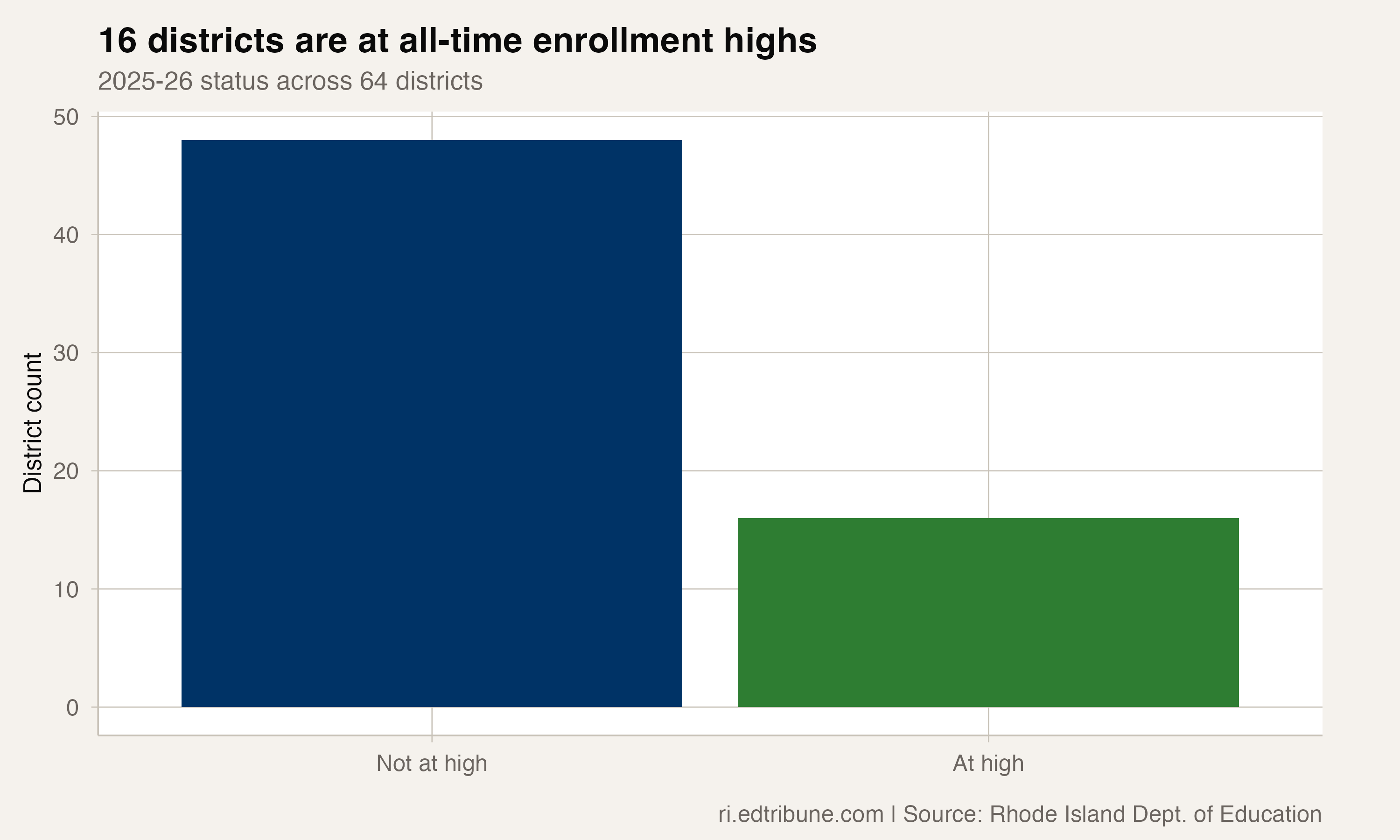
Pick any Rhode Island school district and ask whether enrollment has ever been lower. For 22 of 64 districts, the answer in 2025-26 is yes -- this year is the worst on record. Now ask the opposite question. For 16 districts, this year is the best they have ever seen. The statewide number splits the difference. The statewide number is lying.
A state talking past itself
Rhode Island's enrollment conversation tends to default to one narrative at a time: districts are shrinking, or recovery is underway. The 2025-26 data refuses to cooperate with either framing. More than a third of districts have never enrolled fewer students in any year since 2011. A quarter have never enrolled more. Both facts are true simultaneously, and the six-district gap between the two groups -- 22 lows versus 16 highs -- is narrow enough to make the split feel like a coin flip rather than a landslide.
"22 districts are at all-time enrollment lows in 2025-26. 16 are at all-time highs. The statewide average papers over both."
| Metric | Value |
|---|---|
| Districts with 2025-26 data | 64 |
| Districts at all-time low (2025-26) | 22 |
| Districts at all-time high (2025-26) | 16 |
| Net low-minus-high balance | +6 |
That net balance of plus-six means statewide policy has to serve two operational realities at once: systems managing persistent decline alongside systems scrambling to absorb record demand. A single funding formula or facility plan cannot assume all districts face the same pressure.
What the data can and cannot explain
The enrollment file confirms the split but stays silent on why it exists. District-level demographic shifts, housing development patterns, birth cohort sizes, and school choice migration all plausibly contribute, yet none appear in the dataset itself. Some districts may be structurally stable or growing while others face long-run population decline -- but distinguishing between those mechanisms requires local data this analysis does not have.
Cumberland stands out as the only traditional district currently at an all-time high, a distinction that shows how rare sustained growth is outside charter and specialty districts. Meanwhile, places like Portsmouth and South Kingstown have been declining for 15 consecutive years, suggesting that for some communities the record-low designation is not a single bad year but the latest point on a long downward slope. And this split plays out against a backdrop where half of Rhode Island's districts now enroll fewer than 1,000 students, meaning the districts at record lows are often already small and getting smaller.
The planning problem no one wants to own
The divergence creates an awkward policy environment. Districts at record highs need capacity -- classroom space, staffing pipelines, transportation routes built for larger headcounts. Districts at record lows face the opposite: excess infrastructure, consolidation pressure, and the fiscal strain of fixed costs spread across fewer families. Both groups exist within a state small enough that a 20-minute drive can take you from one reality to the other.
The COVID-era size paradox -- small districts grew while large ones shrank -- may have accelerated this divergence, but it did not create it from scratch. Districts that were already trending downward before 2020 largely kept trending downward. Districts that were growing kept growing. The pandemic reshuffled some families, but the underlying trajectories appear to have deeper roots.
Whether this split widens or narrows in 2026-27 depends on factors the enrollment file cannot predict: where families move, which districts attract school-choice transfers, and whether the state's modest population trends favor urban cores or suburban and rural communities. For now, the data is clear on one point: Rhode Island does not have one enrollment story. It has at least two.
Detailed code that reproduces the analysis and figures in this article is available exclusively to EdTribune subscribers.
Discussion
Sign in to join the discussion.
Loading comments...