Rhode Island's #AttendanceMattersRI campaign earned the state a ranking of fifth nationally for the sharpest decline in chronic absenteeism. The headline numbers are real: the statewide rate dropped from 34.10% to 24.76%, a 9.3 percentage point improvement from peak.
But a district-by-district accounting reveals how narrow the recovery actually is. Of 60 districts with data spanning the pre-COVID and post-COVID eras, only 8 have returned to their pre-pandemic chronic absenteeism rate. That is 13.3% — roughly one in eight.
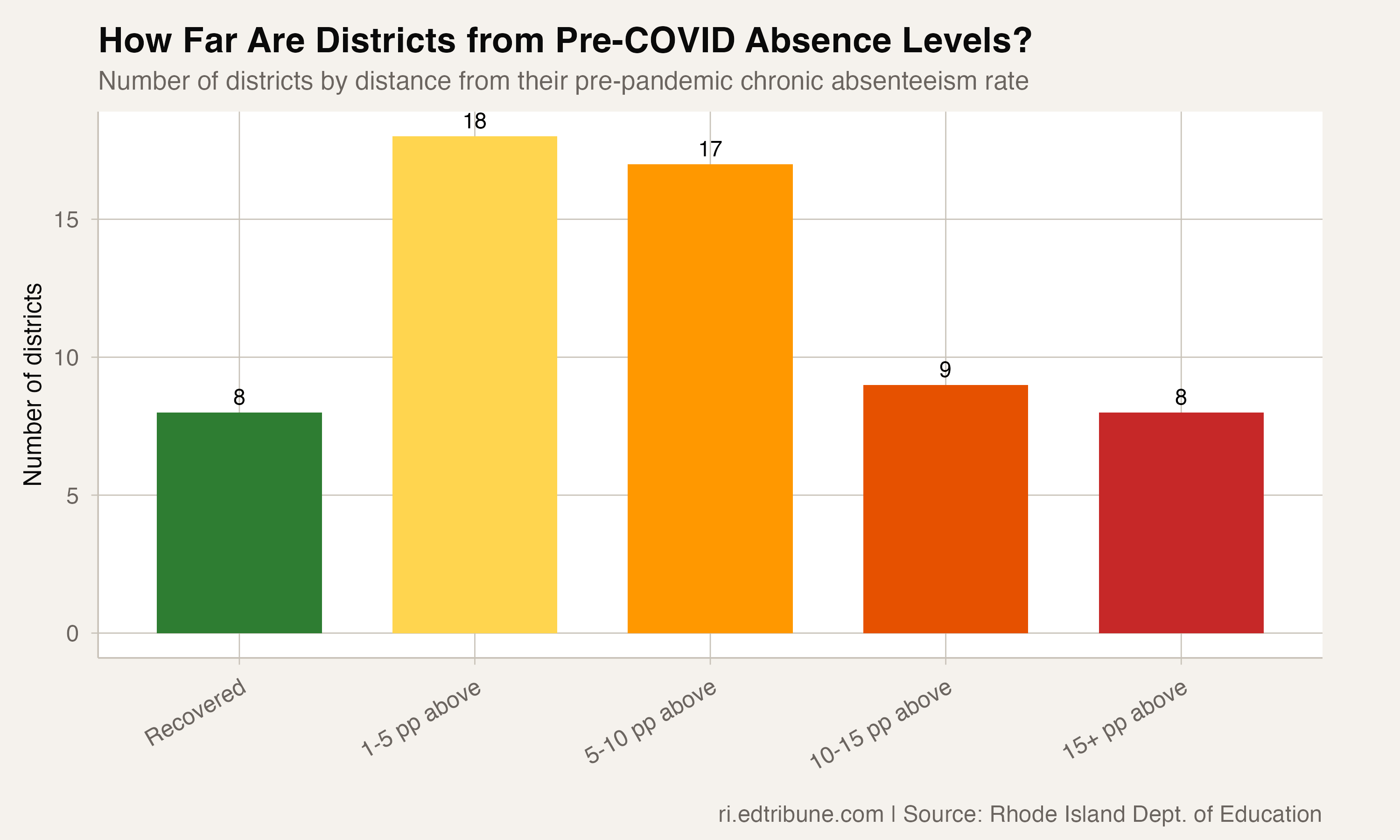
The eight that recovered
The recovered districts are a mixed group. Providence↗ET, the state's largest district, is the headline recovery — down from a peak of 57.06% to 36.37%, slightly below its pre-COVID 37.30%. Jamestown↗ET, at 5.94%, never had much of a problem to recover from. The Segue Institute for Learning↗ET, at 5.64%, is a small charter.
The rest of the list includes alternative and charter schools where chronic absenteeism rates were already high or volatile: the Greene School (32.23% pre-COVID to 11.60%), Urban Collaborative (62.22% to 52.75%), Charette Charter (60.17% to 50.87%), Trinity Academy (13.77% to 11.87%), and RI Nurses Institute Middle College (41.80% to 40.55%).
What the list does not include: any large traditional suburban district. Not Cranston↗ET. Not Warwick↗ET. Not Cumberland↗ET. Every traditional district with more than 3,000 students — except Providence — remains above its pre-COVID rate.
The 52 that have not
The non-recovered districts include virtually every community in the state. Some are close: Barrington↗ET, at 7.64%, is only 1.7 points above its pre-COVID 5.99%. Others are far: Pawtucket↗ET, at 35.16%, is 13.0 points above its pre-COVID 22.11%.
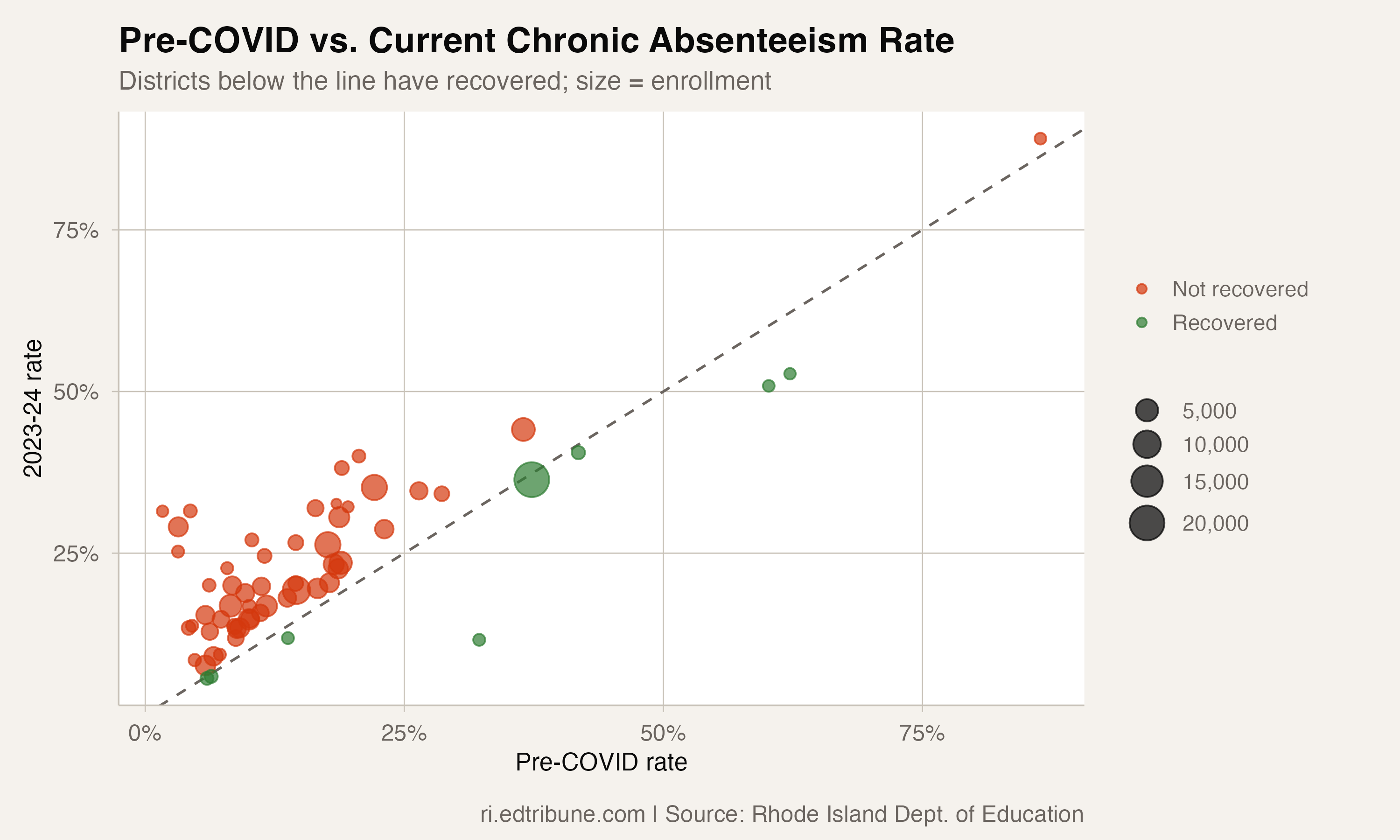
Among the large non-recovered districts, the excess above pre-COVID ranges from modest to severe:
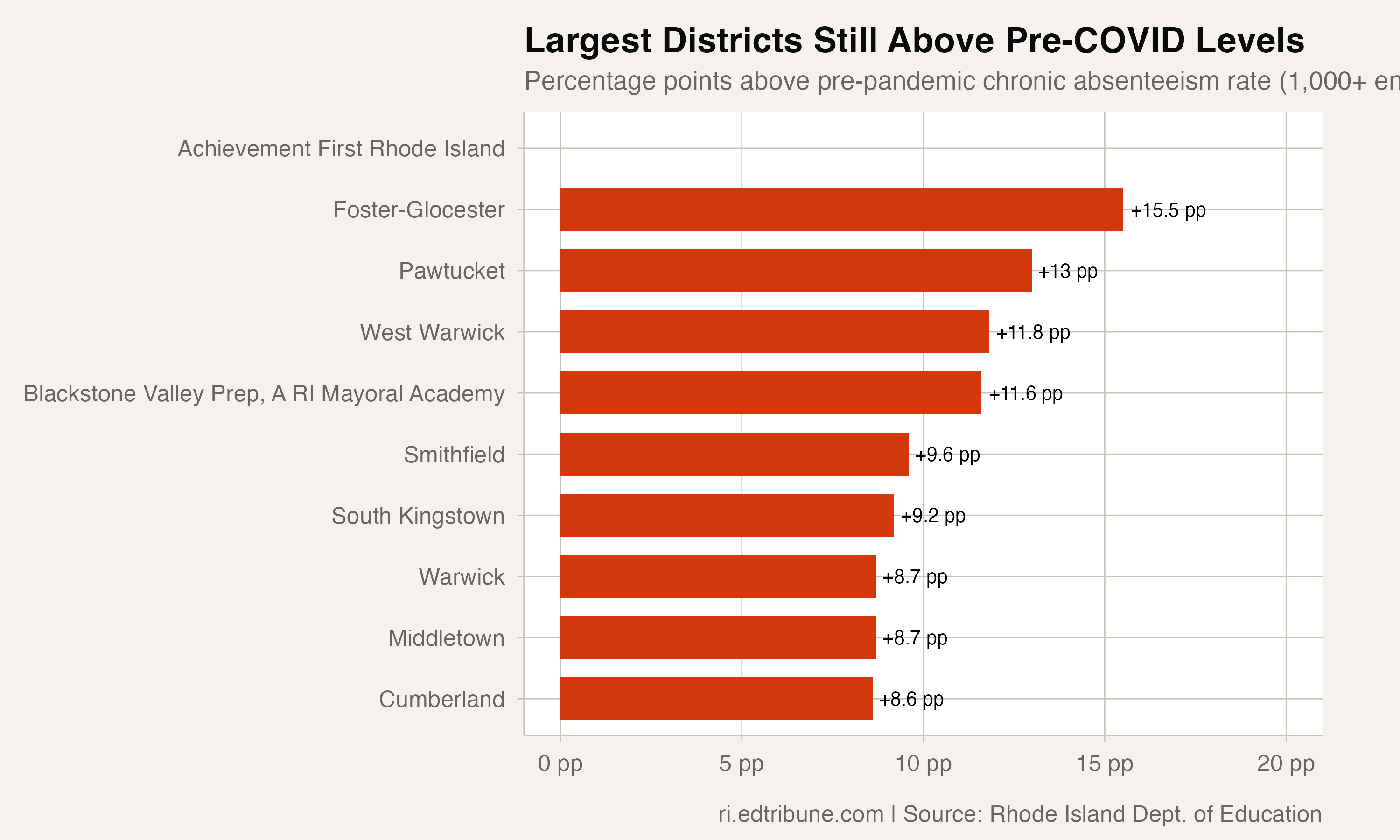
The pattern suggests that recovery is not simply a function of starting point. Districts that began with low chronic absenteeism before the pandemic — like Foster-Glocester (pre-COVID 16.44%, now 31.96%) — have in some cases seen the largest deterioration. Districts that started high, like Providence, have shown the most dramatic improvement.
What recovery means
The 13.3% recovery rate puts Rhode Island's attendance campaign in perspective. The campaign unquestionably worked: a 9.3-point statewide improvement in two years is among the best in the nation. But the improvement has been disproportionately concentrated in a small number of districts, particularly Providence, whose weight in the statewide calculation means its 20.7-point turnaround shifts the state number substantially.
For the 52 non-recovered districts, the pre-COVID rate was not a floor to bounce off of but a benchmark that remains out of reach. The Attendance for Success Act, enacted in August 2024, may help close the remaining gap by requiring systematic intervention before court referrals. Early data from 2024-25 shows the statewide rate dropping further to 22.1%, suggesting continued progress.
But "progress toward recovery" and "recovery" are different things. Rhode Island's attendance crisis is improving. For seven out of eight districts, it is not over.
Detailed code that reproduces the analysis and figures in this article is available exclusively to EdTribune subscribers.
Discussion
Sign in to join the discussion.
Loading comments...