Correction (September 7, 2026): An earlier draft understated the estimated decline in annual dropouts and combined GED and retained outcomes into an "unaccounted" category. A later version also displayed one-decimal endpoint rates beside a change calculated from unrounded values, described Providence's rate-derived count reduction as a share of another estimate, and did not identify the reporting year as 2023-24. The calculations, framing and supporting analysis have been corrected.
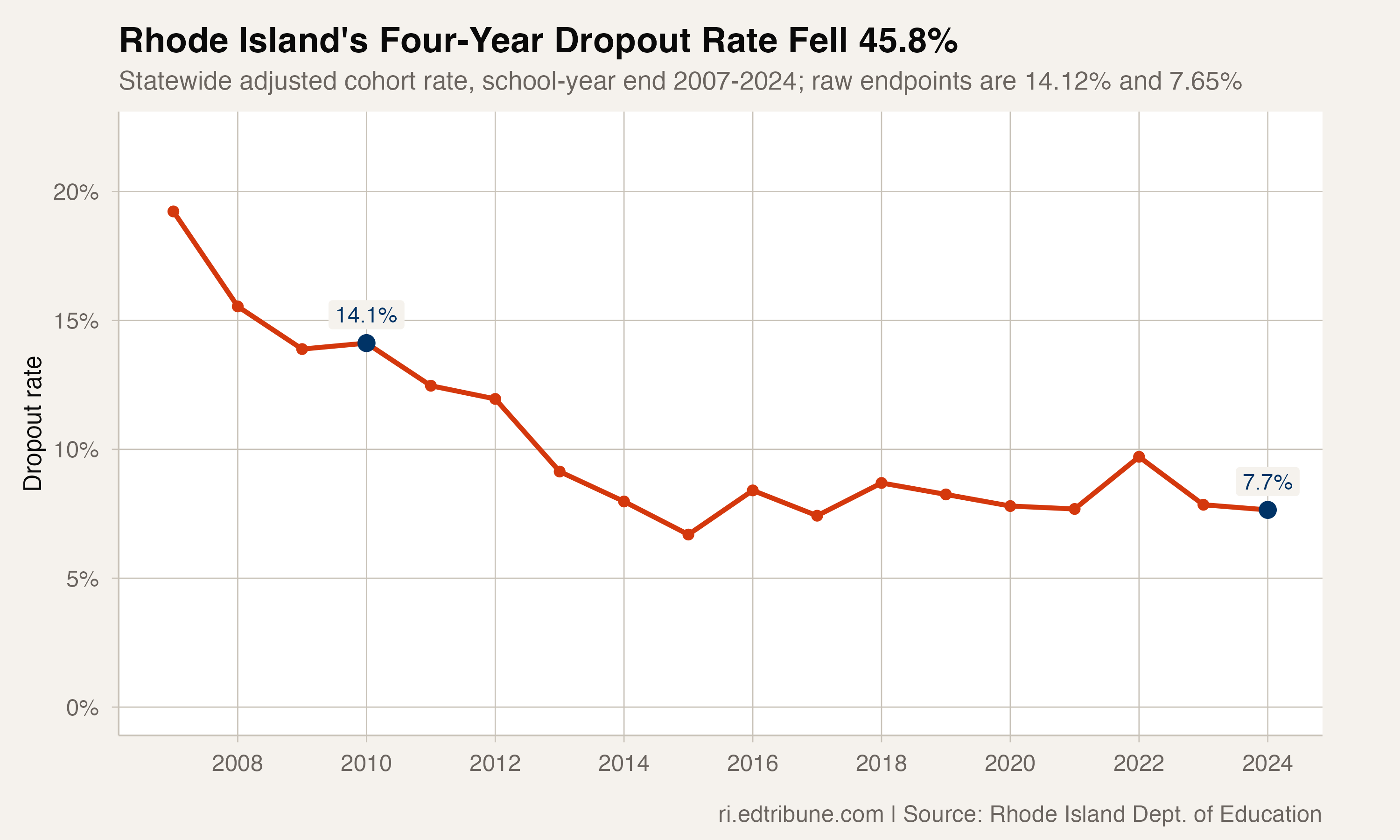
Between the 2010 and 2024 reporting years, Rhode Island's four-year dropout rate fell from 14.12 percent to 7.65 percent. At that displayed precision, that is a 6.47 percentage point decline and a 45.8 percent reduction in the rate—46 percent when rounded to a whole number. Applied to each year's cohort, the estimate fell from 1,761 students to 839, about 922 fewer students dropping out.
The package's 2024 result describes the 2023-24 school year. It is the most recent published graduation result available in the package, not a current 2026-27 outcome.
The measure is part of Rhode Island's four-year adjusted cohort graduation rate, which follows a cohort through four years of high school. Providence↗ET reflects the statewide direction.
Its dropout rate fell from 23.4 percent to 11.2 percent. The estimated number of dropouts there fell from 475 to 204, a reduction of 271. These are estimates produced by applying published rates to published cohort totals; they are not reported headcounts.
Progress with reversals
The statewide decline was not continuous, and 2024 was not a record low. The rate reached 6.7 percent in 2015, then posted year-over-year increases in 2016, 2018 and 2022. It climbed to 9.7 percent in 2022 before returning to 7.65 percent in 2024. Direct evidence: the full 2007-2024 reporting series contains four increases—2010, 2016, 2018 and 2022—and supports a substantial long-run decline, but it does not support an all-time-low or dropout-floor claim.
The cohort also became smaller. It fell from 12,471 students in 2010 to 10,966 in 2024, a decline of 1,505. At the 2024 dropout rate, applying that rate to the larger 2010 cohort would produce an estimate of 954 dropouts, 115 more than the 2024 estimate of 839. Competing explanation: the smaller cohort accounts for about 115 of the estimated count decline, but it cannot explain the lower rate because the published dropout rate itself fell.
Four outcomes, no missing bucket
The earlier draft treated students who neither graduated nor dropped out as an unknown group. Rhode Island's files report two additional outcomes. RIDE's graduation guide identifies them as completing a GED and remaining enrolled beyond the cohort's fourth year.
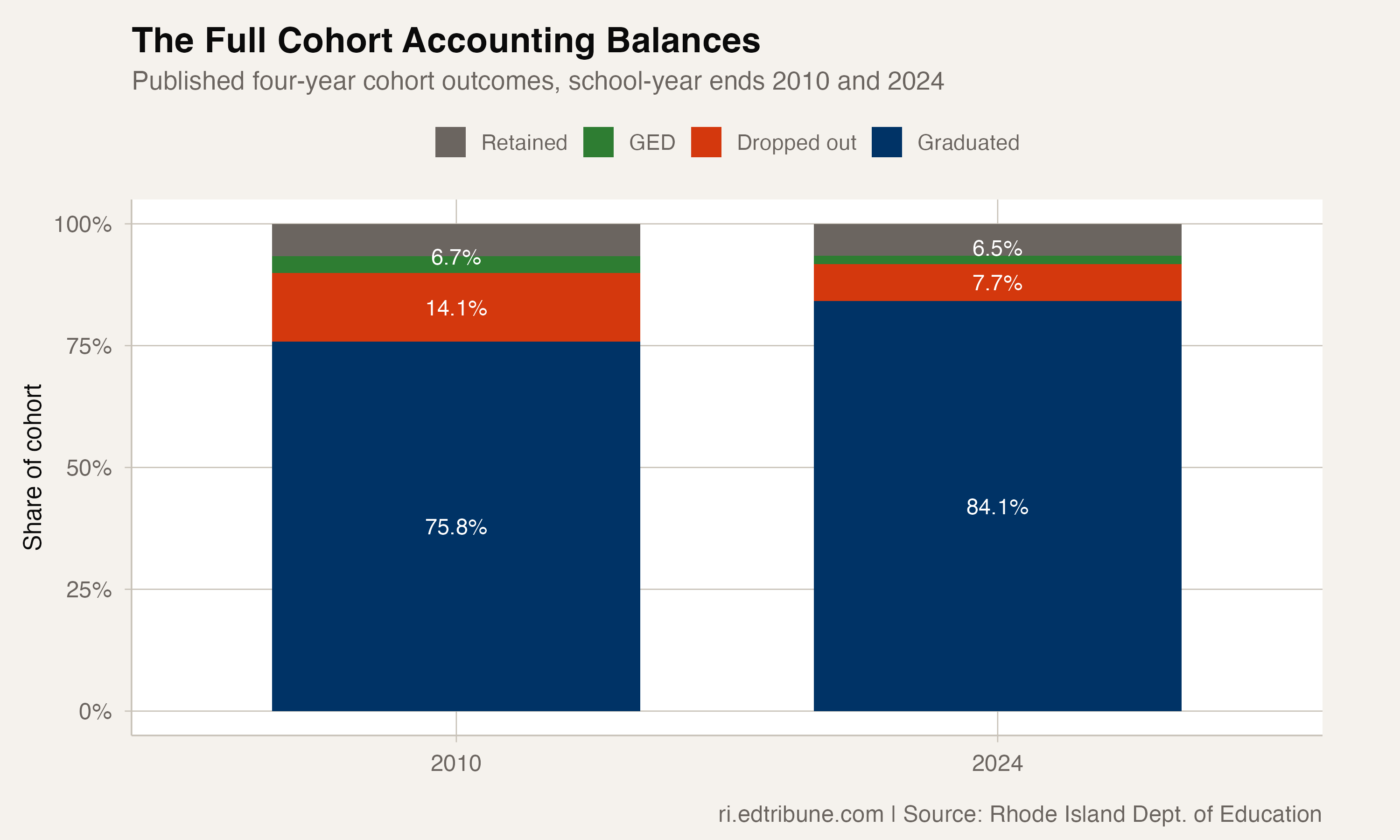
In 2010, 75.8 percent of the cohort graduated, 14.1 percent dropped out, 3.4 percent completed a GED and 6.7 percent remained enrolled. In 2024, the corresponding rates were 84.1 percent, 7.7 percent, 1.7 percent and 6.5 percent. Using the underlying values, the 8.3-point graduation gain matches declines of 6.5 points in dropout, 1.7 points in GED and 0.1 point in retention outcomes, after each result is rounded to one decimal place.
The remaining gaps
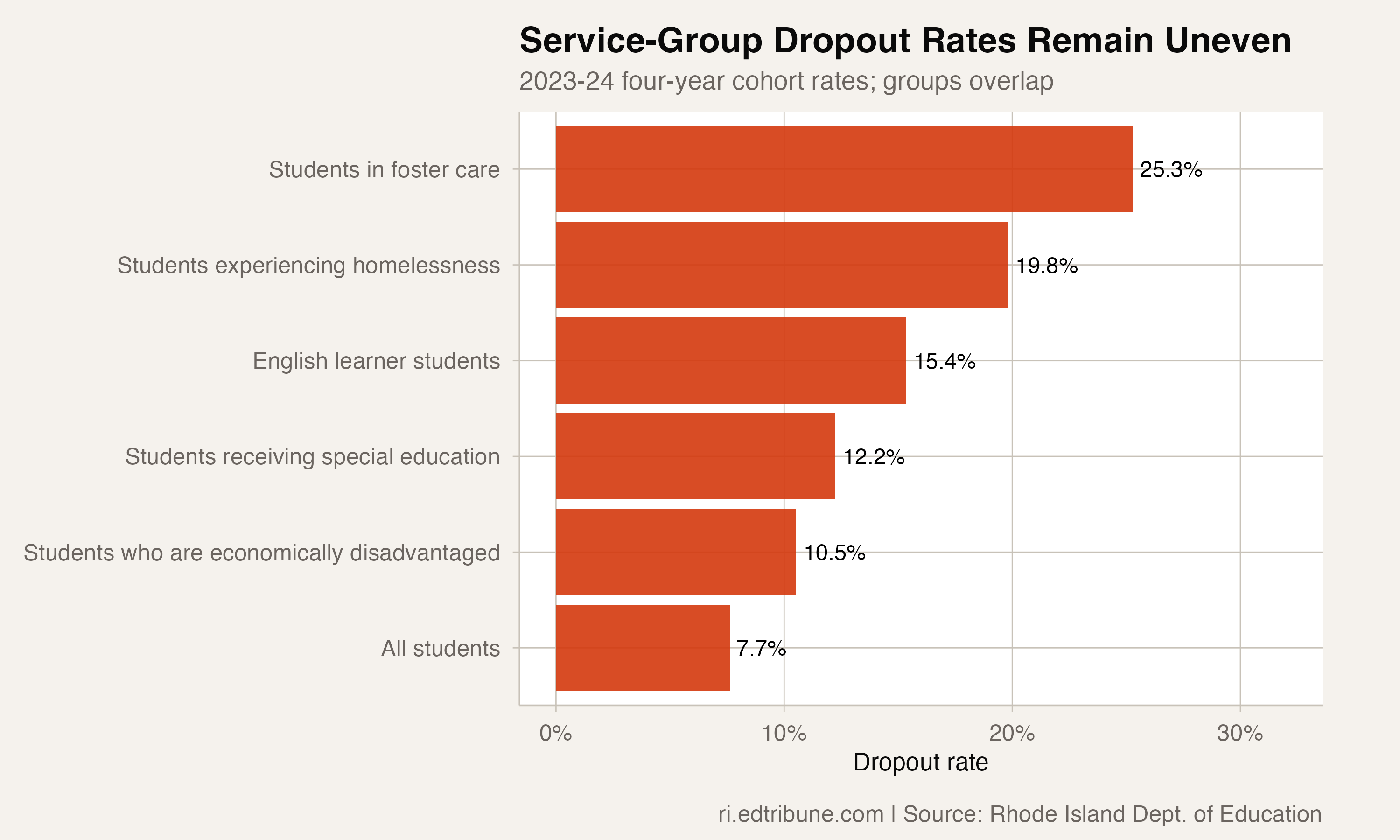
The 2024 reporting-year statewide rate still concealed large differences among service groups. Students in foster care had a 25.3 percent dropout rate, students experiencing homelessness 19.8 percent, English learner students 15.4 percent, students receiving special education 12.2 percent and students who are economically disadvantaged 10.5 percent.
These groups overlap, and their cohort sizes differ. The foster-care rate came from a cohort of 178 students, while the economically disadvantaged group included 6,396. The rates describe unequal risk; they should not be added or treated as equal-sized student counts.
Suggestive context: RIDE's Attendance Matters RI guidance identifies chronic absenteeism as a strong predictor of dropout risk and urges schools to use attendance data for early support. Rhode Island's Alternative Learning Plan framework also gives older students a route to keep working toward a diploma or equivalent while remaining enrolled.
Unresourced: the graduation file does not identify which policies, programs or student circumstances caused the statewide decline. It also cannot link individual attendance histories or Alternative Learning Plan participation to the outcome rates. Rhode Island has already posted a lower statewide dropout rate than the 2024 figure; the unresolved task is to regain that mark while reducing the double-digit rates across the service groups above.
Four-year adjusted cohort outcomes come from RIDE's Enrollment, Dropout, and Graduation Data; the series in this analysis ends with the 2023-24 school year.
Detailed code that reproduces the analysis and figures in this article is available exclusively to EdTribune subscribers.
Discussion
Sign in to join the discussion.
Loading comments...