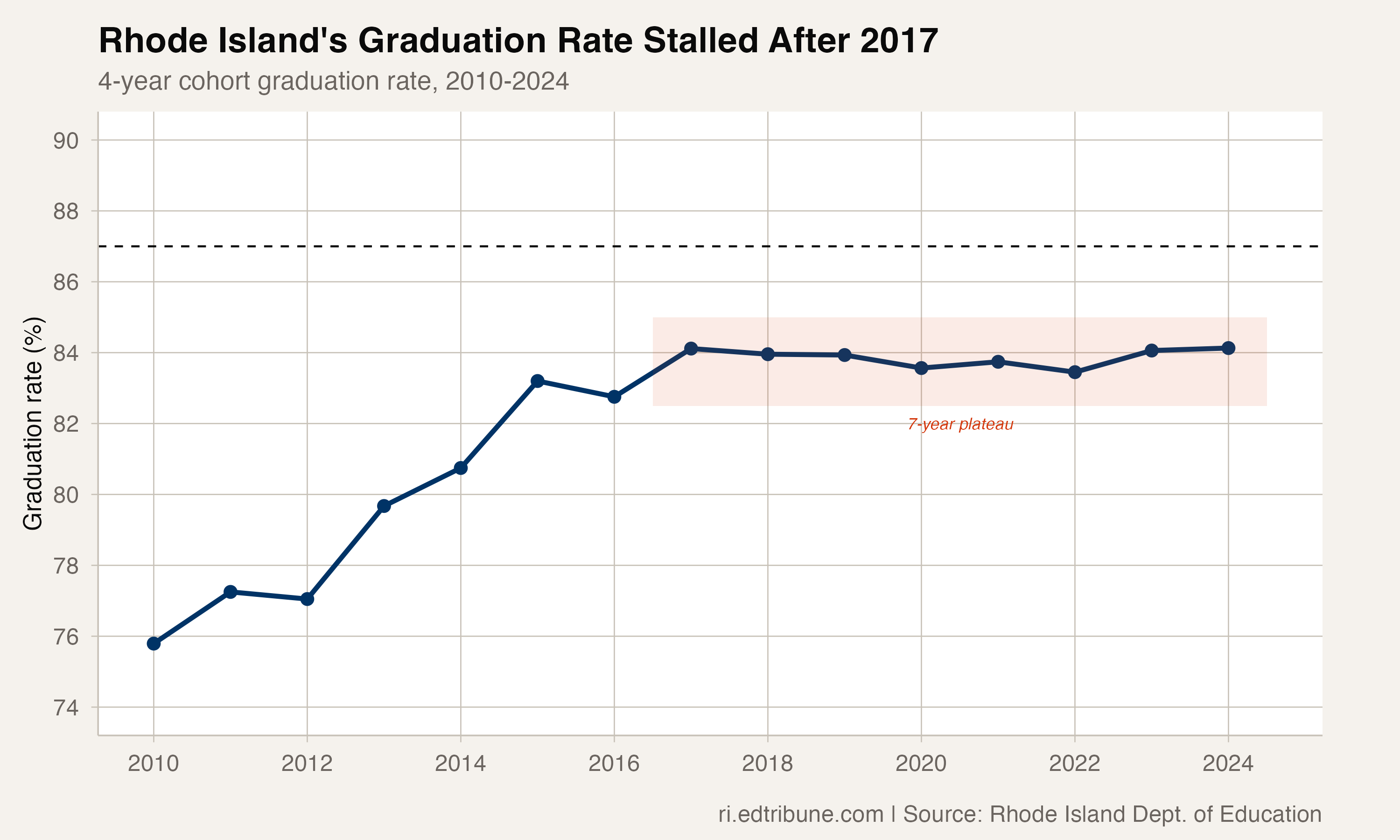
The rapid-improvement era felt inevitable while it lasted. Rhode Island's four-year graduation rate climbed from 75.8 percent in 2010 to 84.1 percent in 2017 — eight points in seven years, powered by new accountability systems, targeted dropout prevention, and an influx of federal school improvement dollars.
Then it stopped.
For seven consecutive years, from 2017 through 2024, the state's graduation rate has oscillated in a narrow band between 83.4 and 84.1 percent. The 2024 rate of 84.1 percent is identical to 2017's. The total variation across seven years is seven-tenths of a percentage point — statistical noise, not progress.
The improvement engine shut off
The numbers tell the story in two acts. From 2010 to 2017, the state added more than a percentage point per year to its graduation rate. Districts hired attendance coaches. Alternative pathways multiplied. The state invested in early warning systems to flag students at risk of dropping out.
Since 2017, the annual change has averaged zero. The rate ticked down to 83.4 percent in 2022, recovered to 84.1 in 2023, and held steady in 2024. At this pace — functionally zero gain per year — the state will not reach 90 percent in any policymaker's lifetime.
Rhode Island's 84.1 percent sits roughly three points below the national average of approximately 87 percent. States like Massachusetts, New Jersey, and Iowa have crossed the 90 percent threshold. Rhode Island has not broken 85 percent once in fifteen years of available data.
A dropout paradox
One of the stranger features of the plateau is that the dropout rate kept improving even as the graduation rate stalled. Rhode Island's four-year dropout rate fell from 14.1 percent in 2010 to 7.7 percent in 2024 — cut nearly in half. If fewer students are dropping out, where are they?
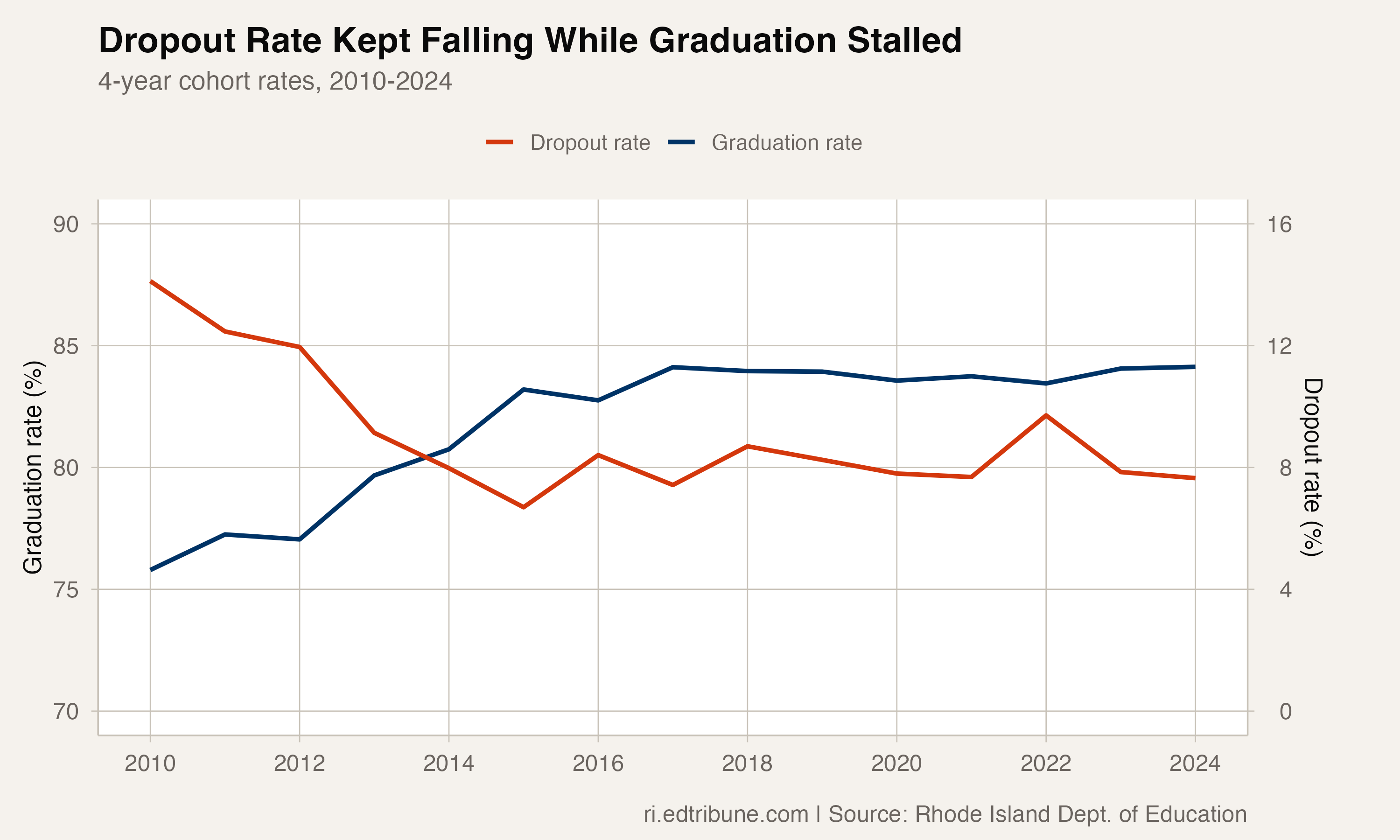
The answer lies in what the state calls the "unaccounted" population — students who neither graduate nor officially drop out within four years. They are retained, transferred, enrolled in alternative programs, or leave the system without formal documentation. In 2024, roughly 8.2 percent of the four-year cohort fell into this category. As the dropout rate shrank, the unaccounted rate held steady, absorbing much of the potential graduation gain.
The year-over-year pattern
Zooming into the annual changes reveals that the plateau is not entirely flat. There were modest gains in 2013, 2015, and 2017, and dips in 2016 and 2022. But nothing since 2017 has produced more than a half-point swing in either direction.
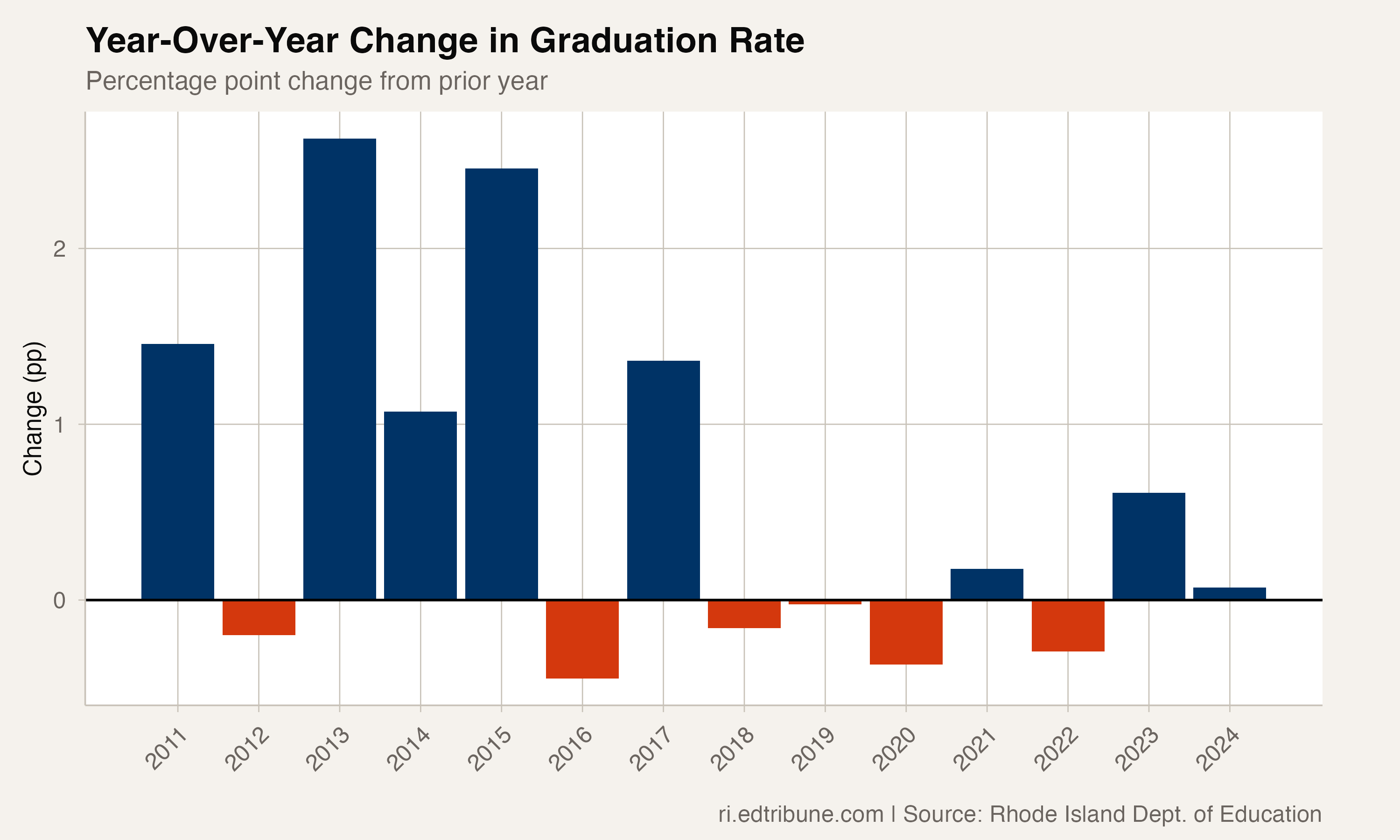
The 2022 dip to 83.4 percent represented the delayed impact of COVID-era disruption — not from the initial pandemic year (the 2020 and 2021 rates were remarkably stable) but from the cohort that started high school in fall 2018 and endured their sophomore year entirely remote. That cohort's recovery to 84.1 percent by 2024 felt like progress but merely returned the rate to its pre-COVID plateau.
What 84 percent means in practice
Behind the percentage is a straightforward count: of the roughly 11,000 students who start a four-year cohort, about 1,750 do not graduate on time. Some will earn a diploma in a fifth or sixth year. Some will earn a GED. Some will disappear from the education system entirely.
The 84 percent figure also masks enormous variation within the state. Suburban districts in the southern and western parts of the state routinely post rates above 93 percent. Urban districts like Central Falls↗ET, Woonsocket↗ET, and Pawtucket↗ET fall well below the state average. The plateau is not a shared experience — it is an average of two Rhode Islands moving in different directions.
What changed in 2017
Several plausible explanations exist for why the improvement engine stalled. The low-hanging fruit of dropout prevention — identifying students who had simply disengaged and reengaging them through alternative programs — was largely picked by 2017. The remaining non-graduates face more complex barriers: housing instability, involvement with the child welfare system, undiagnosed disabilities, and the compounding effects of chronic absenteeism.
Rhode Island's chronic absenteeism rate — the share of students missing 10 percent or more of school days — has remained stubbornly high, with some urban districts above 40 percent. Graduation improvement likely requires solving the attendance crisis first, and that has proven resistant to the same strategies that reduced dropout rates.
New graduation requirements taking effect for the Class of 2028, including additional math coursework and world language study, could push the rate in either direction — raising it if more students are college-ready, or depressing it if the bar proves too high for students already on the margin.
Detailed code that reproduces the analysis and figures in this article is available exclusively to EdTribune subscribers.
Discussion
Sign in to join the discussion.
Loading comments...