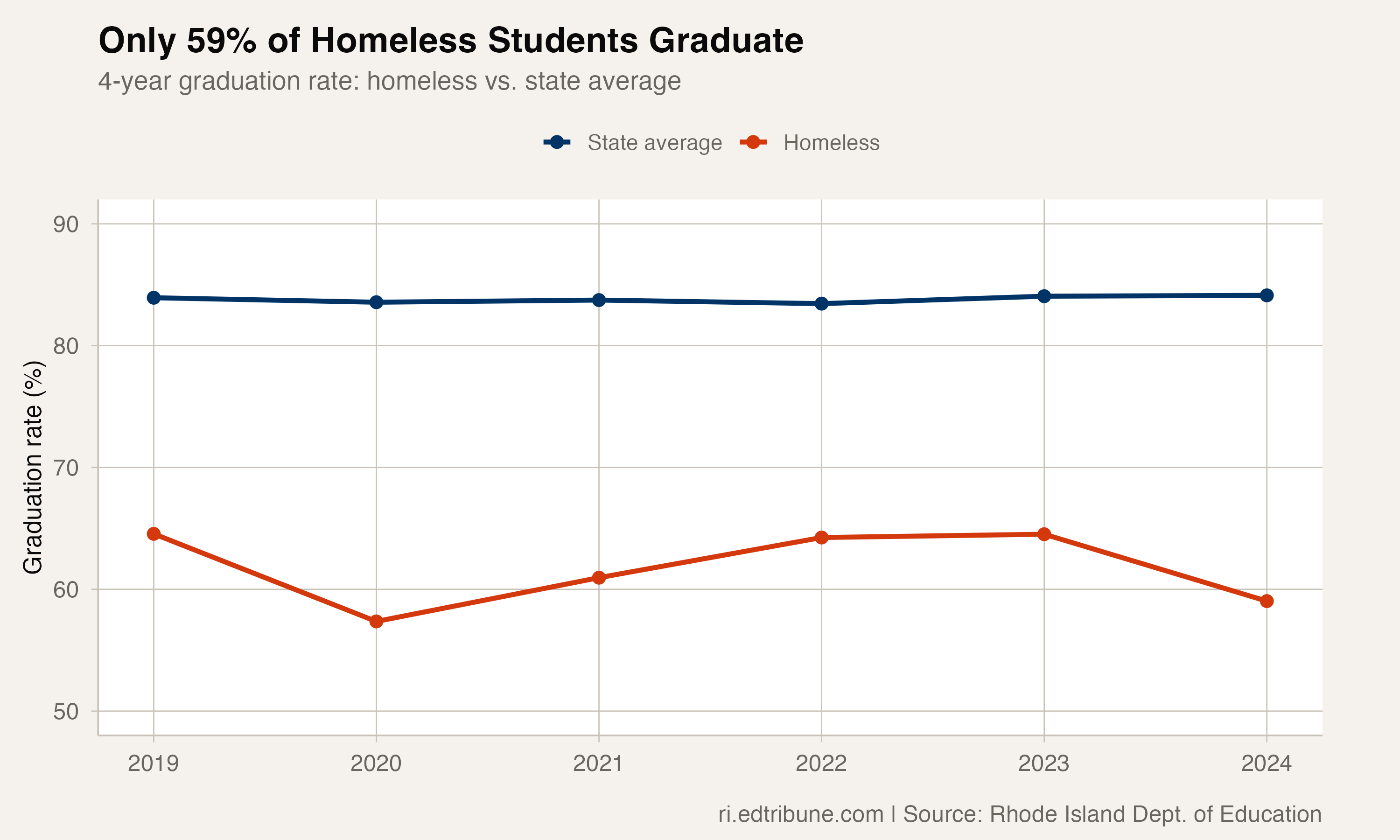
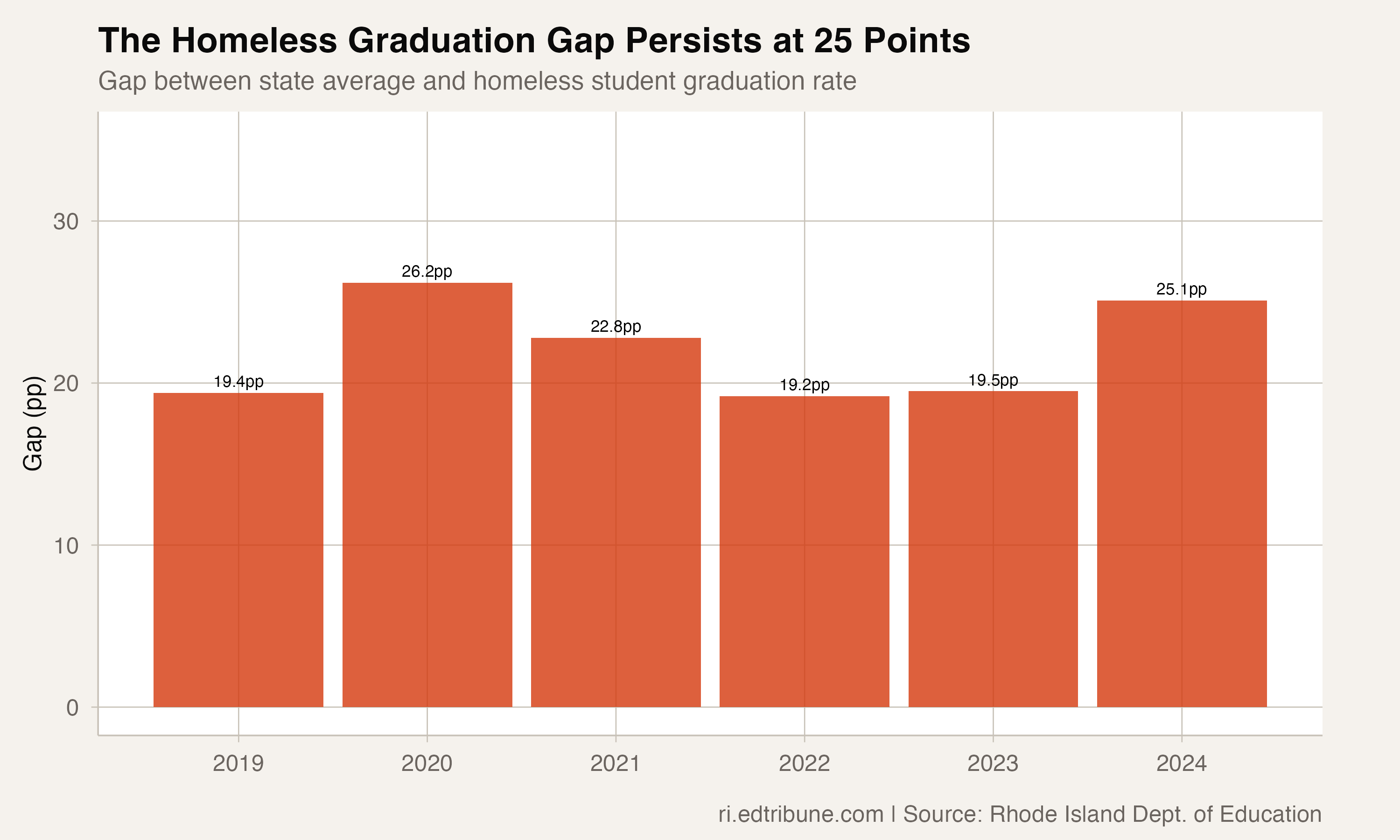
Of the 227 students experiencing homelessness in Rhode Island's 2024 four-year graduation cohort, about 93 did not earn a diploma on time. Their graduation rate of 59.0 percent represents a 25.1 percentage point gap from the 84.1 percent state average — the second-widest gap of any student subgroup, behind only foster care youth.
The rate has not improved since Rhode Island began reporting it in 2019. That first year, 64.6 percent of students who are currently homeless graduated. The rate fell to 57.4 percent in 2020, partially recovered to the low-to-mid 60s in 2021-2023, then dropped back to 59.0 percent in 2024. After six years of data, the trajectory is flat at best.
A gap that refuses to close
The 25.1 percentage point gap in 2024 is actually narrower than the 26.2-point gap in 2020, but wider than the 19.3-point gap in 2019. The variation reflects the small cohort size (189 to 248 students across years) more than any real policy effect. The gap has oscillated between 19 and 26 points without a discernible trend.
The dropout rate for students who are currently homeless tells a more visceral story. At 19.8 percent in 2024, roughly one in five students who are currently homeless dropped out entirely — nearly triple the 7.7 percent statewide rate. Combined with the students who neither graduated nor dropped out, roughly 41 percent of homeless youth in the 2024 cohort did not receive a diploma on time.
The extra year offers partial rescue
Rhode Island's five-year graduation data shows that students who are currently homeless gain 7.7 percentage points with the extra year — the 2024 five-year rate was 66.7 percent compared to the 59.0 percent four-year rate. This gain is the second-largest of any subgroup, behind foster care youth.
The extra year matters because many students who are currently homeless experience disruptions that cost them credits — school changes, extended absences, periods of crisis that make academic work impossible. An additional year allows them to recover lost ground. But 66.7 percent still means a third of students who are currently homeless fail to earn a diploma even with five years.
What homelessness means for students
The federal McKinney-Vento Act defines homelessness broadly for education purposes: students living in shelters, motels, cars, or doubled up with other families due to economic hardship all qualify. In Rhode Island, most students who are currently homeless fall into the "doubled up" category — living temporarily with relatives or friends because their families cannot afford independent housing.
The educational impact is profound. Students who are currently homeless change schools more frequently, miss more days, and carry the cognitive burden of housing instability — the daily uncertainty about where they will sleep disrupts the executive function needed to plan homework, study for tests, and meet deadlines.
RIDE data from the 2022-23 school year showed that 85 percent of all high school dropouts statewide were chronically absent. Students who are currently homeless face the highest chronic absenteeism rates of any subgroup, creating a direct pipeline from housing instability to non-graduation.
The policy response gap
Rhode Island lacks a coordinated strategy for student who is currently homeless graduation. The McKinney-Vento Act requires districts to designate a liaison who ensures students who are currently homeless receive educational services, but the liaison role is often an add-on to another job rather than a dedicated position. Transportation to a school of origin — a right under federal law — is inconsistently provided, particularly for students whose families move across district lines.
Housing vouchers and shelter capacity are outside the education system's control, but they directly affect graduation outcomes. A student who moves from a shelter to stable housing midway through high school has a fundamentally different probability of graduating than one who remains in unstable situations through senior year.
Organizations like the RI Coalition for the Homeless and Amos House have advocated for better coordination between housing services and schools, but the systems operate on different timelines, different funding streams, and different accountability metrics. The education system measures graduation rates. The housing system measures bed nights and placements. Neither fully owns the outcome of the 93 students who are currently homeless who did not graduate in 2024.
Detailed code that reproduces the analysis and figures in this article is available exclusively to EdTribune subscribers.
Discussion
Sign in to join the discussion.
Loading comments...