Central Falls↗ET has been under continuous state control of its schools since 1991, longer than any other district in Rhode Island. Thirty-three years later, fewer than six in ten students are graduating.
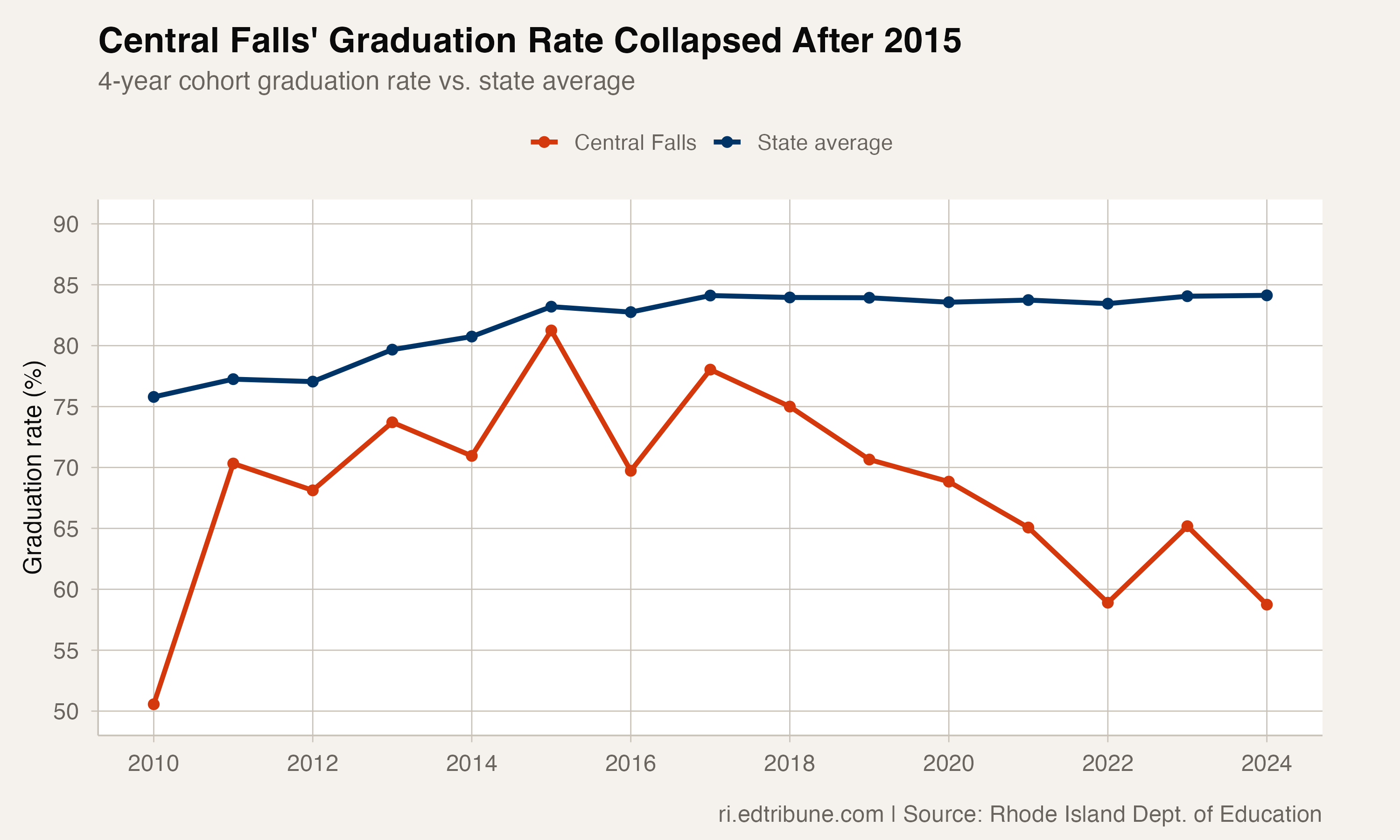
The district's four-year graduation rate hit 81.2 percent in 2015, the high-water mark of a turnaround effort that had lifted the rate from 50.6 percent in 2010. For one year, Central Falls looked like a success story — a small, predominantly Latino district that had clawed its way to within three points of the state average.
Then the floor gave way. The rate dropped to 69.7 percent in 2016, partially recovered to 78.0 in 2017, then entered a sustained decline: 75.0, 70.7, 68.8, 65.1, 58.9, 65.2, and finally 58.7 percent in 2024.
A 22-point fall
The decline from 81.2 to 58.7 percent represents a 22.5 percentage point collapse over nine years. Central Falls now graduates at a rate 25.4 points below the 84.1 percent state average — the widest gap among traditional public school districts in Rhode Island.
The 2024 rate of 58.7 percent means that of the 206 students in the four-year cohort, roughly 85 did not receive a diploma on time. Some will return for a fifth year. Many will not.
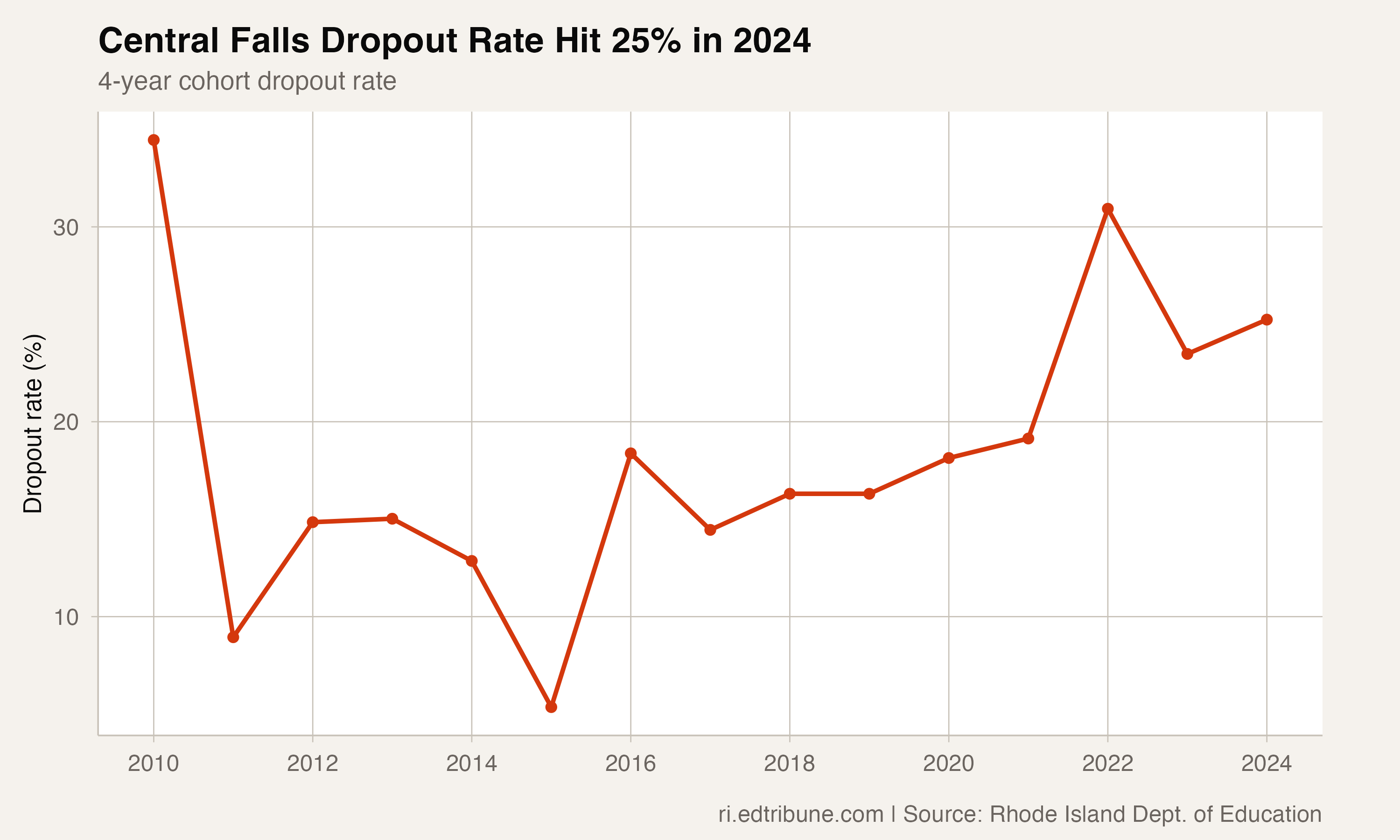
The dropout rate tells an even starker story. In 2024, 25.2 percent of Central Falls' four-year cohort dropped out — one in four students who entered as freshmen in fall 2020 left school entirely before graduation. That dropout rate has more than doubled since the 2015 low of 5.4 percent.
The subgroup picture
The 2024 data reveals graduation disparities within Central Falls that compound the overall crisis. Students with special needs graduated at 48.9 percent, meaning more than half did not earn a diploma in four years. Male students graduated at 53.2 percent compared to 67.1 percent for female students, a 13.9 percentage point gender gap that is more than double the statewide gap.
Hispanic students, who make up the majority of Central Falls' cohort, graduated at 53.7 percent. White students graduated at 61.2 percent, and Black students at 71.4 percent — though the Black cohort of 28 students is small enough that single-year rates should be interpreted cautiously.
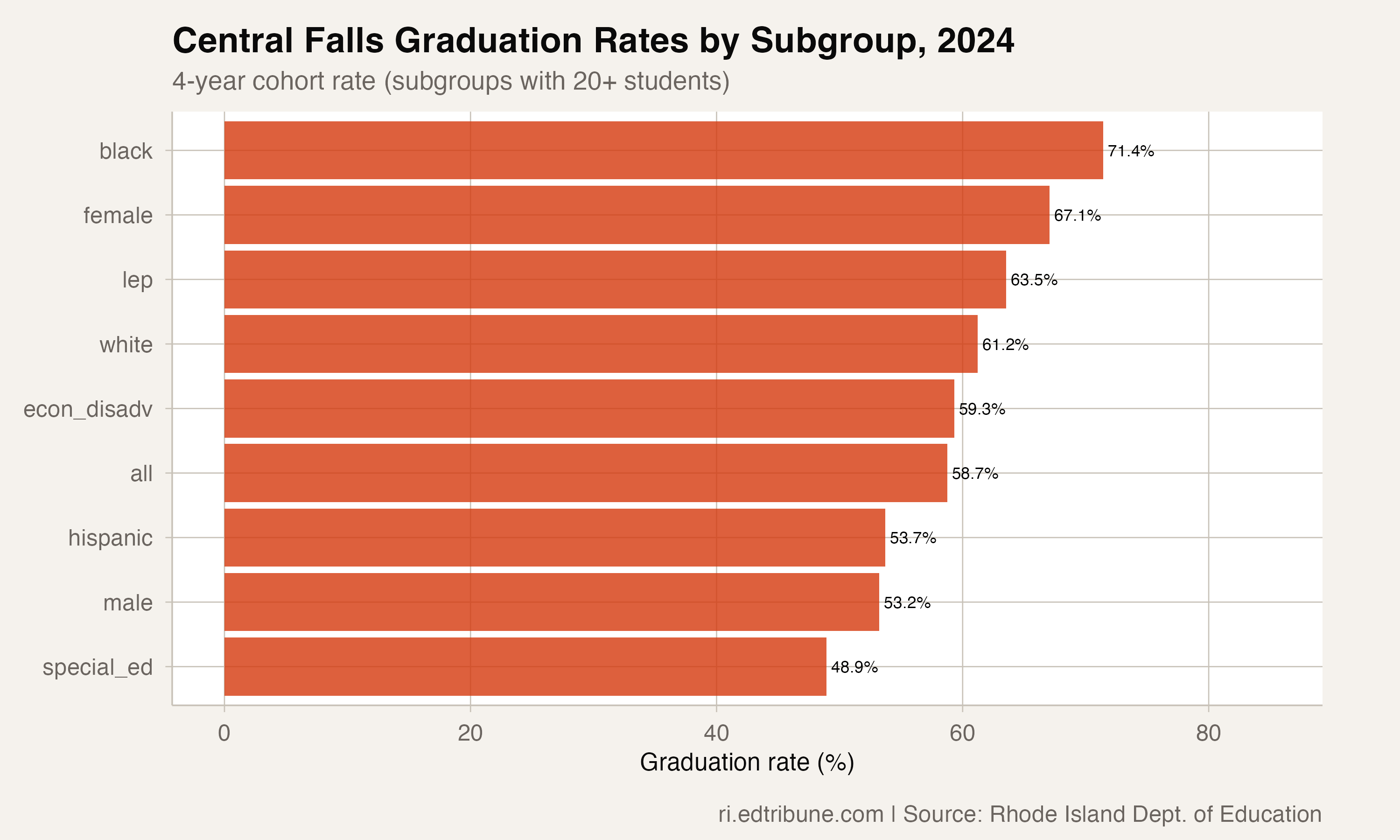
Students classified as Limited English Proficient (LEP) graduated at 63.6 percent, actually higher than the district-wide average. In a district where more than half of families speak a language other than English at home, the multilingual learner population is not the primary driver of the graduation crisis.
Thirty-three years of state control
Rhode Island took over Central Falls' schools in 1991 after years of fiscal mismanagement and declining performance. The state appointed administrators, restructured leadership, and — in 2010 — fired the entire teaching staff at Central Falls High School in a move that drew national attention and a visit from President Obama.
The firing was followed by a negotiated rehab plan, new hires, and significant investment. The graduation rate climbed 30 points in five years. But the gains proved fragile. The structural challenges that led to state takeover in the first place — concentrated poverty, a transient population, limited local tax base — never went away.
In October 2024, Mayor Maria Rivera released a report documenting what she called "systemic failures" in the district under state management. The report called for an end to the 33-year takeover, arguing that state control had not produced lasting improvement and had disconnected the community from its schools. RIDE's accountability data shows that only 6.3 percent of Central Falls students in grades 3-8 met ELA proficiency standards — a number that forecasts continued graduation struggles for years to come.
What went wrong after 2015
Several factors converged to reverse the gains. The cohort of teachers hired after the 2010 mass firing experienced high turnover — by 2018, many had left for higher-paying districts. Federal school improvement grants that funded the turnaround effort expired. Chronic absenteeism, already high, worsened during and after the pandemic.
Central Falls is the smallest and densest city in Rhode Island, a 1.3-square-mile community where roughly four in ten children live in poverty, according to U.S. Census data. The district serves a heavily immigrant population, with many families from Guatemala, the Dominican Republic, and Colombia. Student mobility is high; families move frequently as housing costs shift, disrupting the continuity that graduation requires.
The pandemic did not cause Central Falls' decline — the rate was already falling before COVID — but it accelerated the trajectory. The 2022 rate of 58.9 percent reflected a cohort that spent its sophomore year remote and returned to a high school still struggling with staffing and chronic absenteeism.
The question of accountability
Central Falls' collapse raises an uncomfortable question about state intervention as a strategy. If 33 years of state control produces a 58.7 percent graduation rate, what exactly has the intervention accomplished?
Proponents argue that Central Falls would be worse without state management — that the pre-takeover district was heading toward complete institutional failure. Critics, including Mayor Rivera, counter that the state has substituted one form of dysfunction for another, and that community governance, however imperfect, would generate the local investment and engagement that sustained improvement requires.
The 2024 data supports neither narrative cleanly. Central Falls is graduating 8 points more of its students than it was in 2010, but 22 points fewer than its 2015 peak. The trajectory is what matters most, and that trajectory points steeply downward.
Detailed code that reproduces the analysis and figures in this article is available exclusively to EdTribune subscribers.
Discussion
Sign in to join the discussion.
Loading comments...