Of the 178 foster youth in Rhode Island's 2024 graduating cohort, roughly 100 never received a diploma.
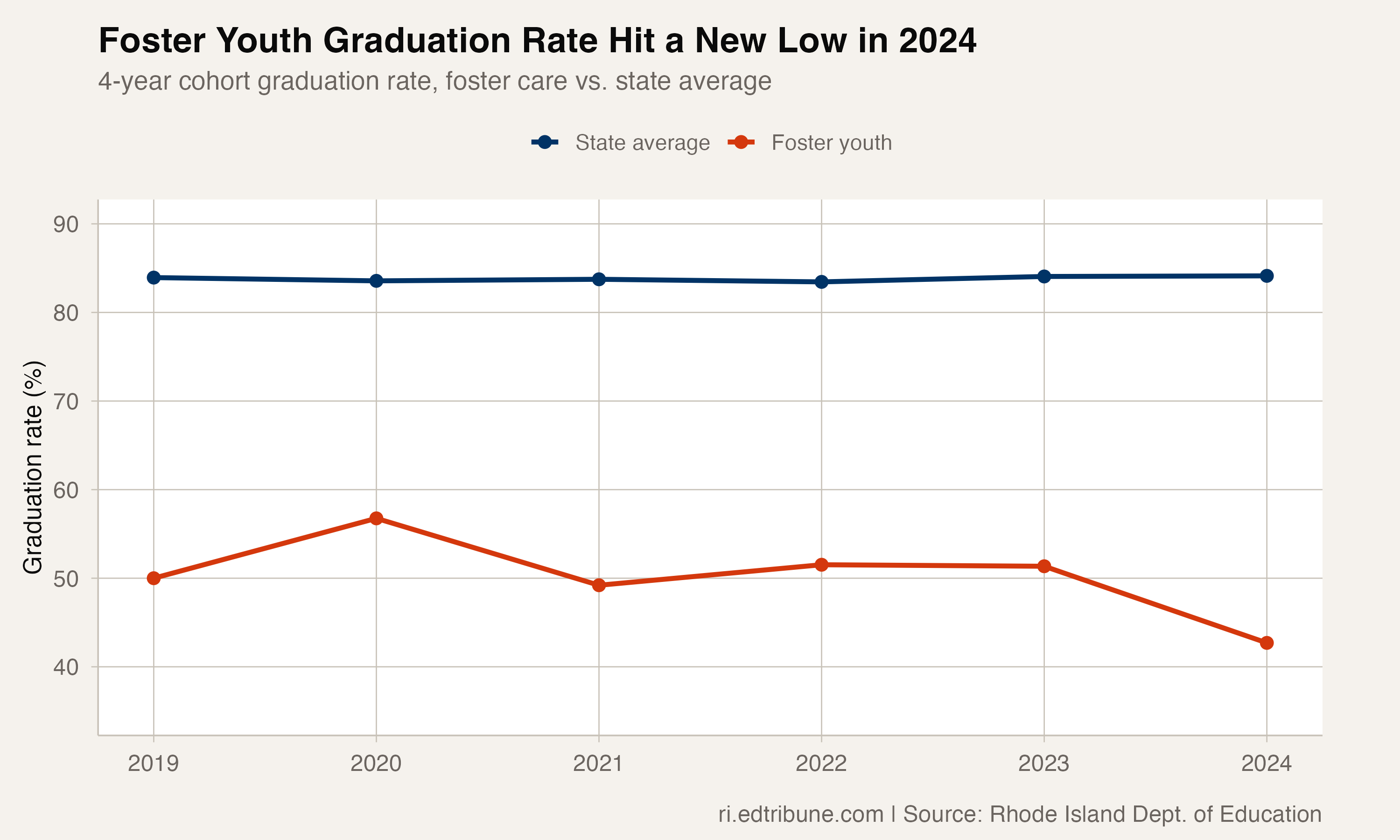
The state's four-year graduation rate for students in foster care fell to 42.7 percent in 2024, a new low in the six years the state has reported the figure. That is an 8.7 percentage point drop from 51.4 percent in 2023, and it opens a 41.4-point chasm between foster youth and the 84.1 percent statewide average — the widest gap of any student subgroup Rhode Island tracks.
A worsening trajectory
The foster care graduation rate has never been good. When Rhode Island began reporting it separately in 2019, the rate was 50.0 percent. It improved briefly to 56.8 percent in 2020, then began a descent: 49.2 percent in 2021, a partial recovery to 51.5 in 2022 and 51.4 in 2023, then the sharp drop to 42.7 percent in 2024.
The one-year decline of 8.7 percentage points is the largest single-year drop for any of Rhode Island's major demographic subgroups in the 2024 data, surpassing the next-largest drop — for students who are currently homeless, at 5.5 points. For a foster-youth cohort of 178 students, it translates to roughly 15 additional young people who did not graduate compared to the prior year's rate.
One in four foster youth in the 2024 cohort dropped out entirely — the dropout rate of 25.3 percent is more than three times the statewide average of 7.7 percent. Another 32 percent fell into neither category: they did not graduate on time and did not formally drop out, instead lingering in the system, transferring, or aging out.
The fifth year helps, but not enough
Rhode Island's five-year graduation rate offers foster youth a partial reprieve. The 2024 five-year rate for foster care students was 51.3 percent, an 8.6 percentage point gain over the four-year rate. That extra year allows students who missed time due to placement changes, school transfers, or emotional disruption to finish their requirements.
But 51.3 percent still means nearly half of foster youth fail to earn a diploma even with an extra year. And the five-year rate captures a different cohort — the students who entered high school five years earlier faced a different set of circumstances than the current four-year cohort.
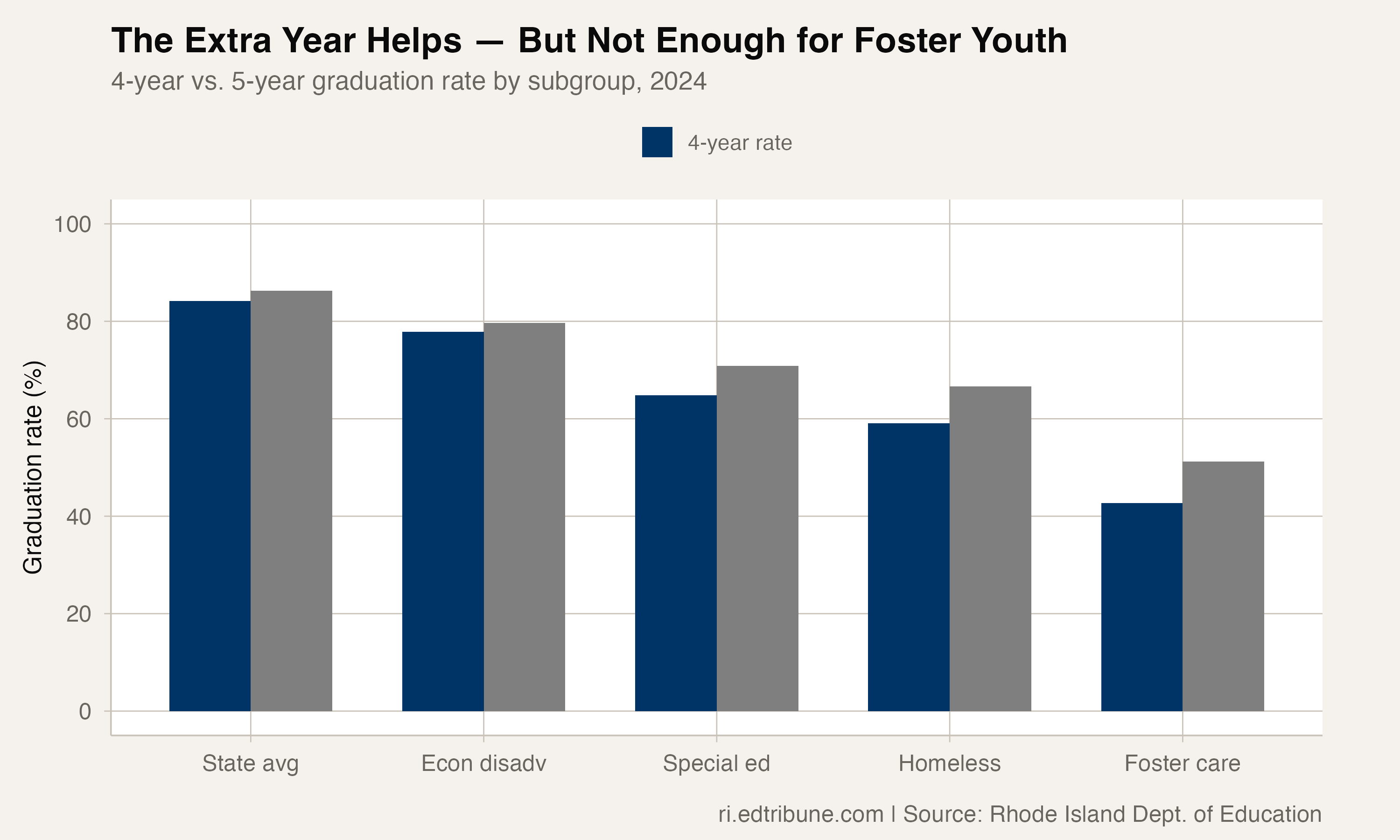
The pattern is consistent across vulnerable populations: students in foster care gain the most from the extra year (8.6 points), followed by students who are currently homeless (7.6 points) and students receiving special education services (6.0 points). The statewide average gains only 2.2 points. The four-year timeline is structurally mismatched for students whose schooling is interrupted by placement changes, court dates, and instability outside their control.
Why foster youth struggle
The barriers facing students in foster care are well documented, though that documentation has not translated into solutions. Placement changes trigger school changes — and research consistently finds that each school change costs a student four to six months of academic progress. A student who changes placements twice in a school year may lose an entire year of learning.
Rhode Island's Department of Children, Youth and Families oversees roughly 2,000 children in care at any given time. The education system and the child welfare system operate on parallel tracks with limited coordination. Case workers prioritize placement stability and safety; school counselors focus on credits and attendance. Neither system fully owns the graduation outcome.
Chronic absenteeism compounds the problem. RIDE data shows that 85 percent of all high school dropouts statewide were chronically absent, and foster youth experience the highest chronic absenteeism rates of any subgroup — driven by court dates, placement transitions, and the trauma responses that make showing up to school each day feel impossible.
A legislative response
In 2025, Rhode Island's General Assembly created a 17-member Special Legislative Commission to study educational outcomes for foster youth. The commission includes legislators, DCYF representatives, RIDE officials, foster care alumni, and education advocates. Its charge is to identify systemic barriers and recommend policy changes.
The commission's work comes at a moment when the data demands urgency. The 42.7 percent rate means Rhode Island is failing a majority of its most vulnerable students, and the trend is moving in the wrong direction.
Organizations like Foster Forward RI have advocated for stronger educational stability provisions — including the right to remain in a school of origin after a placement change and automatic transportation to that school. Federal law under the Every Student Succeeds Act requires such provisions, but implementation varies by district and placement.
What 42.7 percent means
Behind the statistic are 178 young people navigating adolescence without stable family support, many carrying the weight of adverse childhood experiences that would challenge any student. That 76 of them earned a diploma is, in some ways, remarkable. That 102 did not is a failure of the systems designed to protect them.
A 17-member commission cannot, on its own, knit DCYF and RIDE into a single accountable system. But the 2024-25 data is impossible to soften. One hundred and two foster youth in the 2024 graduating cohort left high school without a diploma. The commission's first deliverable will tell Rhode Islanders whether the next cohort's number is meant to be smaller — and who is on the hook if it is not.
Detailed code that reproduces the analysis and figures in this article is available exclusively to EdTribune subscribers.
Discussion
Sign in to join the discussion.
Loading comments...