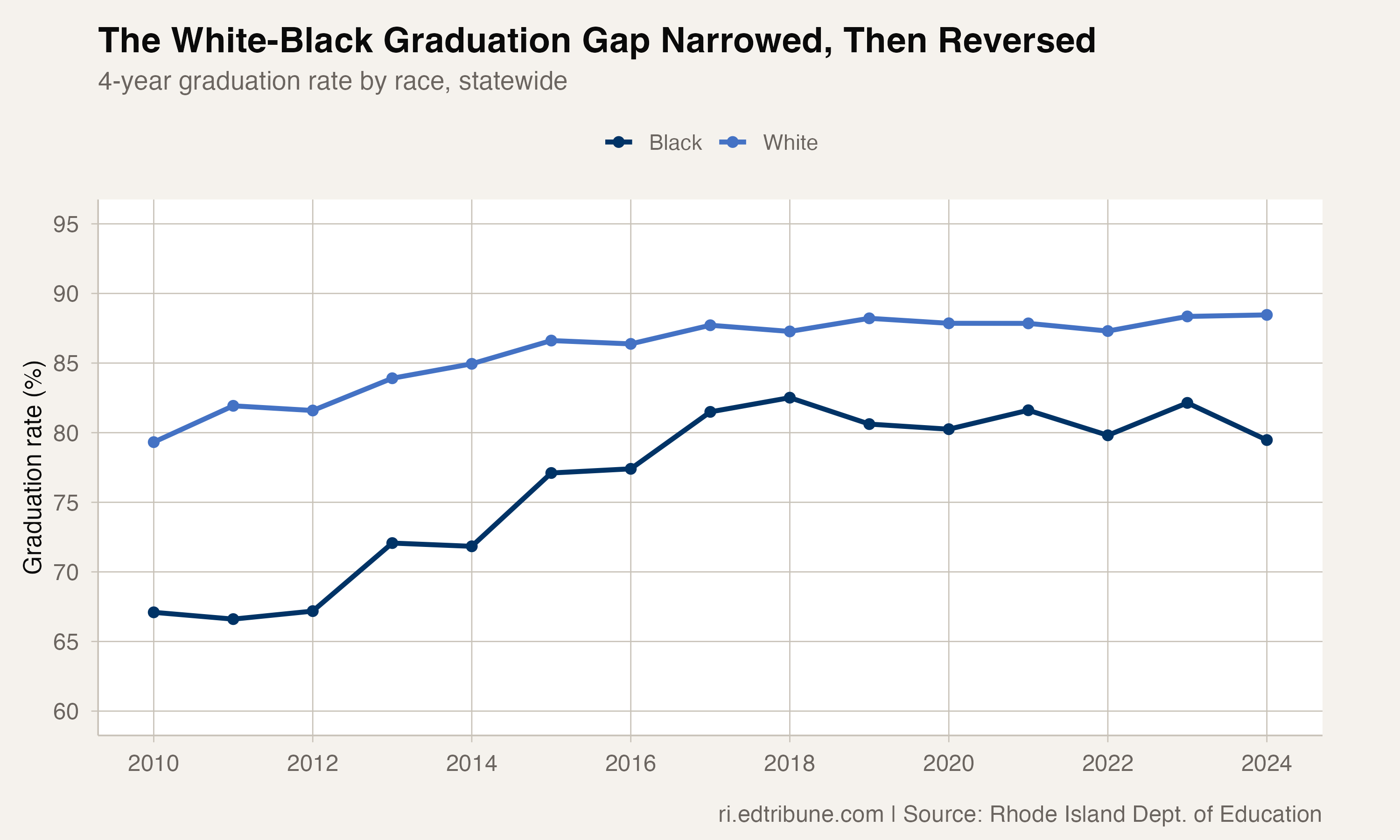
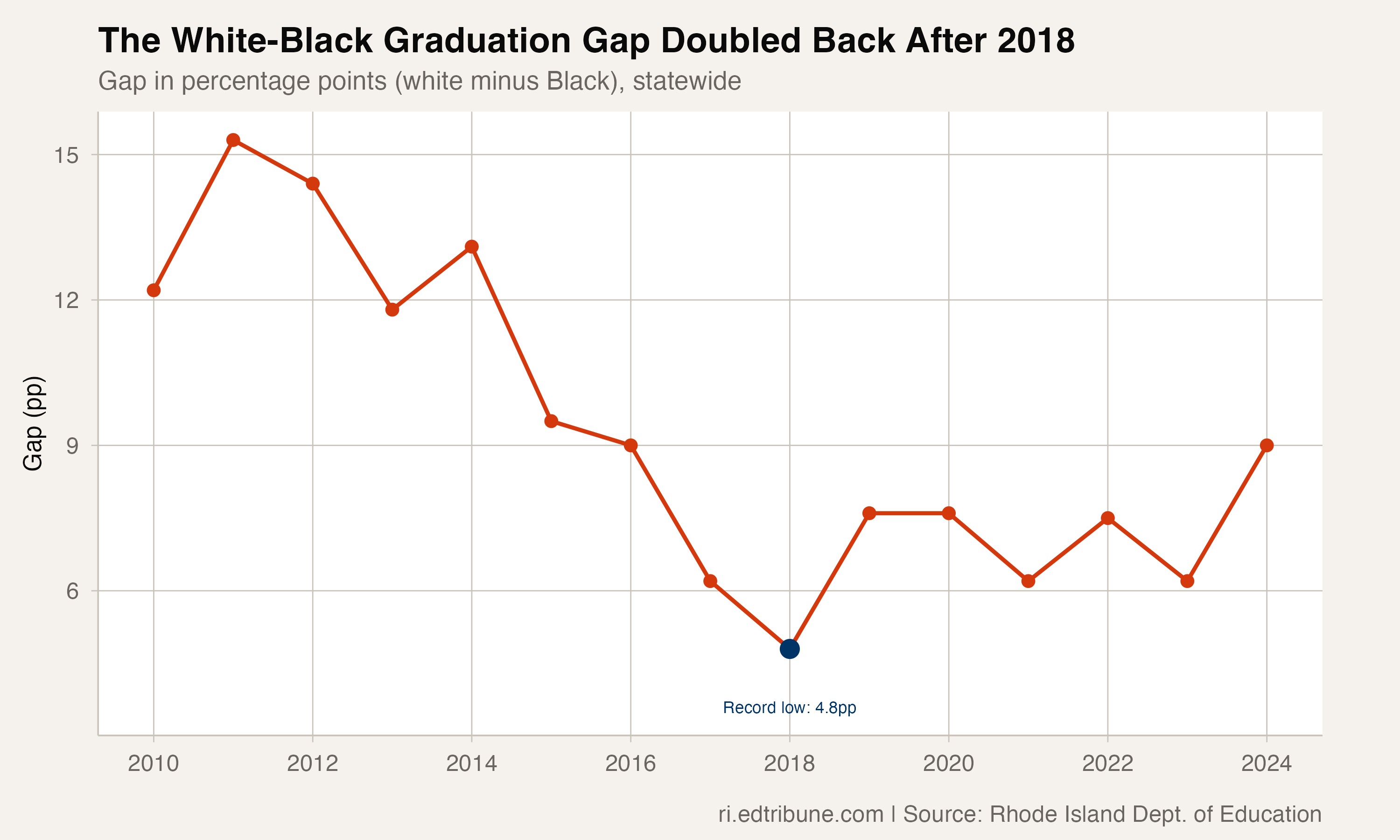
For eight years, the numbers told a hopeful story. Rhode Island's white-Black graduation rate gap stood at 12.2 percentage points in 2010, with white students at 79.3 percent and Black students at 67.1 percent. By 2018, that gap had narrowed to 4.8 points, the smallest on record, as Black students' rates climbed steadily from the mid-60s to 82.5 percent.
Then the progress reversed.
By 2024, the gap had widened back to 9.0 percentage points. White students reached 88.5 percent; Black students sat at 79.5 percent. Six years of backsliding erased more than half the gains of the preceding eight.
The anatomy of a reversal
The gap closed from 2010 to 2018 because Black students were improving faster than white students. Black graduation rates rose 15.4 points over that span, from 67.1 to 82.5 percent. White rates rose 8.0 points, from 79.3 to 87.3 percent. The gap narrowed because the floor was rising faster than the ceiling.
After 2018, Black students' rates stopped climbing. The rate oscillated between 79.5 and 82.1 percent for six years, never returning to the 2018 peak. White students, meanwhile, continued a slow ascent to 88.5 percent in 2024. Black students didn't lose much ground after the peak. They plateaued, while white students kept climbing, and the gap widened.
What happened after 2018
Several factors may explain why Black students' graduation rates plateaued. The most direct is that the easiest gains were made first. The students who were closest to graduating, those a credit or a single intervention away, were captured by the dropout prevention and alternative pathway programs that drove the 2010-2018 improvement.
The remaining non-graduates face more entrenched barriers. Research from the Annenberg Institute at Brown University, located in Providence, has documented how chronic absenteeism, housing instability, and involvement with the juvenile justice system create compounding obstacles that no single program can address.
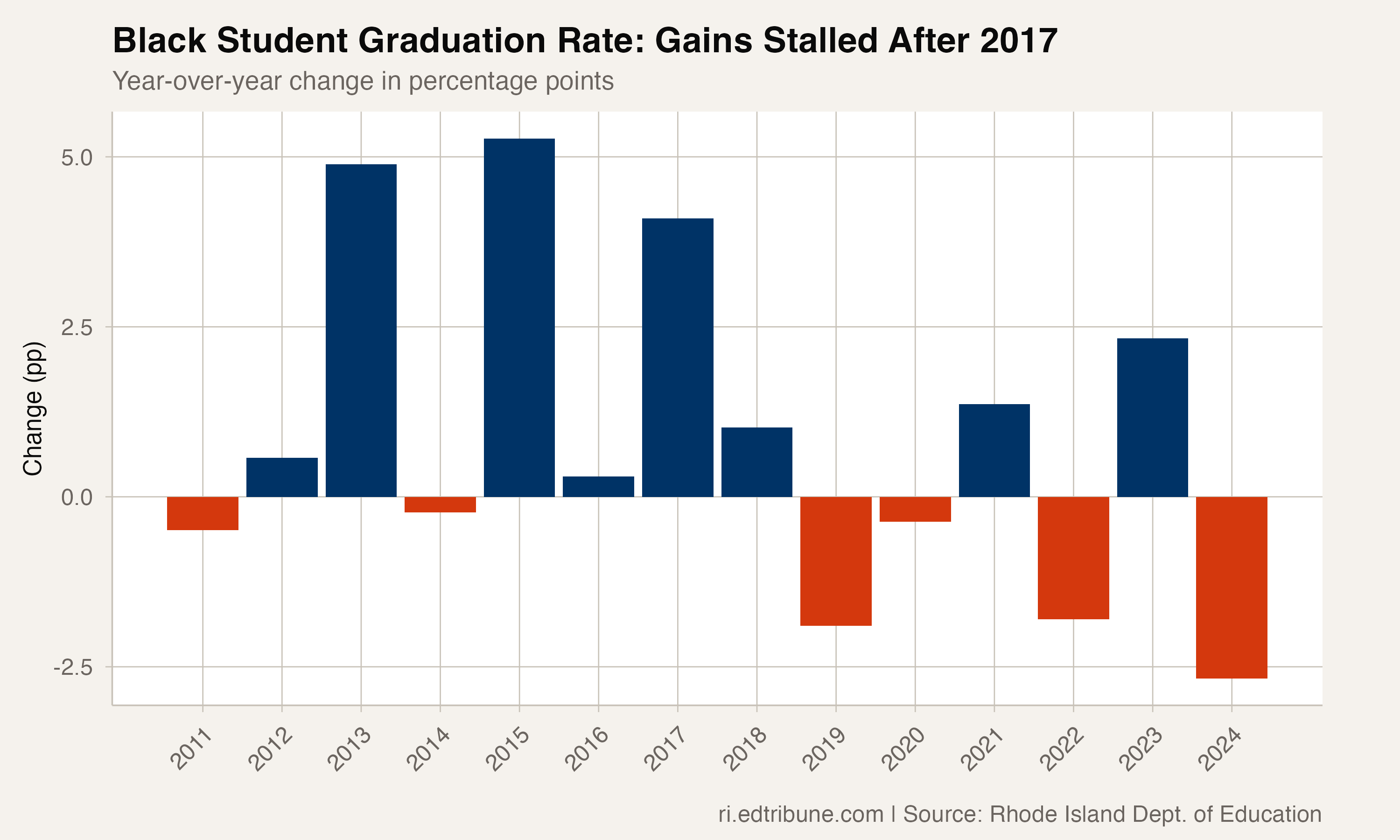
COVID also played a role, though not in the obvious way. Rhode Island's statewide graduation rate was remarkably stable during the pandemic years of 2020 and 2021. The state maintained test-optional graduation pathways and expanded credit recovery programs. But the cohort that entered high school in 2018-19 and graduated in 2022 showed a pronounced dip, and the Black student rate dropped to 79.8 percent that year, its lowest since 2016.
The comparison that matters
A 9.0 percentage point gap sounds modest compared to other equity metrics in American education. But in graduation rates, where the top end is compressed (you cannot graduate at 110 percent), a 9-point gap is a large difference in outcomes. It means that for every 100 Black students who enter a Rhode Island high school, roughly 9 fewer will earn a diploma in four years compared to a cohort of 100 white students.
The cohort sizes add weight to the numbers. Rhode Island's 2024 four-year graduation cohort included 5,799 white students and 1,028 Black students. The Black cohort is small enough that targeted interventions could meaningfully move the rate, but large enough that the gap is a real structural pattern, not a small-sample artifact.
The Hispanic comparison
While the white-Black gap reversed, the white-Hispanic gap has been quietly closing. Hispanic students graduated at 78.7 percent in 2024, up from 66.3 percent in 2010, a 12.4-point improvement. The white-Hispanic gap narrowed from roughly 13 points to 9.8 points over the same period.
The divergent trajectories suggest that the forces holding back Black graduation rates since 2018 are not simply the forces that affect all students of color. Hispanic students continued gaining ground during the same period that Black students stalled. Understanding why requires looking beyond race to the specific communities, schools, and circumstances that shape outcomes for Black students in Rhode Island, a state where the Black population is concentrated in Providence, Central Falls, and a handful of other urban centers.
What closing the gap would require
Returning to the 2018 gap of 4.8 points from the current 9.0 points would require Black graduation rates to rise to roughly 83.7 percent, assuming white rates hold steady at 88.5 percent. That is a 4.2-point increase from the current 79.5 percent, roughly equivalent to graduating 43 additional Black students per year from a cohort of about 1,028.
Closing that 4.2-point gap means reaching the students whose obstacles sit outside the classroom: unstable housing, untreated health needs, and limited paths from a diploma to a first job. The 2018 peak showed the work can move. The six years since show how easily it stalls.
Detailed code that reproduces the analysis and figures in this article is available exclusively to EdTribune subscribers.
Discussion
Sign in to join the discussion.
Loading comments...