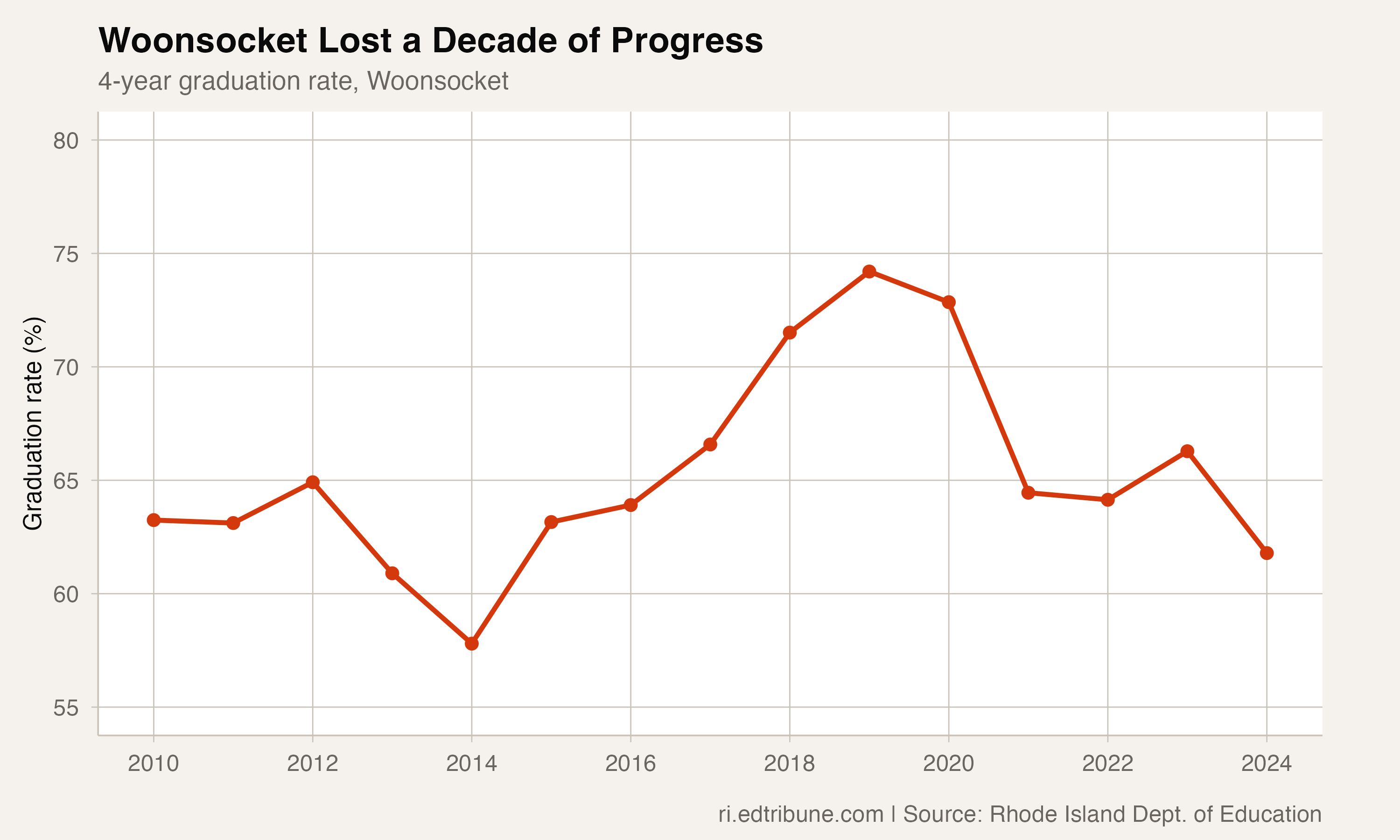
Woonsocket↗ET spent ten years building something. From 2010 to 2019, the district's four-year graduation rate climbed from 63.2 percent to 74.2 percent, an 11-point improvement won through new alternative pathways, expanded credit recovery, and a city that believed its schools were turning a corner.
It took three years to lose nearly all of it.
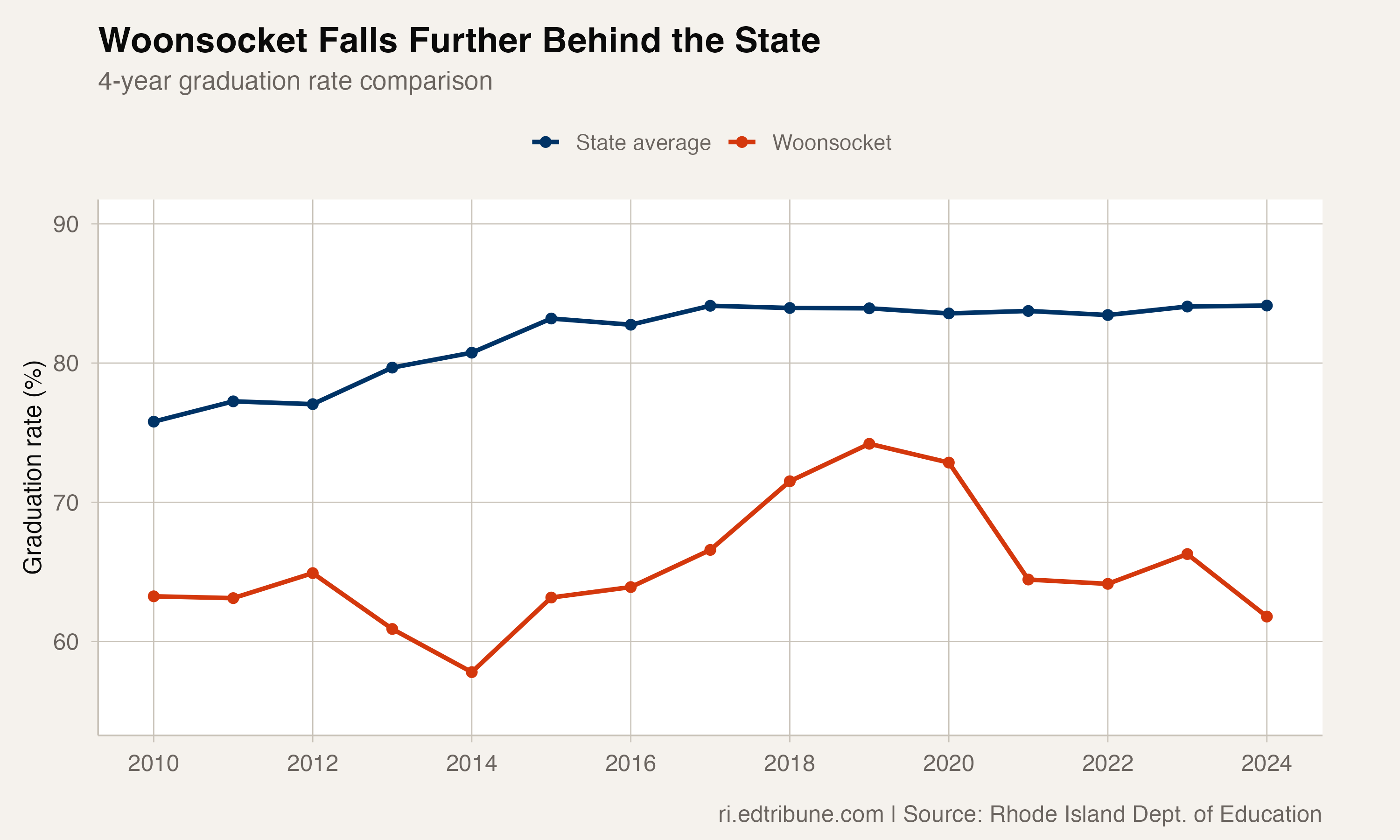
By 2021, the rate had fallen to 64.4 percent. By 2024, it hit 61.8 percent, below where the district started in 2010. The 12.4 percentage point collapse from the 2019 peak represents the sharpest decline among Rhode Island's large districts, and it shows no sign of reversing.
The shape of the decline
The trajectory follows a familiar pattern for struggling urban districts: slow, hard-won gains wiped out by a cascade of compounding crises. Woonsocket's graduation rate peaked at 74.2 percent in 2019, the last pre-pandemic year. The initial COVID impact was modest: 72.9 percent in 2020, a 1.3-point dip. The real damage came in 2021 and 2022, when the rate cratered to 64.4 and 64.1 percent respectively.
The 2023 rate of 66.3 percent offered a glimmer of recovery. The 2024 rate of 61.8 percent extinguished it.
Of the 369 students in the 2024 four-year cohort, roughly 141 did not graduate on time. Woonsocket's dropout rate of 16.3 percent (more than double the 7.7 percent state average) means about 60 of those students left school entirely.
Budget crisis and staff losses
The graduation collapse did not happen in isolation. Woonsocket has faced recurring budget shortfalls driven by flat state aid, declining enrollment, and rising fixed costs. In 2025, the district laid off 31 staff members (teachers, counselors, and support staff) to close a budget gap.
For a district where dropout prevention depends on personal relationships between students and adults, losing 31 positions is not a line-item reduction. It is the removal of the connective tissue that keeps vulnerable students in school. The counselor who notices a student has been absent for a week, the teacher who stays after school for tutoring, the administrator who calls a parent. These are the interventions that graduation rates are built on, and they require people.
Chronic absenteeism has compounded the crisis. In the 2022-23 school year, 47.2 percent of Woonsocket students were chronically absent, nearly half the student body missing 10 percent or more of school days. Research consistently shows that chronic absenteeism is the single strongest predictor of non-graduation, and Woonsocket's absenteeism rates forecast continued struggles for years to come.
The dropout reality
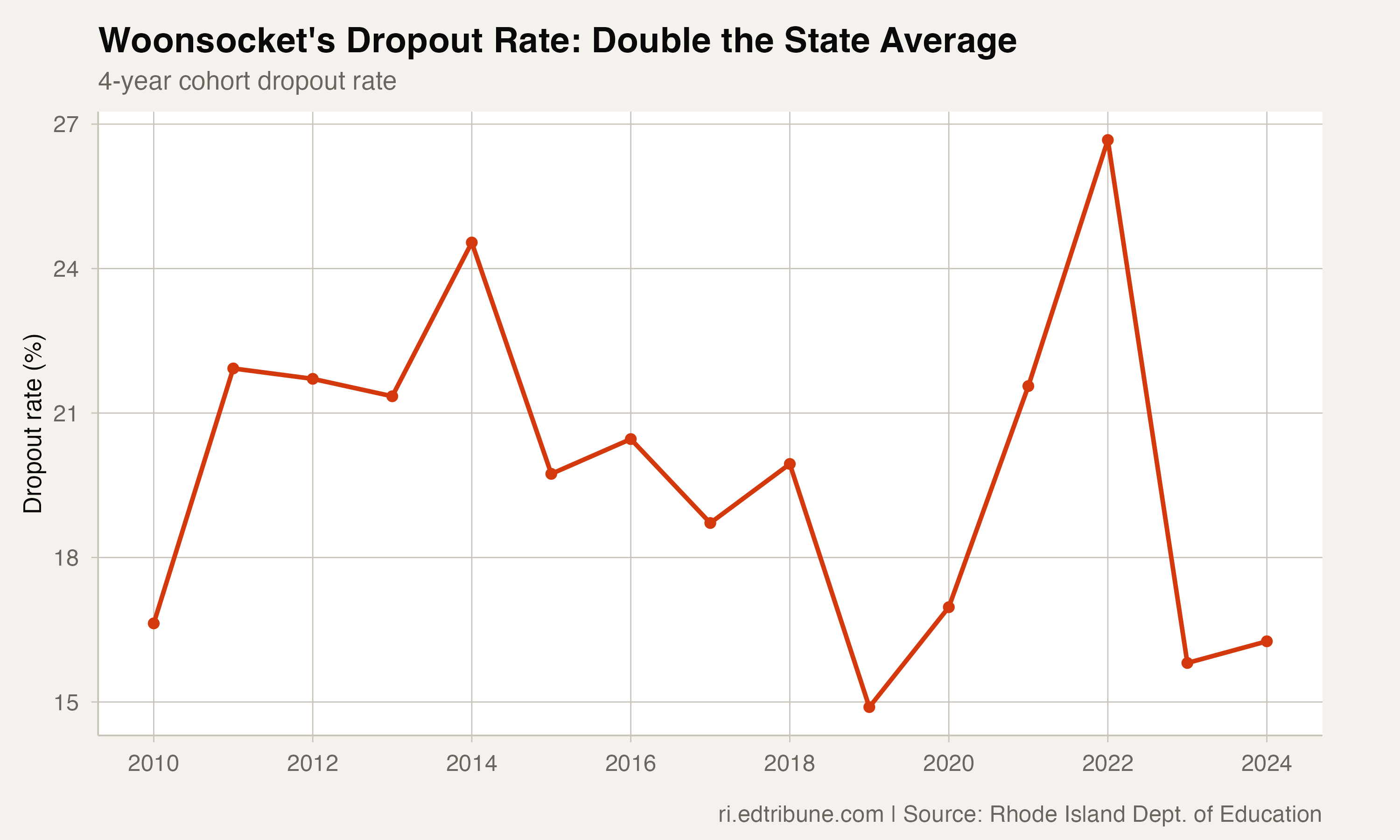
Woonsocket's dropout rate has been volatile, spiking to 26.7 percent in 2022, a figure that meant more than one in four freshmen-to-senior cohort members dropped out, before falling to 16.3 percent in 2024. Even at 16.3 percent, Woonsocket's dropout rate is the second-highest among traditional public school districts in Rhode Island, behind only Central Falls.
The improvement from 26.7 to 16.3 percent between 2022 and 2024 is real, but it did not translate into a graduation rate increase because many of the students who stopped dropping out did not graduate either. They remained in the system (retained, transferred, or enrolled in alternative programs) without earning a diploma in four years.
A smaller, more challenged district
Woonsocket's graduating cohort has shrunk from 487 students in 2010 to 369 in 2024, a 24 percent decline that mirrors the district's overall enrollment loss. The students who remain are more likely to be low-income, multilingual, or in need of special education services, the populations that national data shows are hardest to graduate on time.
The city itself is one of Rhode Island's poorest. Woonsocket's child poverty rate exceeds 30 percent. The Blackstone Valley Community Health Center, the city's largest employer, cannot compensate for the structural disadvantages that students bring to school each morning.
What would recovery look like
Returning to the 2019 peak of 74.2 percent would require graduating roughly 46 additional students per year from the current cohort of 369. That is achievable in theory (it represents about 12.5 percent of the current cohort) but requires the resources and stability that the district currently lacks.
The budget cuts, staff layoffs, and chronic absenteeism crisis create a negative feedback loop: fewer staff means less support, less support means more absenteeism, more absenteeism means lower graduation rates, lower graduation rates mean less confidence from families and policymakers, and less confidence means less funding. Breaking that cycle requires investment, and Woonsocket has been losing ground on investment for years.
Detailed code that reproduces the analysis and figures in this article is available exclusively to EdTribune subscribers.
Discussion
Sign in to join the discussion.
Loading comments...