In the 2021-22 school year, more than half of Providence↗ET Public Schools students were chronically absent. The rate — 57.06% — meant that the majority of students in Rhode Island's capital city were missing at least 10% of school days. At the city's high schools, the figure was worse: 64.61%.
Two years later, Providence's chronic absenteeism rate had dropped to 36.37%, a 20.7 percentage point improvement that represents the largest turnaround among Rhode Island's major districts. More striking: Providence is now below its pre-COVID rate of 37.30%, making it one of only 8 districts out of 60 statewide that have fully recovered.
A district under state control
The turnaround unfolded under unusual governance. Providence Public Schools has been under state control since 2019, when then-Governor Gina Raimondo placed the district under the Rhode Island Department of Education after a scathing review by Johns Hopkins University documented systemic dysfunction — from crumbling facilities to classrooms without functioning heating.
State takeover is typically associated with academic intervention. In Providence, it also meant rethinking how the district approached the most basic question: whether students show up.
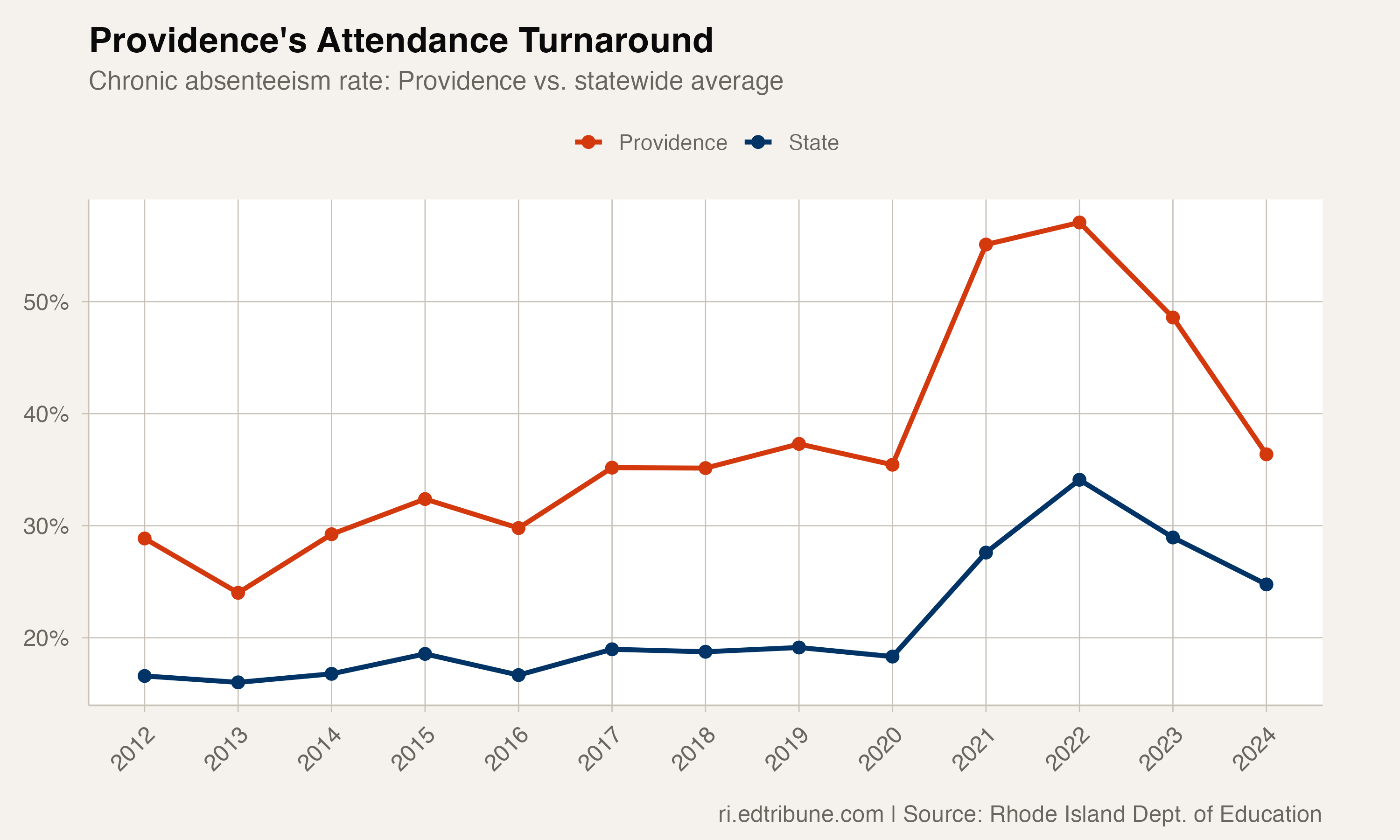
The gap between Providence and the state has historically been wide. In 2019, Providence's rate was 37.30% against a statewide 19.13% — an 18-point chasm. At the COVID peak in 2022, the gap exploded to 23 points as Providence's rate surged to 57.06% while the state hit 34.10%. By 2024, the gap had narrowed back to 12 points as Providence's recovery outpaced the state's.
Every grade level improved
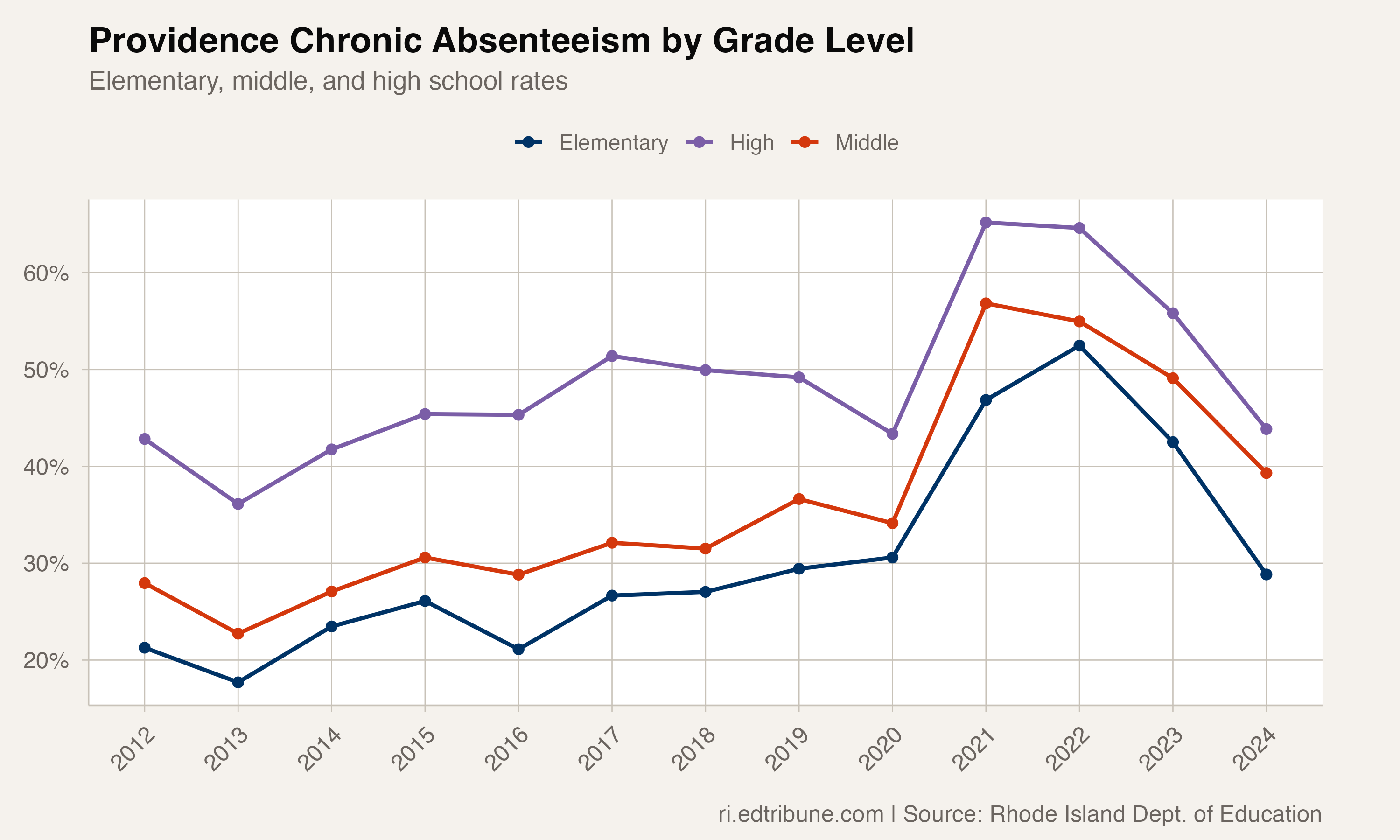
Providence's elementary schools saw the most dramatic swing. The elementary chronic rate peaked at 52.47% in 2022 — more than half of the youngest students chronically absent — and fell to 28.84% by 2024, slightly below the pre-COVID 29.43%.
High school remains the most challenging. Even after a 20.8-point improvement from the 64.61% peak, the high school rate sits at 43.85% — meaning nearly half of Providence's high schoolers are still chronically absent. But that is well below the pre-COVID high school rate of 49.19%.
Middle school improved from 54.96% to 39.31%, though that remains above the pre-COVID 36.63%.
Other large districts are not following
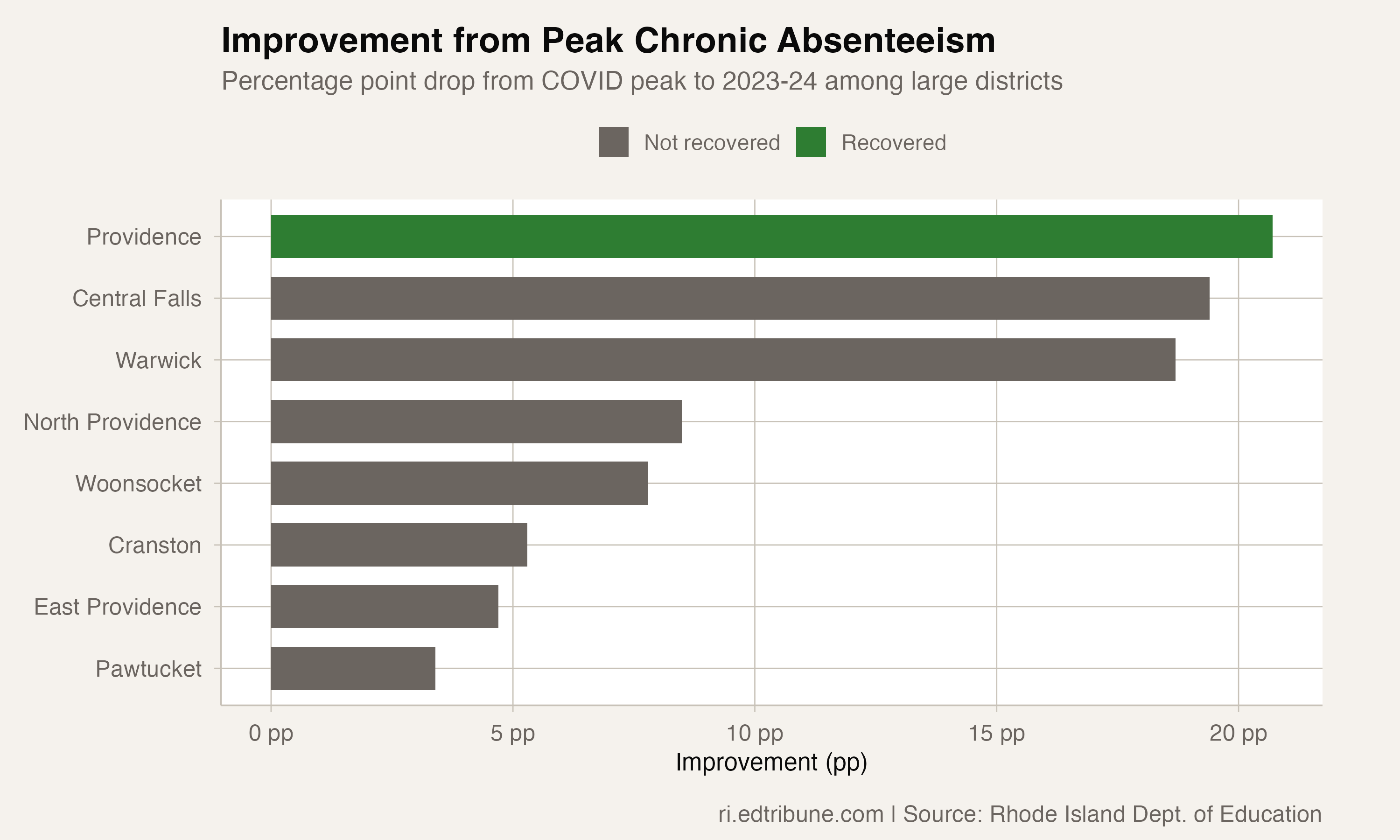
Providence's recovery stands in sharp contrast to the rest of Rhode Island's urban core. Among the state's eight largest districts, only Providence has recovered to pre-COVID levels:
- Pawtucket↗ET: improved just 3.4 points from peak, still 13.0 points above pre-COVID
- Woonsocket↗ET: improved 7.8 points, still 7.6 above pre-COVID
- Warwick↗ET: improved 18.7 points from peak but still 8.7 above pre-COVID
- Central Falls↗ET: improved 19.4 points — nearly matching Providence's trajectory — but started from a lower pre-COVID baseline of 23.07% and sits at 28.72%
The divergence between Providence and Pawtucket is particularly striking. Both serve similar demographics. Both saw chronic absenteeism spike during COVID. But while Providence cut its rate by 20.7 points, Pawtucket managed just 3.4 — and at 35.16%, Pawtucket is now within a point of Providence despite starting with a far lower pre-COVID rate.
What happened
Providence's turnaround coincided with several converging forces. The RIDE-led #AttendanceMattersRI campaign, launched in November 2023, deployed real-time attendance dashboards and school-level heatmaps that made chronic absenteeism visible at a granular level. The campaign earned Rhode Island a ranking of fifth nationally for attendance improvement.
The Attendance for Success Act, enacted in August 2024, requires schools to monitor attendance data and exhaust interventions before referring families to family court. State control may have given Providence the institutional capacity to implement these changes faster than locally governed districts.
Early data from the 2024-25 school year, not yet in the state's official dataset, suggests Providence improved further to 29.3% — a rate that would represent a 7-point improvement on top of an already dramatic recovery.
Whether state control deserves the credit is a question that resists a clean answer. Central Falls, also under state oversight, has tracked a similar improvement curve. But Pawtucket and Woonsocket, operating under local governance with similar student populations, have barely moved. The pattern at least suggests that top-down capacity — whether through state takeover or concentrated campaign resources — may matter more than demographics in driving attendance recovery.
Detailed code that reproduces the analysis and figures in this article is available exclusively to EdTribune subscribers.
Discussion
Sign in to join the discussion.
Loading comments...