Superintendent Patrick McGee has been blunt about the numbers. Woonsocket↗ET has two attendance officers for 5,300 students. In a city where chronic absenteeism runs at 44.13% (nearly double the state average of 24.76%), that amounts to one officer responsible for tracking attendance for roughly 2,650 children.
The math is part of the problem. But the numbers behind Woonsocket's attendance crisis tell a story that goes deeper than staffing ratios.
A problem that predates COVID
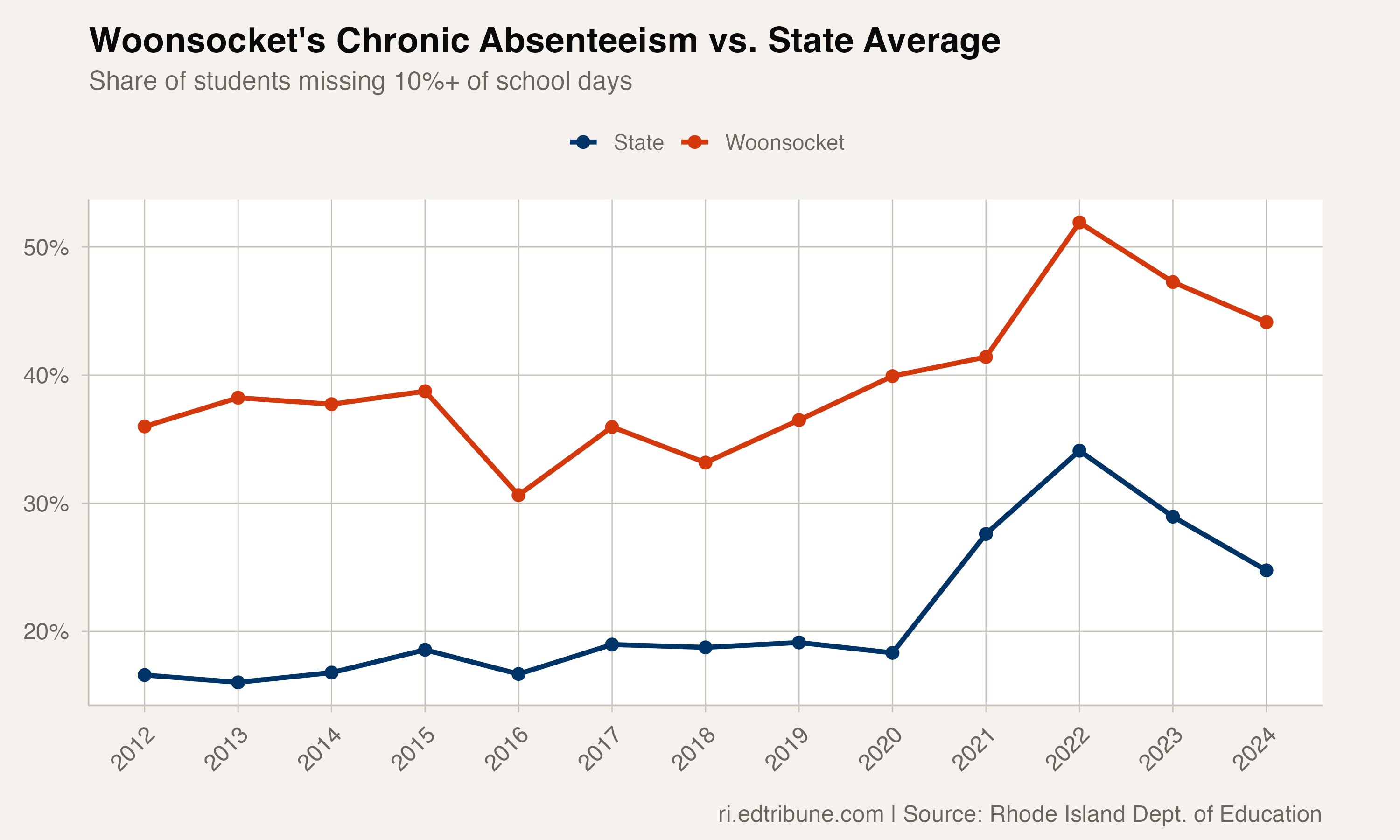
Unlike most Rhode Island districts, where chronic absenteeism was a manageable challenge before the pandemic and became a crisis after it, Woonsocket arrived at COVID with a crisis already in progress. In 2011-12, Woonsocket's rate was 35.99%, already more than double the state average. By 2018-19, it had barely budged, sitting at 36.49%.
COVID made it worse. The rate spiked to 51.91% in 2021-22, meaning more than half of Woonsocket's students were missing at least 10% of school days. It has since improved to 44.13%, a 7.8 percentage point drop from the peak. But that still leaves Woonsocket 7.6 points above its pre-COVID baseline, and that baseline was already among the worst in the state.
Middle school: more than half chronically absent
The grade-level breakdown reveals where the problem is most acute. Woonsocket's middle school chronic absenteeism rate in 2023-24 was 53.75%, meaning more than half of middle schoolers missed 10% or more of school days. That rate has barely improved from the COVID peak of 56.17%.
Elementary school has been Woonsocket's relative bright spot, though "bright" is a generous term for a 39.82% rate. High school, at 44.40%, actually improved substantially from its 2019 rate of 49.46%, one of the few grade levels in Woonsocket that is better than before the pandemic.
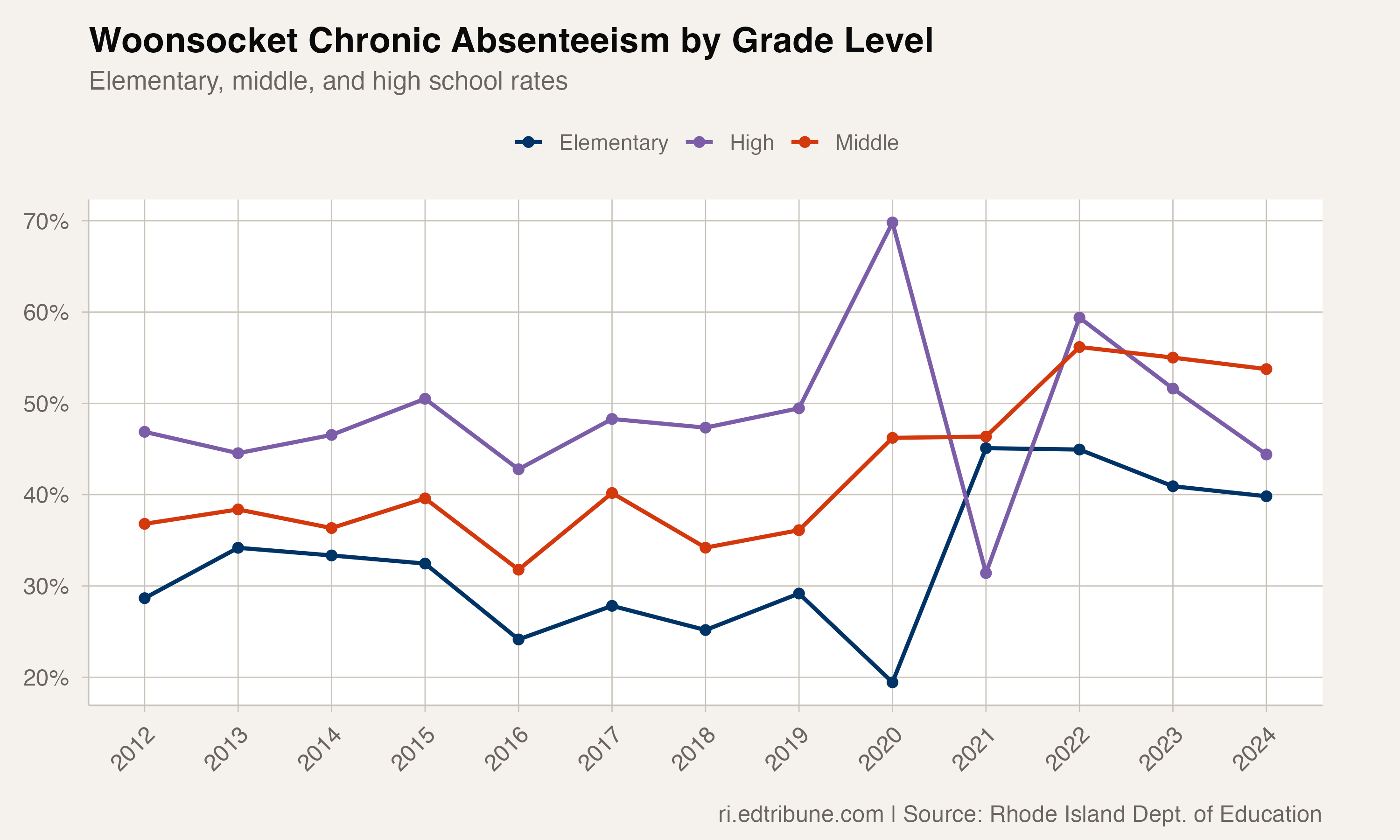
The middle school stagnation stands out because it diverges from the statewide pattern. Measured against the pre-pandemic baseline, Rhode Island's middle school chronic absenteeism has closed about 53% of the gap between its COVID peak and its 2018-19 level. In Woonsocket, that figure is only about 12%.
The gateway city that fell behind
Woonsocket's trajectory diverges sharply from the other gateway cities. Providence dropped from 57.06% to 36.37%, falling below its pre-COVID rate. Central Falls improved from 48.15% to 28.72%. Even Pawtucket, the slowest to recover among the four, has a lower rate than Woonsocket at 35.16%.
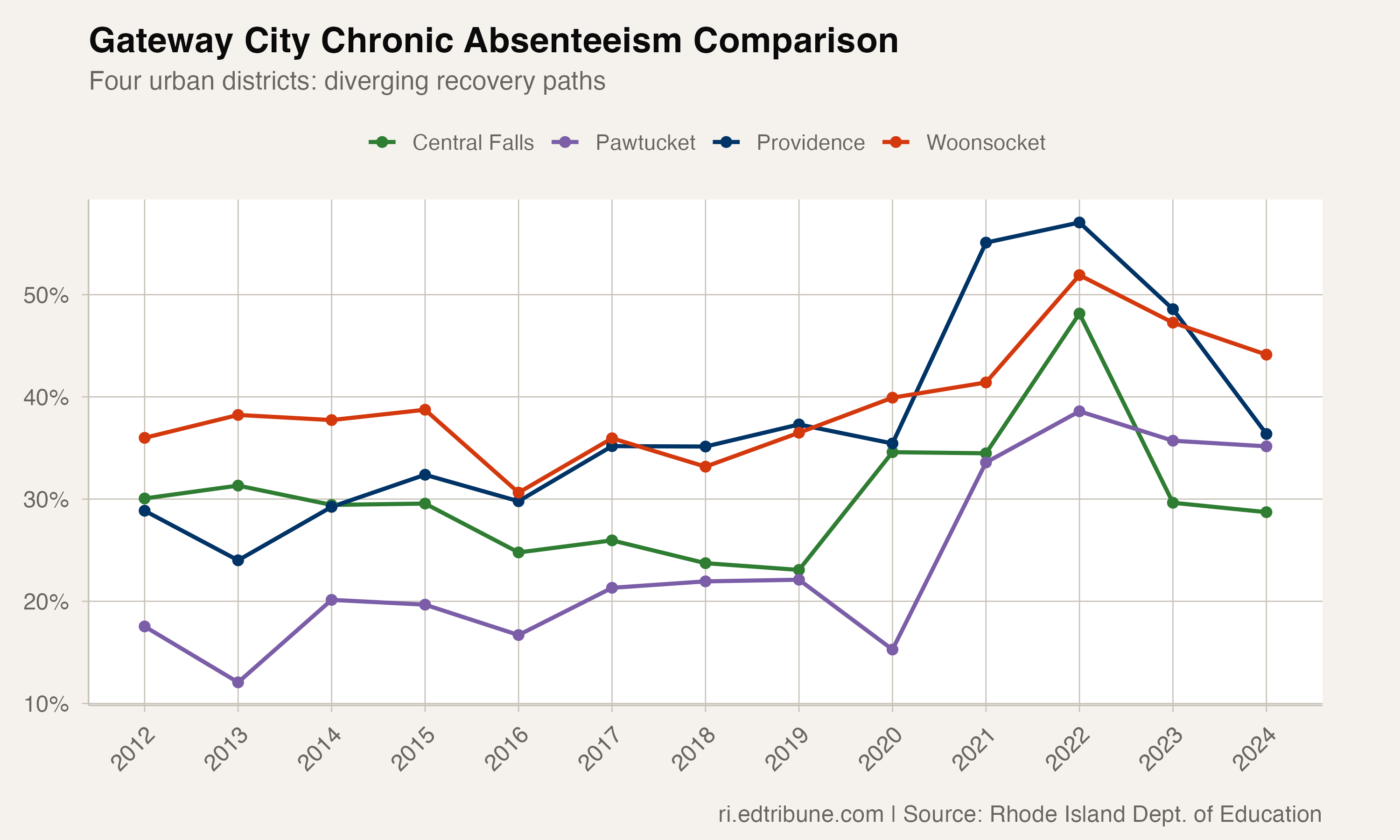
The contrast with Central Falls is particularly striking. Central Falls, also a small, dense, high-poverty city, has driven its rate down nearly 20 points from peak. Central Falls has a liaison in every school. Woonsocket has two attendance officers districtwide, a resource disparity that Superintendent McGee has pointed to repeatedly.
Woonsocket's transient student population compounds the challenge. McGee has described chronic absenteeism in the district as fueled by families moving frequently, older siblings staying home to care for younger ones, and a general pattern of disengagement that was entrenched before the pandemic gave it a name.
2,422 students
In absolute terms, 2,422 of Woonsocket's 5,488 enrolled students were chronically absent in 2023-24. That is 357 more than in 2012, despite the district enrolling 250 fewer students.
The scale matters because Woonsocket is small enough that individual school interventions can move the needle. The district has roughly a dozen schools. Unlike Providence, which must coordinate attendance efforts across 40+ buildings, Woonsocket's challenge is concentrated.
Whether the resources match the concentration is the question Superintendent McGee keeps answering in the same way: two officers, 5,300 students.
Detailed code that reproduces the analysis and figures in this article is available exclusively to EdTribune subscribers.
Discussion
Sign in to join the discussion.
Loading comments...