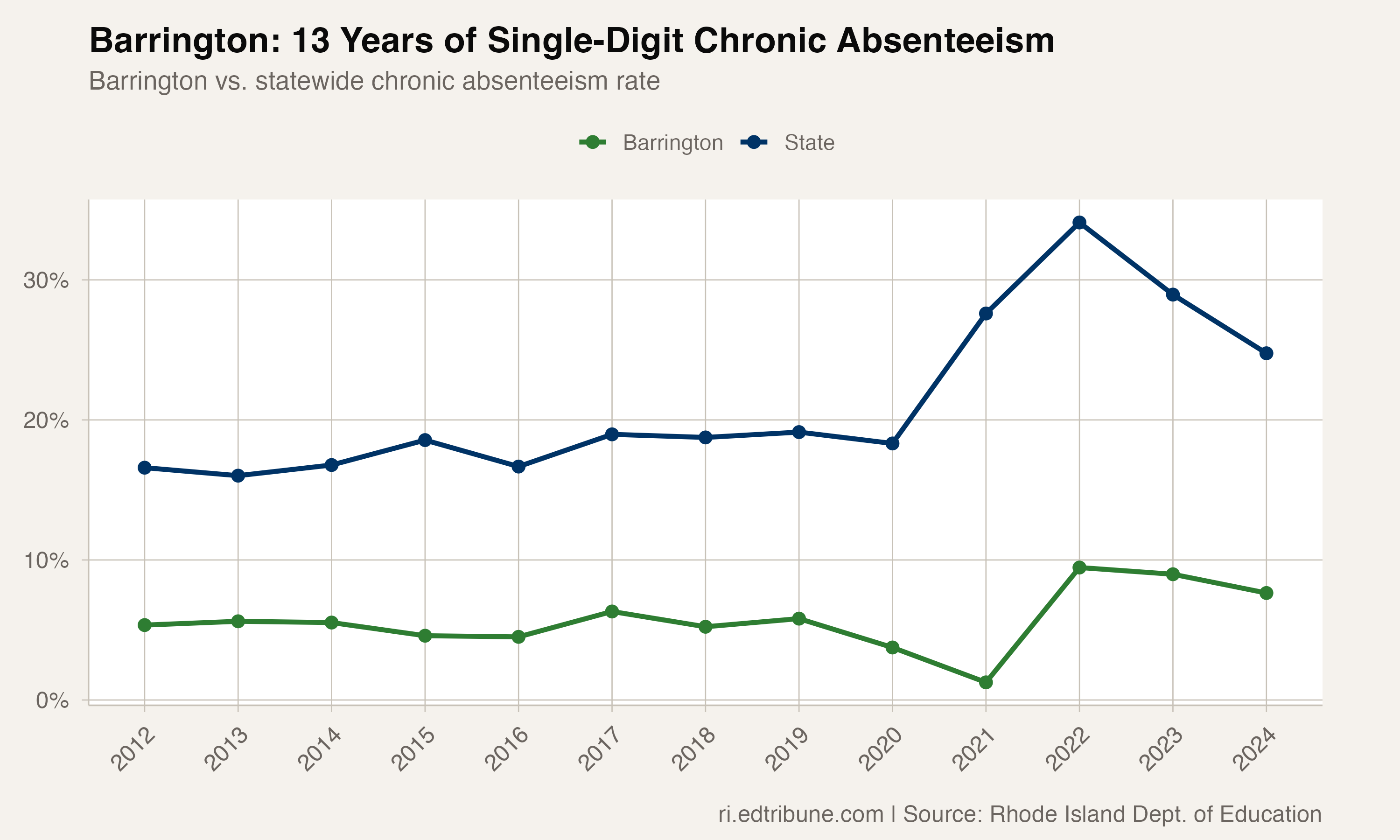
When COVID drove Rhode Island's chronic absenteeism to 34.10% in the 2021-22 school year, Barrington↗ET peaked at 9.46%. Less than one in ten students missed 10% or more of school days — in a year when one in three students statewide did.
By 2023-24, Barrington's rate had fallen further to 7.64%. In 13 consecutive years of data, the district has never crossed 10%. No other district of comparable size in Rhode Island can make that claim.
Every grade level, every year
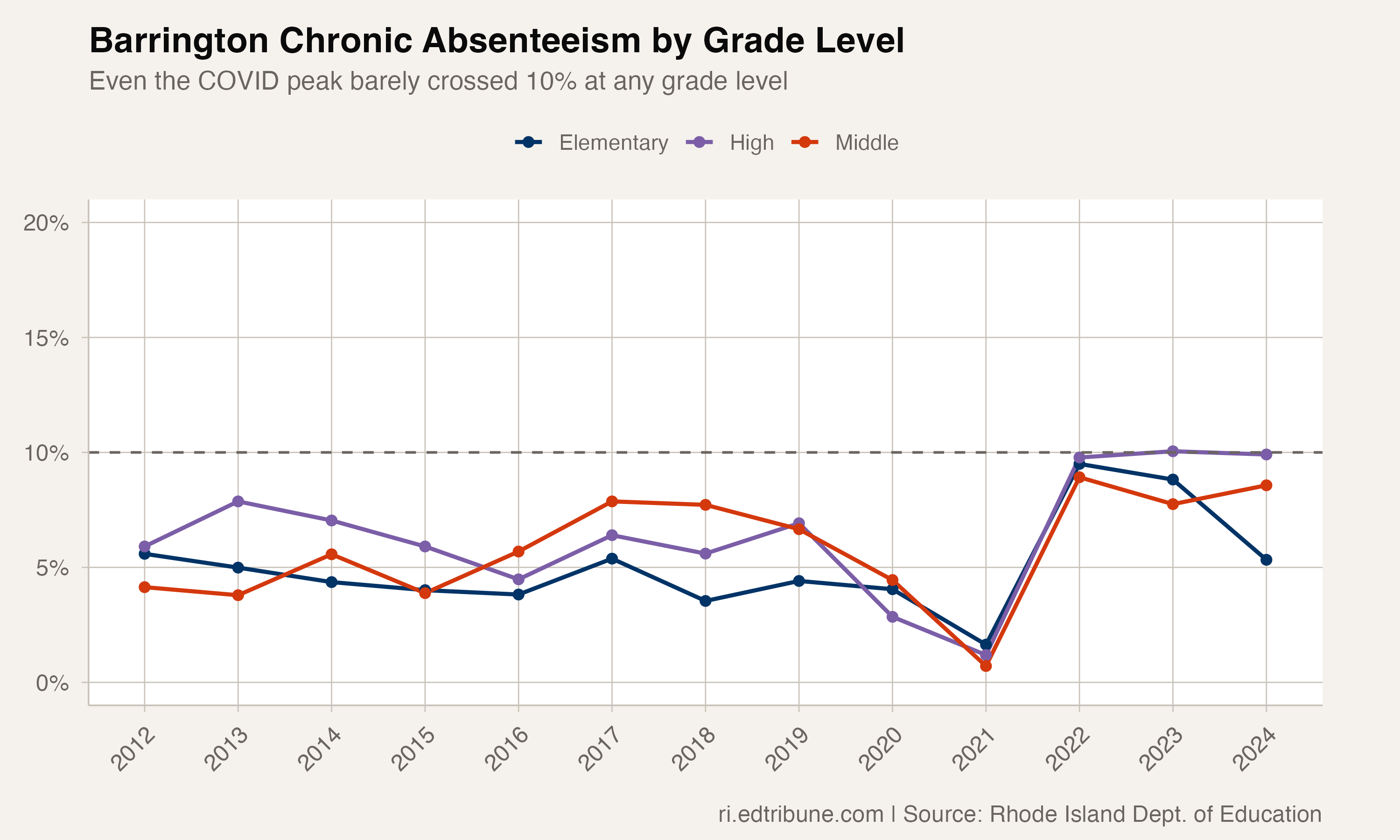
The consistency extends across grade bands. In 2023-24, Barrington's elementary rate was 5.33%. Its middle school rate was 8.57%. Even high school — where chronic absenteeism statewide runs at 31.22% — was 9.91% in Barrington.
No grade level in Barrington has exceeded the statewide average in any year on record. Even during COVID, when Barrington's high school rate briefly touched 14.65%, it remained below the pre-pandemic statewide average of 19.13%.
Context matters
Barrington is one of Rhode Island's wealthiest communities. Median household income exceeds $120,000. The student population is overwhelmingly white and affluent. The district's 3,258 students attend well-resourced schools in a compact suburban setting where transportation barriers are minimal and parent engagement is high.
None of this diminishes the attendance outcomes. But it limits the transferability of whatever Barrington does differently. The research is clear that chronic absenteeism correlates more strongly with poverty, housing instability, and health access than with any school-level intervention. A district where families have stable housing, reliable transportation, and flexible work schedules will have lower chronic absenteeism regardless of its attendance policies.
What is notable about Barrington is not that its rate is low, but that it stayed low when the pandemic disrupted attendance across every demographic. Affluent suburbs nationally saw chronic absenteeism rates double or triple during COVID. Barrington's went from 5.99% to 9.46% and then came back down. The spike was modest by any standard, and the recovery was swift.
Part of a pattern
Barrington is the largest district in a group of 19 that have been below the state chronic absenteeism average every single year on record. The group includes a mix of suburban and small districts, from Segue Institute↗ET (5.64%) to North Providence↗ET (23.28%).
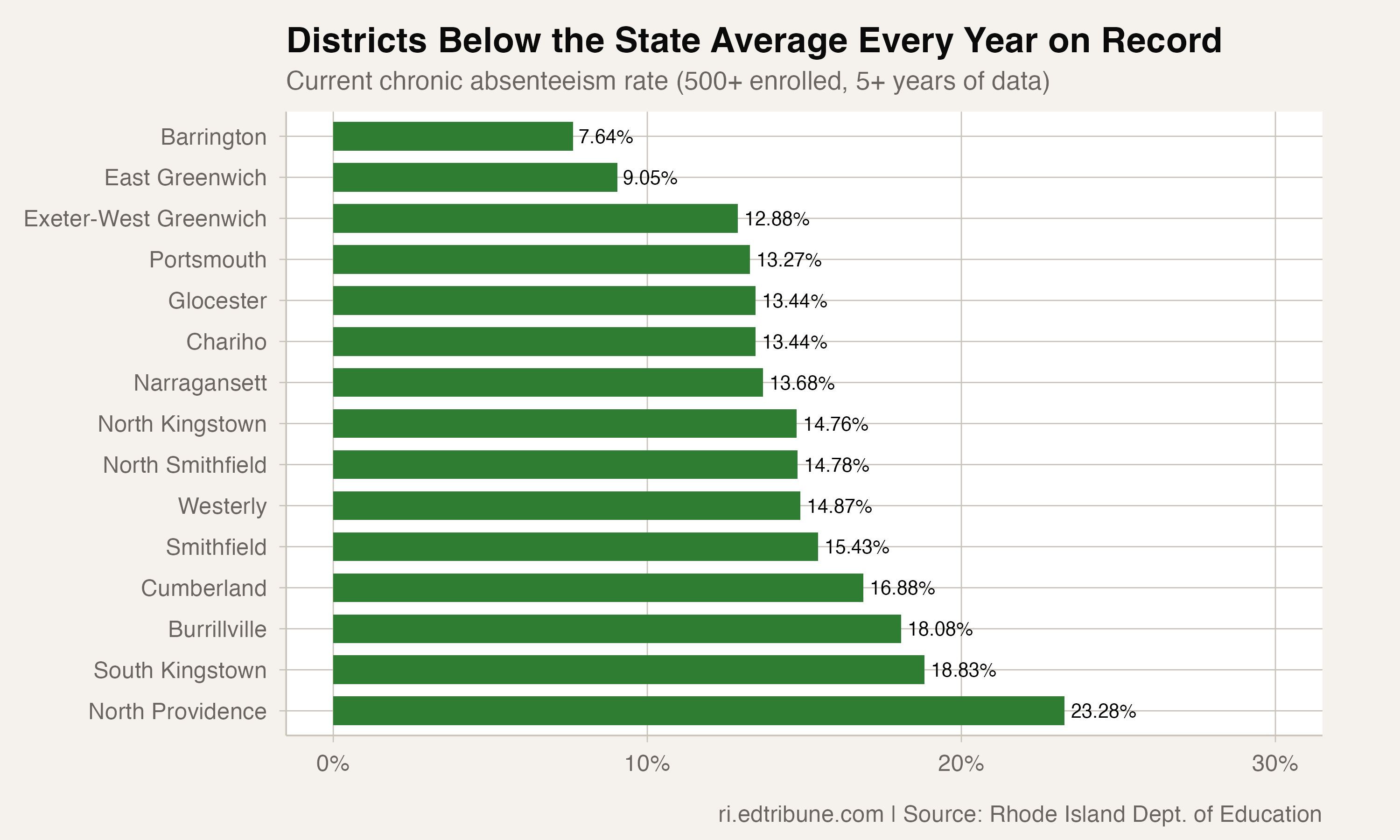
The group is exclusively non-urban. No gateway city appears on the list. The correlation between community type and sustained low absenteeism is not surprising, but the consistency — not a single year above the state average across 13 years of data — suggests that some districts operate in an attendance environment fundamentally different from the one most Rhode Island students experience.
Barrington's consistency is real. So is the distance between its circumstances and those of the 33,061 chronically absent students elsewhere in Rhode Island. Attendance liaisons and dashboards help at the margins. But in Barrington, regular attendance is the default -- built on housing stability, health access, and economic security that most districts cannot conjure through policy alone.
Detailed code that reproduces the analysis and figures in this article is available exclusively to EdTribune subscribers.
Discussion
Sign in to join the discussion.
Loading comments...