The chronic absenteeism recovery stories in Rhode Island tend to center on Providence and Central Falls — large urban districts under state control where concentrated resources and top-down intervention drove dramatic improvement.
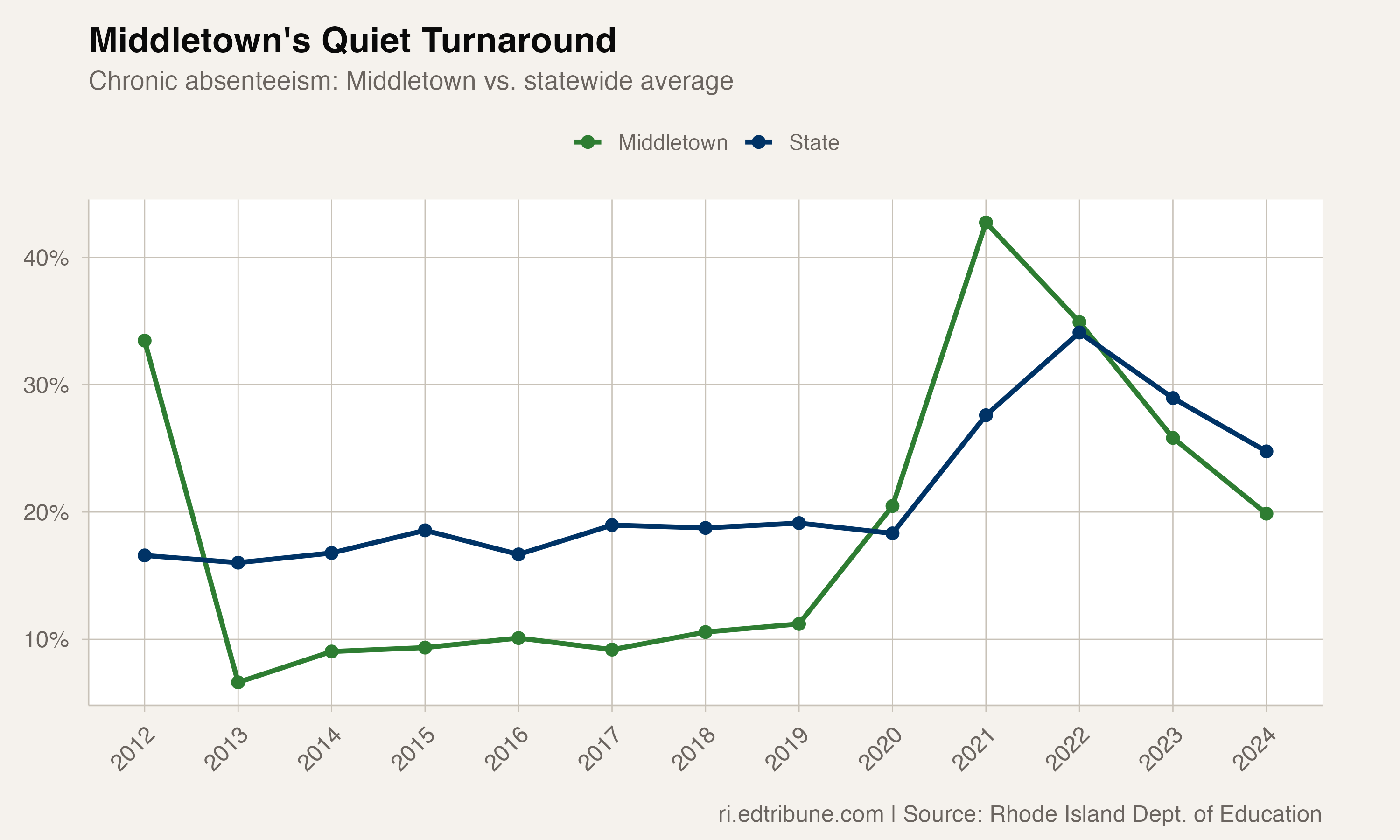
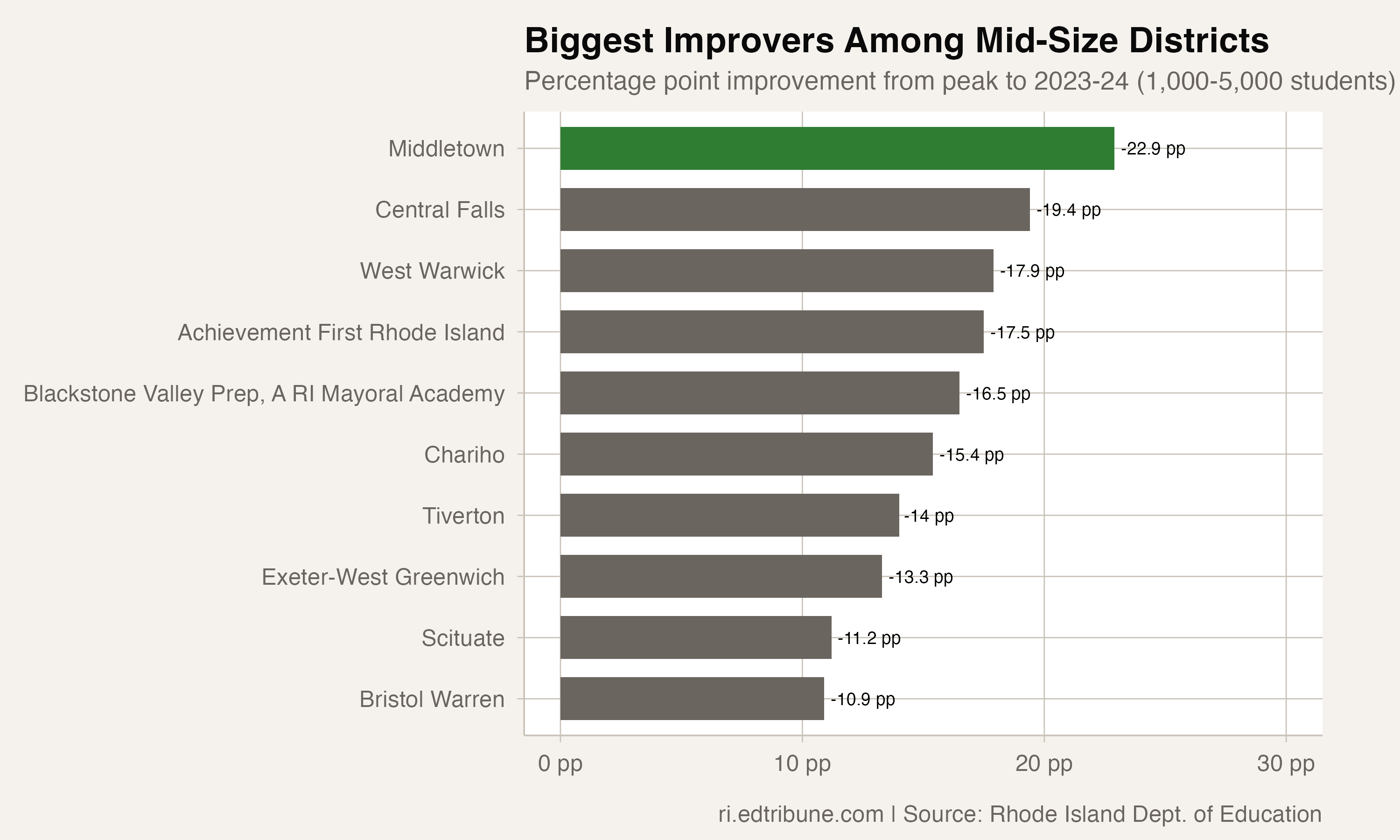
Middletown↗ET, a mid-size community of 1,922 students on Aquidneck Island, has a different story. No state takeover. No headlines. Just a 22.9 percentage point drop in chronic absenteeism over three consecutive years, from a peak of 42.74% in 2020-21 to 19.87% in 2023-24.
That makes Middletown the largest per-point improver among mid-size traditional districts in Rhode Island. And unlike the gateway city recoveries, Middletown's turnaround happened under local leadership.
Below the state average
Middletown's current rate of 19.87% is below the statewide average of 24.76%. Before COVID, the district was well below the state rate — 11.21% against the state's 19.13% in 2018-19. The pandemic drove Middletown's rate to 42.74% in 2020-21, more than 15 points above the state's 27.60% — a sharper jump than nearly any other district experienced.
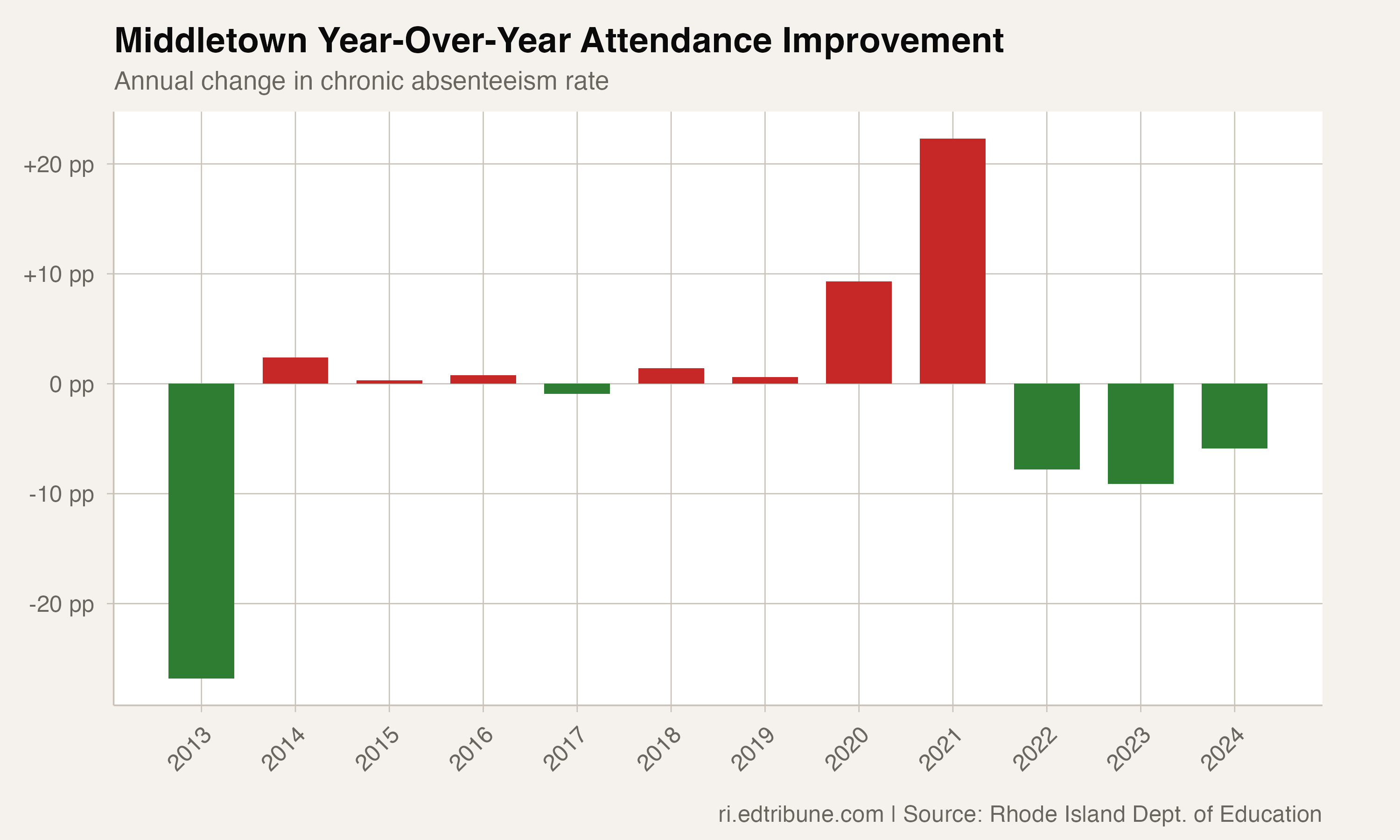
The recovery has been remarkably consistent: three straight years of improvement. From 42.74% to 34.91% to 25.82% to 19.87%. Each year peeled off roughly six to nine points.
What makes it different
Middletown is not Providence. It does not have 20,000 students, a state-appointed superintendent, or the full weight of RIDE's attendance campaign focused on its buildings. It is a community with five schools, a mix of Navy families from nearby Naval Station Newport and longtime residents, and a student body that is more diverse than typical suburban Rhode Island.
The turnaround's speed — essentially returning to pre-COVID levels in three years, starting from a 43% peak — is notable because it suggests that district size and local governance are not inherent barriers to attendance recovery. The gateway city narrative implies that state intervention is what drives improvement. Middletown complicates that narrative.
Among districts with between 1,000 and 5,000 students, Middletown's improvement from peak ranks among the largest in the state. Several mid-size districts have made substantial progress, but few have completed the full round trip back to pre-COVID levels while also dropping below the state average.
Still a small story
With 1,922 students, Middletown's turnaround does not move the statewide needle the way Providence's does. If every district had matched Middletown's improvement rate, Rhode Island would already be below its pre-pandemic chronic absenteeism rate.
But scale is not the only measure. Middletown demonstrates that the attendance habits disrupted by COVID can be rebuilt at the community level, without state takeover or nationally recognized campaigns. The mechanisms may be simpler than what drove Providence's recovery: consistent school leadership, a small enough district to know families individually, a community stable enough that the same students are enrolled year after year.
For the 52 districts that have not recovered to pre-COVID levels, Middletown is worth studying. Not because its demographics or resources are typical — they are not — but because its recovery suggests that the problem is solvable at scales smaller than a statewide campaign.
Detailed code that reproduces the analysis and figures in this article is available exclusively to EdTribune subscribers.
Discussion
Sign in to join the discussion.
Loading comments...