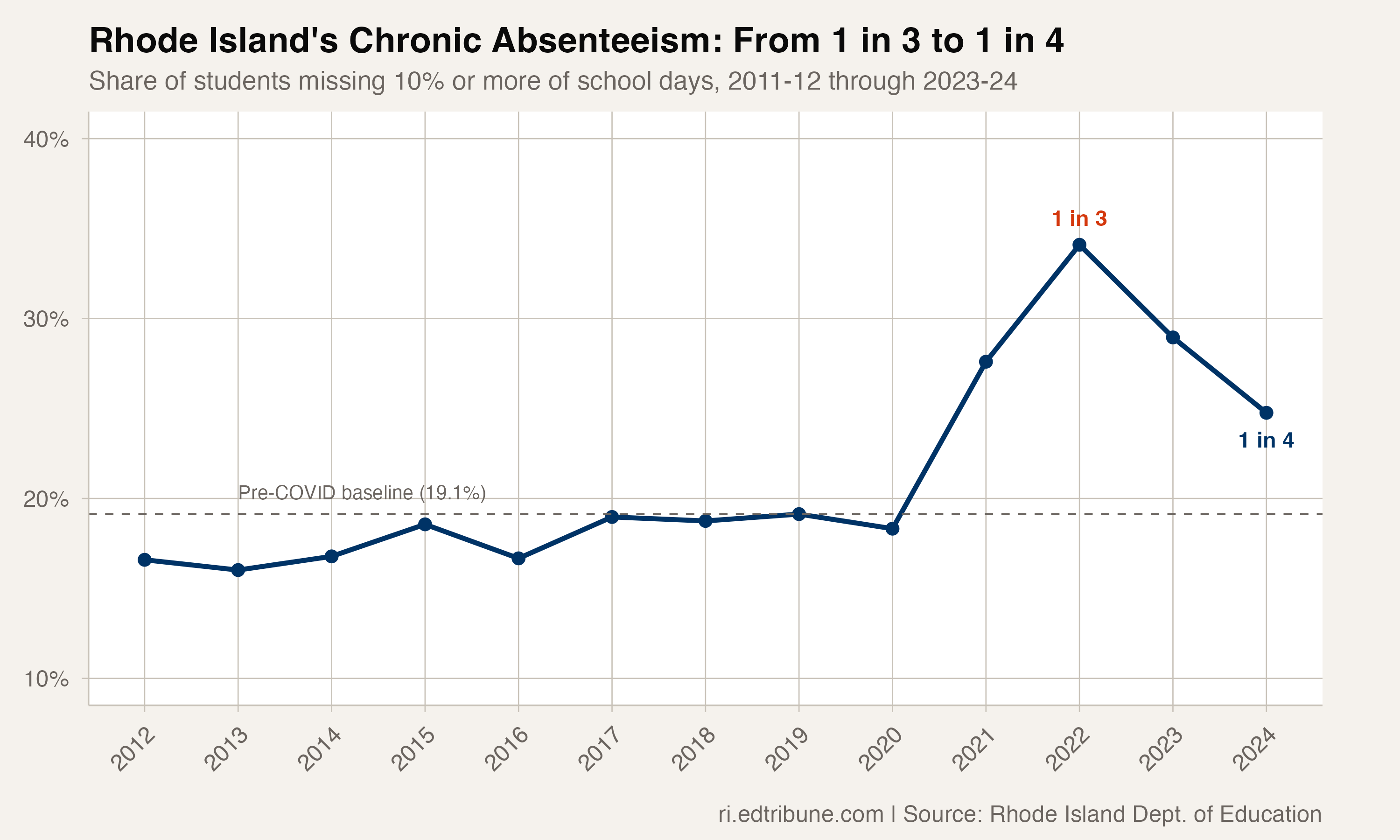
Two years ago, Rhode Island's attendance crisis hit a number that shook educators across the state: more than one in three students was chronically absent. In the 2021-22 school year, 46,328 students — 34.1% of the total — missed at least 10% of school days.
By 2023-24, that fraction had fallen to roughly one in four. The state's chronic absenteeism rate dropped to 24.76%, a 9.3 percentage point improvement from the peak. The #AttendanceMattersRI campaign, launched by the Rhode Island Department of Education in November 2023, became a centerpiece of the state's recovery effort, pairing real-time attendance dashboards with school-level heatmaps that flagged at-risk students for outreach.
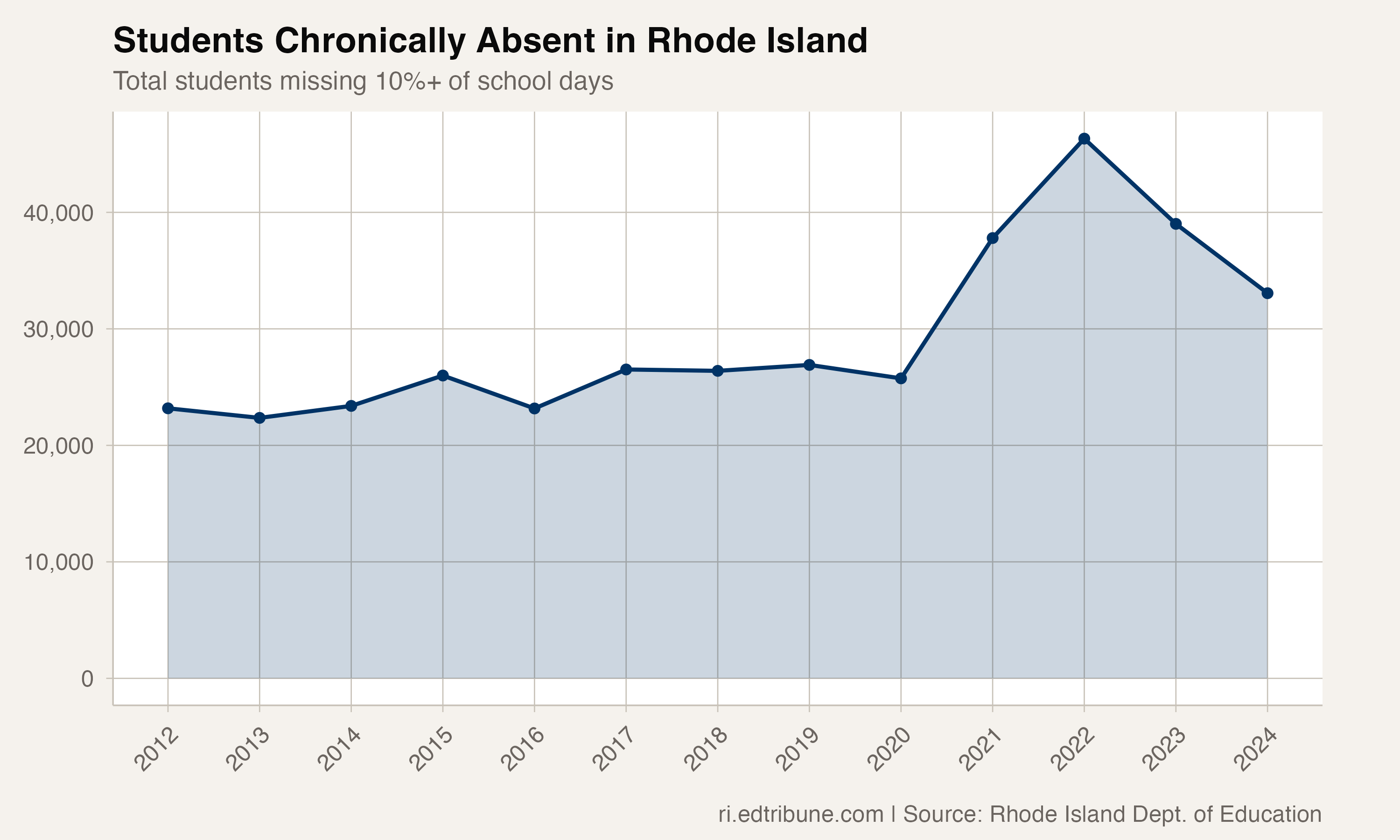
But the progress obscures a stubborn fact: 33,061 students are still chronically absent. That is 10,703 more students than at the pre-pandemic low of 22,358 in 2012-13, despite enrollment declining by more than 6,000 students over the same period.
The recovery is real but incomplete
The state has recovered 62.4% of the way back to its pre-COVID rate of 19.13%. At the pace of improvement from 2022 to 2024 — roughly 4.7 percentage points per year — Rhode Island could reach its pre-pandemic baseline around 2025 if that pace holds.
The Attendance for Success Act, enacted in August 2024, requires schools to monitor attendance data and exhaust interventions before referring families to court. It codifies the shift from punitive enforcement to proactive engagement that drove the #AttendanceMattersRI campaign.
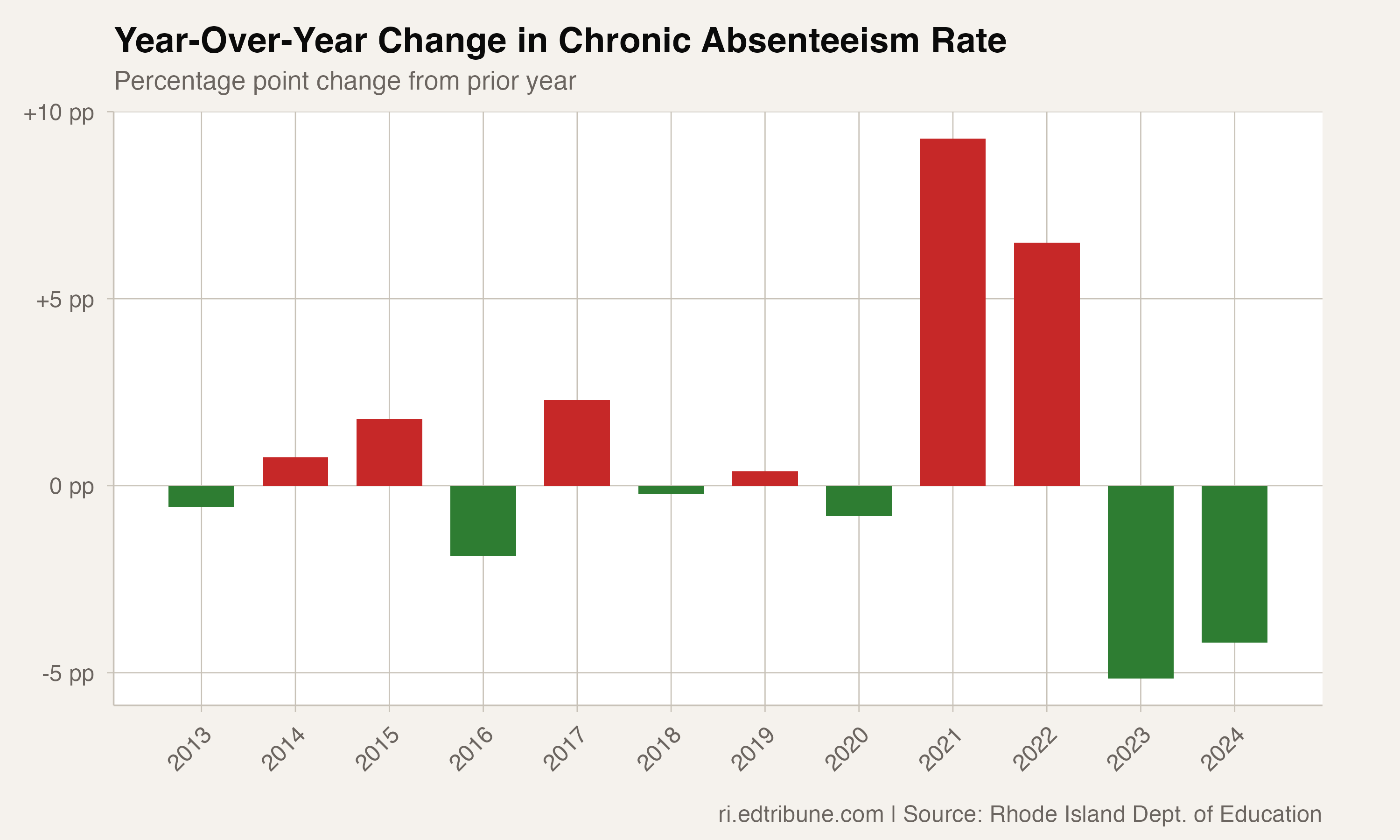
But the year-over-year numbers tell a more nuanced story. The two largest annual improvements in recorded history — a 5.15 point drop in 2023 and a 4.19 point drop in 2024 — followed the two largest annual spikes. The 2020-21 school year added 9.28 points in a single year as remote and hybrid instruction disrupted attendance habits statewide.
Middle school is the laggard
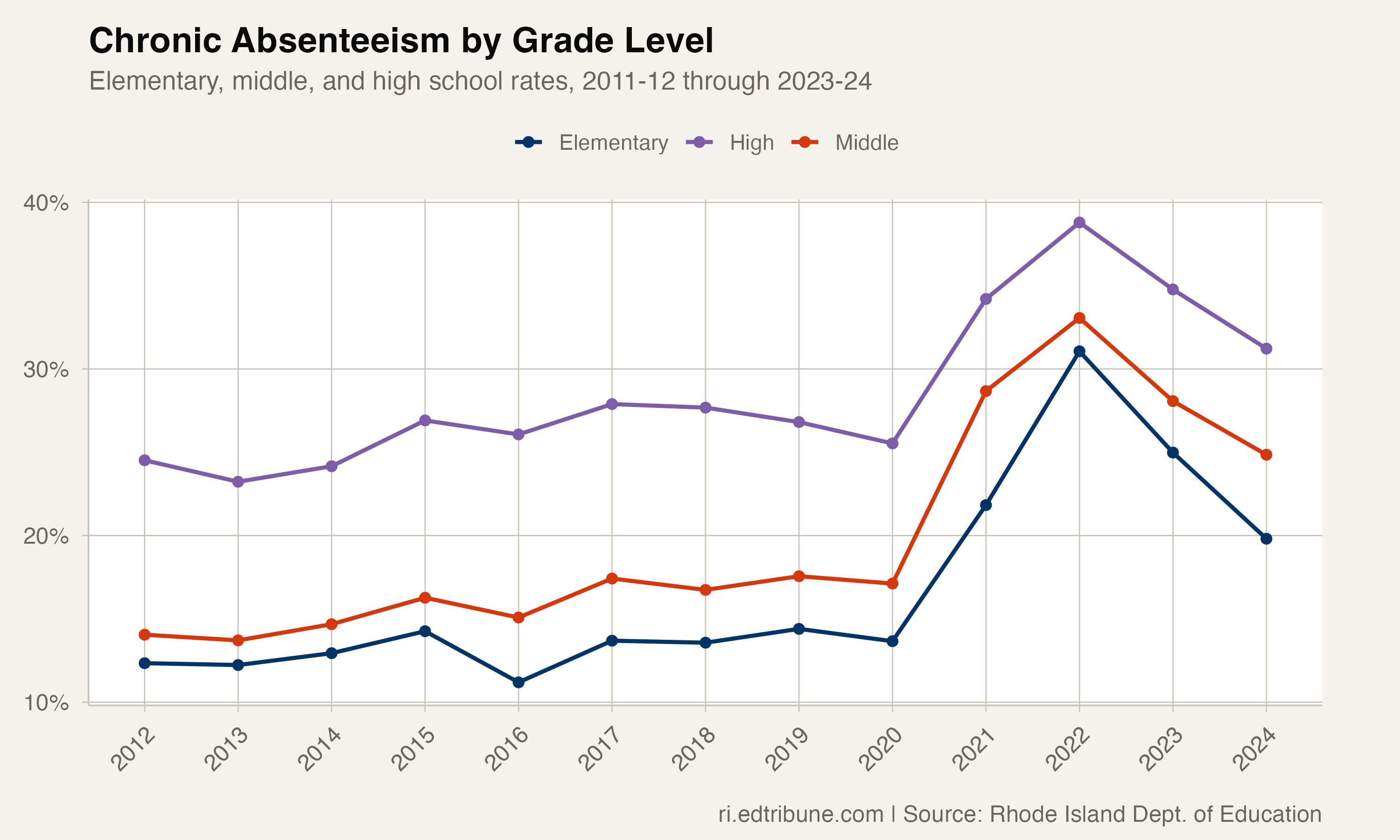
Not all grade levels are recovering at the same pace. Elementary schools have recovered the fastest, clawing back 67.5% of the ground lost during COVID. Their rate of 19.81% remains 5.4 points above the pre-COVID 14.40%, but the trajectory is clear.
High schools, which have always had the worst chronic absenteeism rates in Rhode Island, sit at 31.22% — nearly one in three. That is 4.4 points above the pre-pandemic 26.81%, but high schools actually show the second-best recovery rate at 63.2%.
The surprise is middle school. At 24.85%, the middle school rate has recovered only 53% from its 2022 peak of 33.06%. The 7.3-point excess above the pre-COVID rate of 17.56% is the largest of any grade band. The 5th-to-6th grade transition has historically been associated with attendance drops, and the post-COVID data suggests middle schoolers have been the hardest to re-engage.
What 33,061 students looks like
Before the pandemic, chronic absenteeism in Rhode Island was slowly worsening. The rate drifted from 16.02% in 2013 to 19.13% in 2019 — a gradual increase that might have continued to draw modest attention in annual RIDE reports. COVID did not create the attendance problem. It accelerated an existing trend by a decade.
The absolute numbers make the scale concrete. At the 2022 peak, 46,328 students were chronically absent — nearly 24,000 more than the 2013 baseline. The state has eliminated 13,267 students from that count since the peak, but 33,061 remain. In a state with only 133,519 enrolled students, 33,061 is more than the combined enrollment of Providence↗ET and Cranston↗ET — the state's two largest districts. It is one in four students, every year, missing enough school to fall behind.
Rhode Island's funding formula runs on Resident Average Daily Membership, not average daily attendance. Unlike states that fund schools based on who shows up, Rhode Island pays based on who is enrolled. That means chronic absenteeism does not directly cut state aid — but research has consistently linked missing 10% or more of school days to weaker academic outcomes, lower graduation rates, and slower reading growth, particularly in the early grades.
The trajectory from one in three to one in four is genuine progress. Getting to one in five — the pre-COVID norm — is a different kind of problem. The easy gains came from re-engaging students who wanted to be in school but weren't during the pandemic. The remaining 33,061 include students whose absence patterns predate COVID entirely.
Detailed code that reproduces the analysis and figures in this article is available exclusively to EdTribune subscribers.
Discussion
Sign in to join the discussion.
Loading comments...