At William E. Tolman Senior High School in Pawtucket↗ET, 59.04% of students were chronically absent in the 2023-24 school year. Nearly six in ten students missed at least 10% of school days — a rate that would have qualified as a crisis at any point in the school's history.
Tolman is not an outlier in its own district. Across all of Pawtucket's high schools, the chronic absenteeism rate was 50.84%, the highest among any traditional district's high schools in Rhode Island. More than half of Pawtucket's high schoolers are chronically absent.
What makes the number alarming is not just its magnitude but its direction. While the rest of Rhode Island has spent two years driving chronic absenteeism down, Pawtucket's high school rate is still climbing. It was 35.00% in 2018-19, rose to 46.63% at the 2022 COVID peak, and then continued to 50.84% in 2024 — 4 points higher than the peak, 16 points above pre-COVID.
A district falling behind
Pawtucket's overall chronic absenteeism rate of 35.16% tells a less dramatic story than its high schools, but the trajectory is still troubling. In 2018-19, Pawtucket was 3.0 percentage points above the state average. By 2023-24, that gap had widened to 10.4 points.
The state improved 4.2 points from 2023 to 2024. Pawtucket improved 0.6.
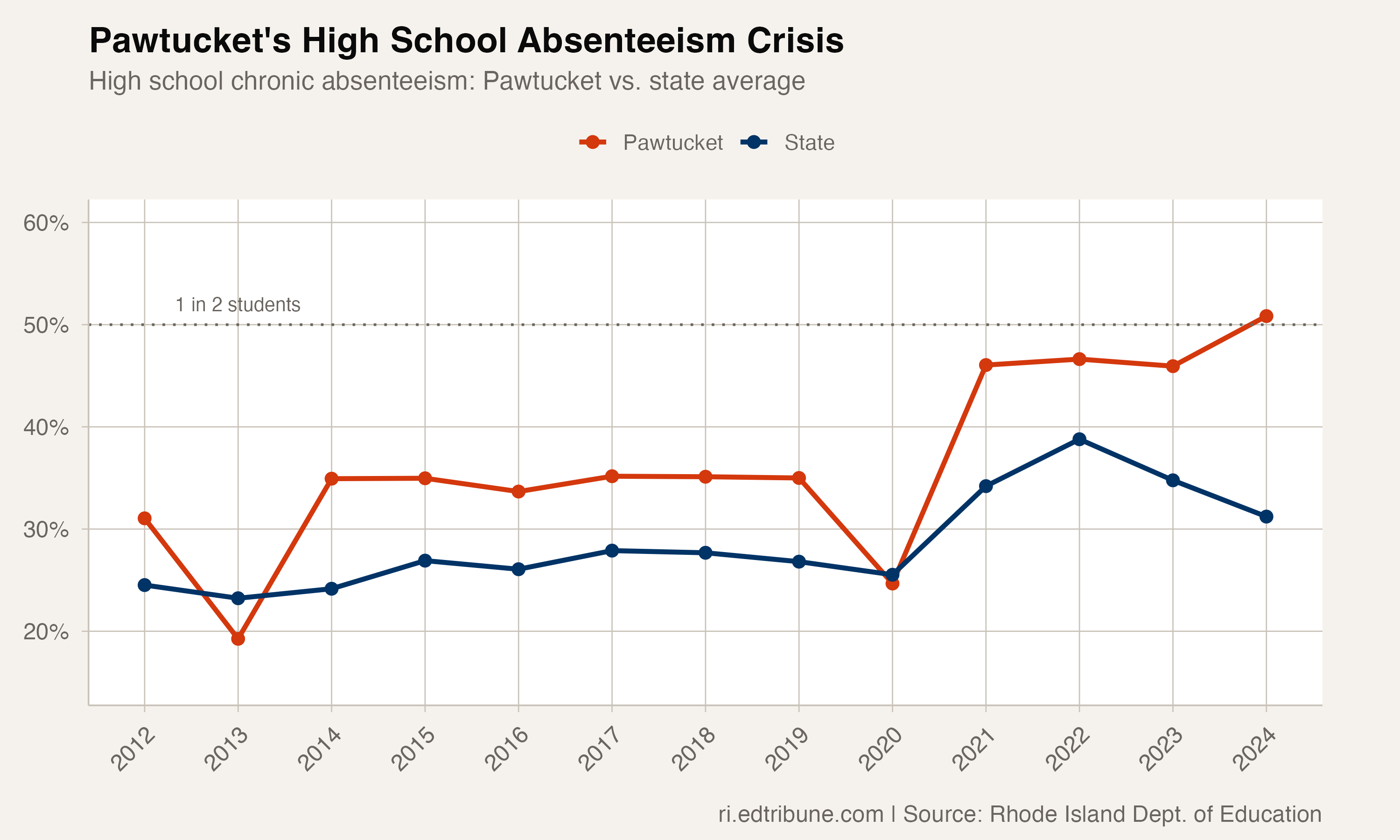
The contrast with the other gateway cities is stark. Providence dropped 20.7 points from its peak. Central Falls dropped 19.4 points. Even Woonsocket, which has the highest overall rate in the state, managed a 7.8-point improvement. Pawtucket's 3.4-point total drop from peak is the smallest among any urban district.
The grade-level story
Pawtucket's elementary schools have fared better, tracking closer to statewide patterns. But middle and high school have diverged — middle school stagnating, high school worsening.
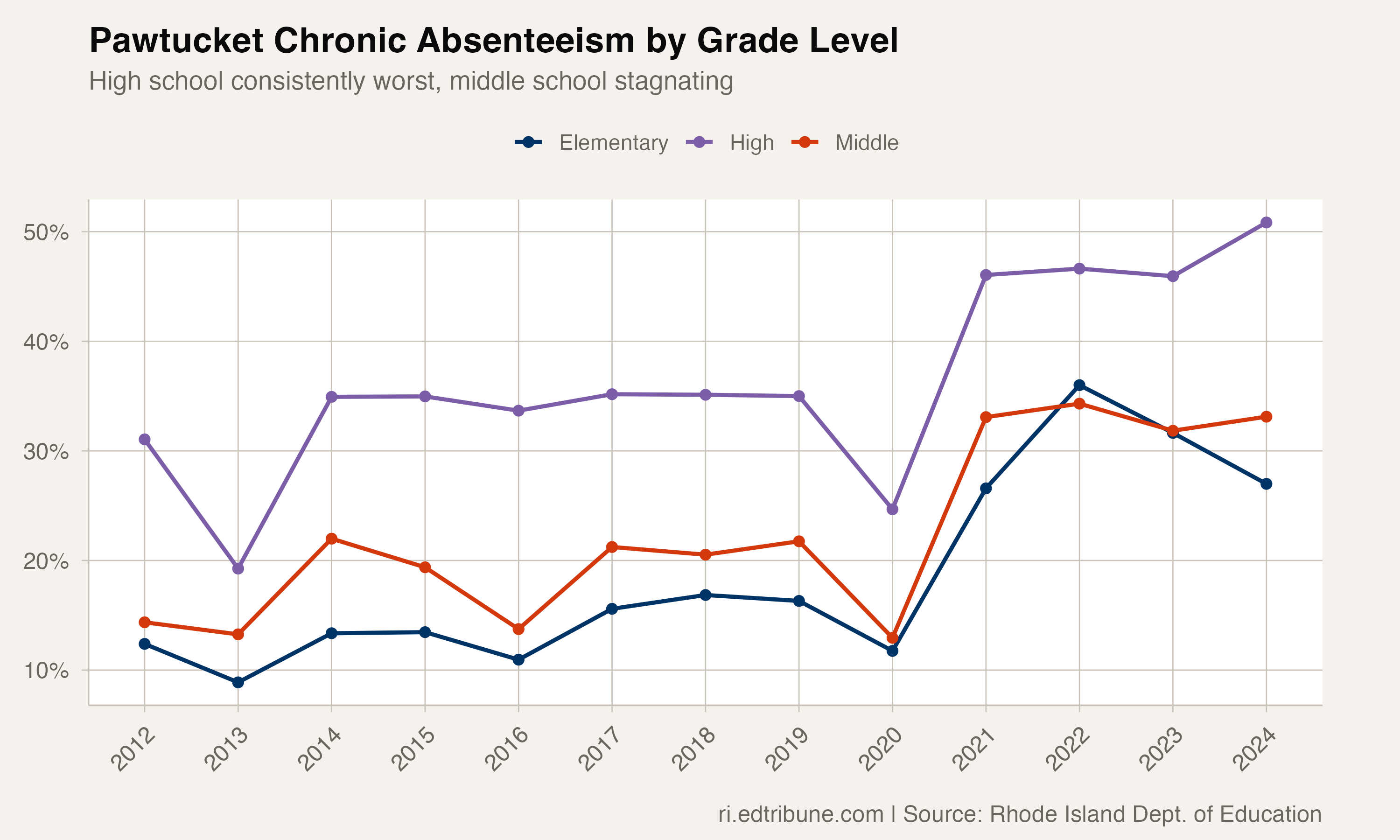
The high school trajectory is what separates Pawtucket from the rest of the state. In most Rhode Island districts, high school chronic absenteeism peaked in 2021-22 and has declined since. In Pawtucket, it peaked in 2023-24. The COVID disruption did not create a spike that subsided. It created a trend that accelerated.
The widening gap
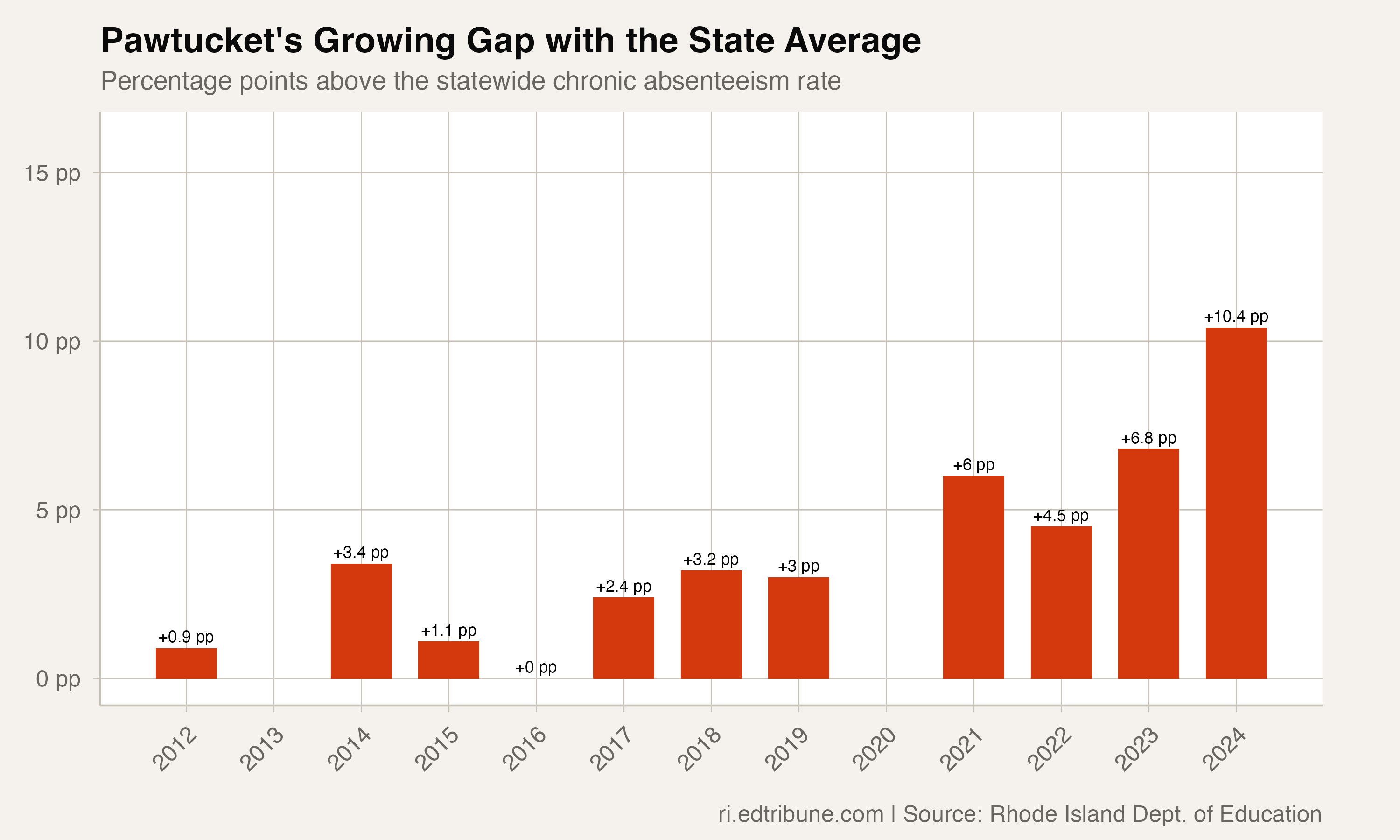
Before COVID, Pawtucket's chronic absenteeism was modestly above average — the kind of gap that might be attributed to demographics and wouldn't make headlines. The 3-point spread in 2019 was smaller than the gap between many urban and suburban districts.
The post-COVID divergence has turned a manageable difference into a structural one. At 10.4 points above the state average, Pawtucket is now closer to Woonsocket's 44.13% than to the statewide 24.76%.
WPRI's Target 12 has described Pawtucket and Providence as a "tale of two cities" — similar demographics, radically different attendance trajectories. Both serve high-poverty populations with large immigrant communities. Both faced the same COVID disruptions. But Providence, under state control with concentrated attendance intervention resources, has recovered. Pawtucket, operating under local governance, has not.
The gap is no longer subtle enough to require statistical analysis to detect. Half of the high schoolers in Rhode Island's fourth-largest city are chronically absent. At Tolman, it is six in ten and still climbing.
Detailed code that reproduces the analysis and figures in this article is available exclusively to EdTribune subscribers.
Discussion
Sign in to join the discussion.
Loading comments...