Rhode Island's elementary schools are bouncing back. Its high schools, despite stubbornly high rates, have made meaningful progress. But middle school is stuck.
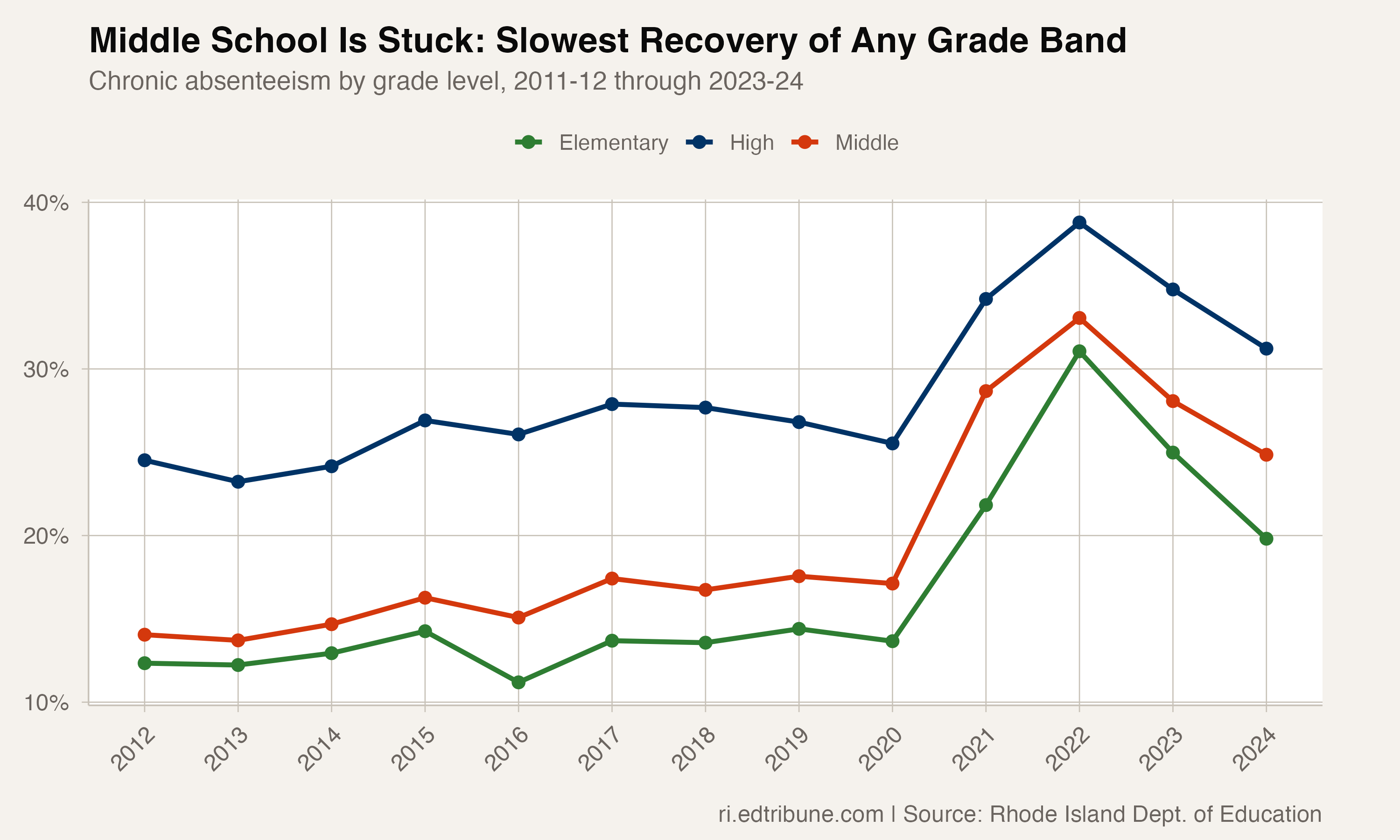
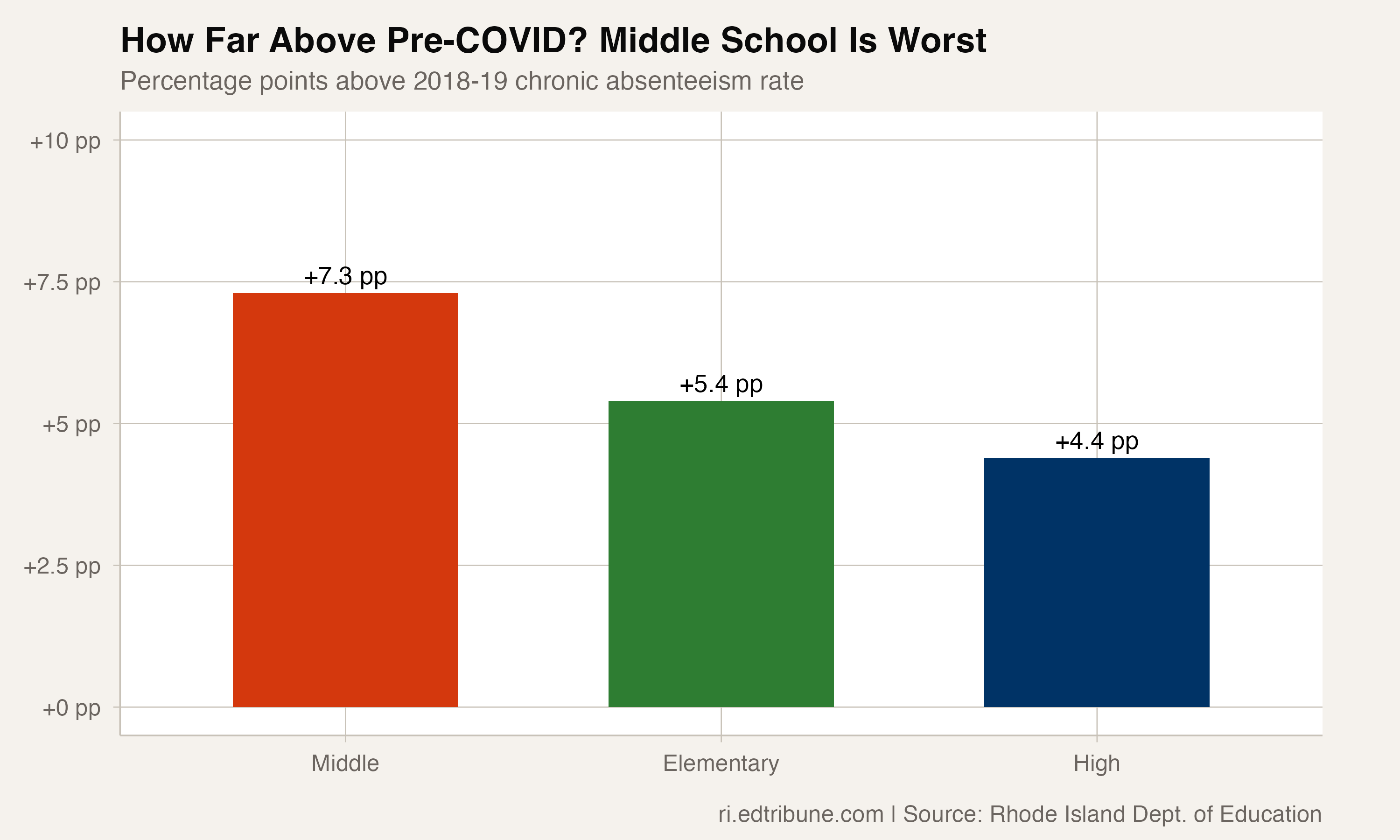
At 24.85% chronic absenteeism in 2023-24, Rhode Island's middle schools remain 7.3 percentage points above their pre-COVID rate of 17.56% — the largest excess of any grade band. Elementary schools sit 5.4 points above pre-pandemic levels. High schools, despite carrying the highest absolute rate at 31.22%, are only 4.4 points above where they were in 2019.
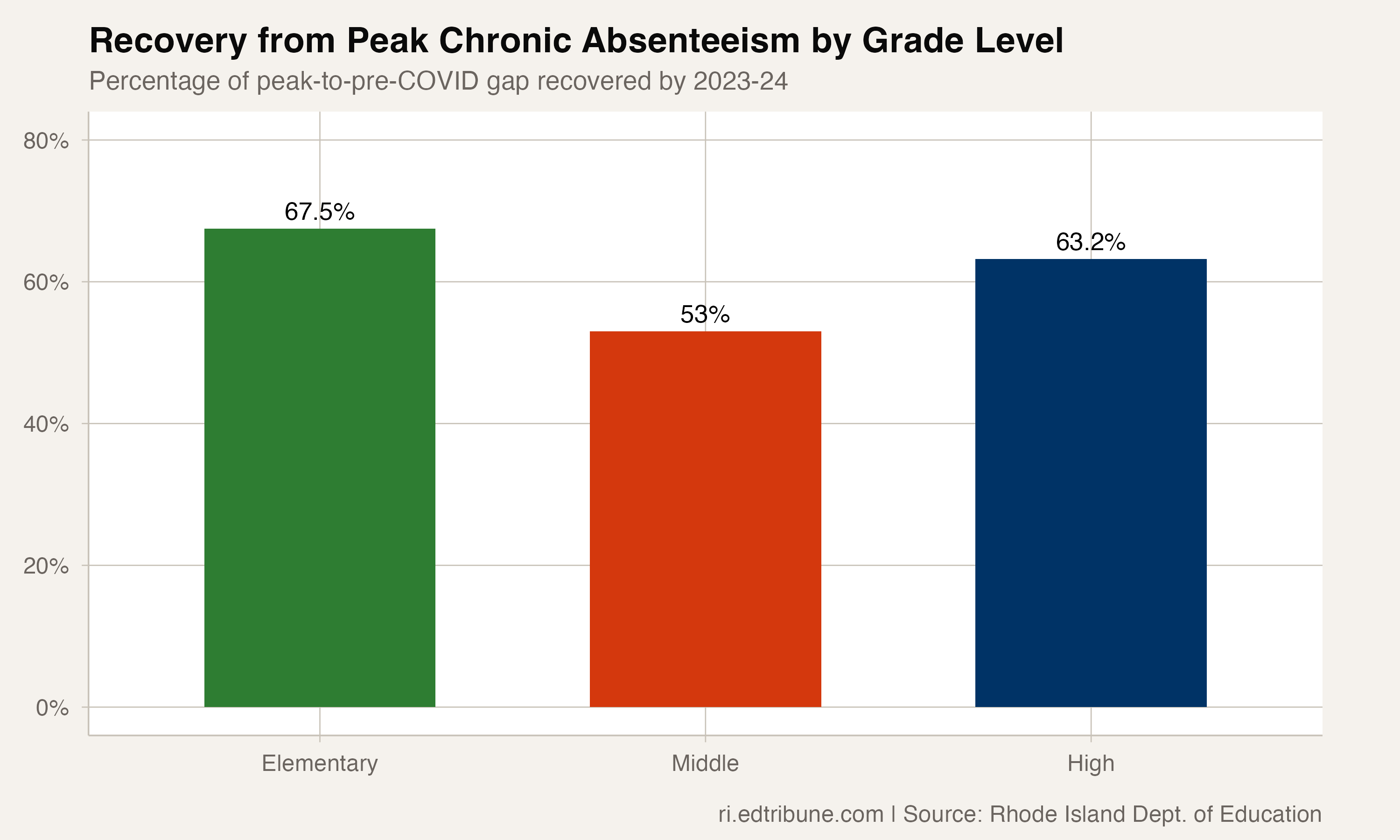
In recovery terms, middle school has clawed back just 53.0% of the ground lost during COVID. Elementary has recovered 67.5%. High school, 63.2%.
The transition that never recovered
Before the pandemic, middle school chronic absenteeism occupied a predictable middle ground — higher than elementary, lower than high school. The 2019 rates formed a clean gradient: 14.40% elementary, 17.56% middle, 26.81% high.
COVID compressed that gradient. In the 2021-22 school year, all three grade bands converged toward a narrow range: elementary at 31.06%, middle at 33.06%, high at 38.79%. The high school-to-elementary gap, which had been nearly 15 points, shrank to less than 8.
The recovery pulled them apart again — but not evenly. Elementary schools snapped back fastest, driven by what educators describe as younger students' readiness to return to school routines and parents' willingness to send them. High schools, where chronic absenteeism has always been highest, improved substantially in absolute terms.
Middle school did neither. It has recovered at roughly half the pace of elementary schools.
Why middle school?
The 5th-to-6th grade transition has long been associated with attendance drops — students move from a single-classroom environment to one with multiple teachers, rotating schedules, and higher academic demands. Research has consistently shown that the transition year itself carries attendance risk, independent of demographics or school quality.
The post-COVID data suggests that the transition-year vulnerability may have compounded with broader pandemic effects. Students who experienced disrupted elementary years are now entering middle school with weaker attendance habits. The cohort that was in 2nd or 3rd grade during the height of pandemic disruption is now in 5th or 6th grade — arriving at middle school without the attendance foundation that previous cohorts had.
The district picture
At the district level, middle school chronic absenteeism in 2024 shows the same urban-suburban divide visible in overall rates, but amplified. Woonsocket↗ET's middle school rate of 53.75% means more than half of the city's middle schoolers are chronically absent. Pawtucket↗ET and Providence↗ET middle schools hover around 39-40%.
Even in suburban districts where chronic absenteeism is relatively low overall, middle school tends to be the grade band with the least improvement from peak. The pattern is not unique to high-poverty communities — it cuts across demographics in a way that suggests systemic rather than purely socioeconomic factors.
One in three Rhode Island middle schoolers missed enough school to qualify as "at risk" on RICAS assessments. Research published by the Annenberg Institute at Brown University shows that chronically absent students score 18 to 25 percentage points lower on standardized tests than peers who attend regularly. The performance gap is largest in suburban schools, where the academic penalty for missing school is highest precisely because the baseline expectations are highest.
Middle school is where attendance habits either solidify or fracture for high school. The 7.3-point excess above pre-COVID suggests that for a significant share of Rhode Island's adolescents, the fracture happened during COVID and has not yet healed.
Detailed code that reproduces the analysis and figures in this article is available exclusively to EdTribune subscribers.
Discussion
Sign in to join the discussion.
Loading comments...